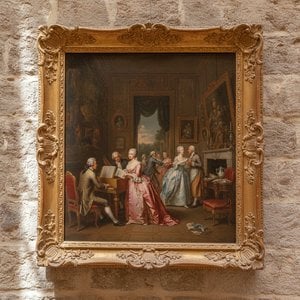
Early Life and Academic Foundations
Henri-Camille Danger, born in Paris on January 31st, 1857, emerged from a milieu steeped in the traditions of French academic painting. His father, Jules Félix Camille Danger, was a tailor, providing a stable if unartistic background for the young Henri’s burgeoning talent. From an early age, it became clear that his path lay not in fabrics but in pigments and canvas. He entered the prestigious École des Beaux-Arts, where he received rigorous training under two of the era's most respected masters: Jean-Léon Gérôme and Aimé Millet. These instructors instilled in him a deep respect for classical technique, meticulous draftsmanship, and a narrative approach to painting that would define his early career. The emphasis on historical subjects and mythological themes became foundational to Danger’s artistic vocabulary, shaping the direction of his work as he prepared to enter the competitive world of the Paris Salon.
The Prix de Rome and Italian Influences
Danger's dedication and skill quickly garnered recognition, culminating in a pivotal moment in 1887: winning the coveted Prix de Rome for his painting *The Anger of Achilles Relieved by Minerva*. This prestigious award was more than just an honor; it provided him with a residency at the Villa Medici in Rome from 1888 to 1891. The experience proved transformative. Immersed in the art and architecture of Italy, Danger absorbed the lessons of the Renaissance masters, refining his understanding of composition, light, and form. He studied ancient sculpture and frescoes, deepening his appreciation for classical mythology—a subject that would remain central to his oeuvre throughout his life. This period was crucial in solidifying his technical prowess and developing a distinctive style that blended academic rigor with a growing sense of poetic sensibility.
Salon Success and the Rise of Historical Painting
Upon returning to Paris, Danger established himself as a prominent figure in the Salon system, exhibiting regularly from 1886 until 1937. His paintings quickly gained attention for their skillful execution and dramatic narratives. He tackled historical subjects with a meticulous attention to detail, recreating scenes of conflict, diplomacy, and religious fervor. In 1900, his career reached a high point with the award of a silver medal at the Exposition Universelle in Paris. This recognition earned him *hors-concours* status—a testament to his established reputation and exemption from future jury selection. Danger’s success coincided with a renewed interest in historical painting during the Belle Époque, reflecting a broader cultural fascination with national identity and grand narratives.
Beyond History: Allegory, Mythology, and Tapestry Design
While celebrated for his historical works, Danger's artistic range extended beyond mere documentation of the past. He delved into allegorical compositions, exploring themes of peace, arbitration, and societal harmony. *The Great Artisans of Arbitration and Peace*, dedicated to Alexander III of Russia in 1898, exemplifies this aspect of his work—a bold statement reflecting both his artistic ambition and political awareness. He also demonstrated a keen interest in mythological subjects, imbuing scenes from classical literature with a sense of drama and emotional depth. Furthermore, Danger’s talents weren't confined to canvas; he created numerous designs for tapestries at the Gobelins Manufactory, showcasing his versatility and mastery of decorative arts. These tapestry cartoons reveal his attention to detail and ability to translate complex compositions into large-scale works.
Legacy and Historical Significance
Henri-Camille Danger’s career spanned a period of significant artistic change, bridging the gap between academic tradition and the emerging modern movements. Appointed a Chevalier of the Légion d'Honneur in 1903, he continued to exhibit until his death in Fondettes in 1939. His paintings, held in both public and private collections, represent a fascinating intersection of classical rigor and Symbolist aesthetics. Danger’s work embodies a balance between tradition and innovation—a testament to his skill as a painter and his ability to adapt to the evolving tastes of his time. He remains an important figure in understanding the complexities of French art during the late 19th and early 20th centuries, offering a compelling glimpse into the values and aspirations of the Belle Époque. His dedication to narrative painting, combined with his poetic sensibility, continues to resonate with art lovers and collectors today.