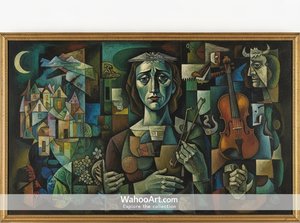
The Architect of Fluid Geometry
Clement Meadmore’s journey into the heart of abstraction began not with a brush, but with the rigorous logic of aeronautical engineering. Born in Melbourne in 1929, his early years were shaped by a unique duality: the mathematical precision of his studies at RMIT and the soft, impressionistic world nurtured by his mother. Through her, he encountered the delicate light of Corot and the rhythmic motion of Degas, seeds that would later bloom into a sculptural language capable of making heavy steel appear as supple as silk. This early exposure to the beauty of movement and form laid the fundamental foundation for a career dedicated to transcending geometry, where the rigid lines of mathematics met the expressive pulse of life.Steel in Motion: The Mastery of Material
As Meadmore transitioned from the structural certainties of engineering to the visceral world of welded steel, he developed a technique that redefined the boundaries of modern sculpture. He did not merely shape metal; he treated it as if it were wood or clay, coaxing a sense of plasticity from the most unyielding materials. His mastery was particularly evident in his use of COR-TEN steel, a material celebrated for its weathered, rust-colored patina that allowed his monumental works to interact organically with their environments. By blending the stark, clean lines of Minimalism with the gestural energy of Abstract Expressionism, Meadmore created pieces that possessed both structural integrity and a palpable, breathing materiality. His sculptures often explored:- The tension between closed forms and their expansion into space.
- The interplay of light and shadow across textured, weathered surfaces.
- The transformation of geometric primitives—squares and circles—into dynamic, sweeping arcs.
A Global Monumentality
Meadmore’s relocation to New York in 1963 marked the ascent of a truly international figure. His work soon commanded the attention of the world's most prestigious institutions, earning him recognition from MoMA and securing his place in the pantheon of twentieth-century masters. Whether standing as a silent sentinel in a desert landscape or anchoring a bustling urban plaza, his sculptures possess a monumental scale that engages rather than detaches the viewer. Beyond the studio, Meadmore lived a life of profound versatility, finding rhythm in the jazz drums and a keen eye for composition as a photo editor for Vogue. Today, his legacy remains etched in the very landscapes he sought to transform, leaving behind a body of work that continues to challenge our perception of weight, space, and the infinite possibilities of form.Q&A
특정 색상 팔레트의 Clement Meadmore 작품은 어디에서 찾아볼 수 있나요?
특정 색상 팔레트의 Clement Meadmore 작품을 찾으시려면, 작가의 컬러 팔레트별로 보기 페이지를 이용해 보세요.
Clement Meadmore의 모든 작품을 어디에서 볼 수 있나요?
이 사이트에 등록된 Clement Meadmore의 모든 작품은 작가의 전체 작품 보기 페이지에서 만나보실 수 있습니다.
Clement Meadmore가 그린 모든 주제를 한눈에 볼 수 있는 개요가 있나요?
Clement Meadmore의 주제별 작품 모음는 작가의 작품들을 주제별로 찾아볼 수 있는 페이지입니다.