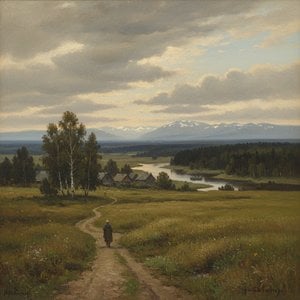
Cesare Maggi: A Pioneer of Divisionist Landscape Painting
Cesare Maggi (1881 – 1961) stands as a pivotal figure in the second generation of Italian divisionist painters, renowned for his masterful depictions of Alpine landscapes imbued with a profound sensitivity to light and color. Born in Rome into an artistic family—his father was an actor—Maggi’s early exposure to theatrical performance instilled within him a keen observation of human emotion and expression, qualities that would subsequently inform his artistic endeavors. He pursued classical studies at his father's insistence but simultaneously cultivated his passion for painting, initially under the tutelage of Vittorio Matteo Corcos in Livorno and later with Gaetano Esposito in Naples.
These formative experiences cemented Maggi’s commitment to capturing the essence of nature—specifically the dramatic interplay of light and atmosphere—through a technique championed by Giovanni Segantini: divisionism. This method, characterized by juxtaposed brushstrokes of complementary colors, aimed to reproduce the optical sensations experienced during visual perception, prioritizing subjective experience over objective representation. Maggi’s artistic breakthrough occurred in 1889 following the posthumous exhibition of Segantini's work organized by Milanese Society of Fine Arts, which profoundly impacted his creative trajectory.
His subsequent journey took him to Paris in 1898 where he honed his skills at Fernand Cormon Academy and engaged with the intellectual currents of the Belle Époque. Returning to Italy, Maggi established himself in Turin and embarked on a prolific artistic career, collaborating closely with Alberto Grubicy until 1913—a partnership that secured him considerable recognition within the burgeoning divisionist movement. Grubicy’s gallery actively promoted Maggi's paintings and fostered his engagement with prominent artistic circles of the time.
Maggi’s landscapes weren’t merely visual representations; they were meditations on the sublime beauty of the Alpine environment, reflecting Segantini’s spiritual ethos. He participated in major exhibitions across Italy and Europe, including the Venice Biennale in 1912 where his work garnered considerable acclaim—a testament to his artistic prowess and contribution to Italian art history. After a brief hiatus focused on portraiture during the 1920s, Maggi returned to landscape painting, refining his style and deepening his exploration of light’s transformative power. He achieved the chair in painting at the Albertina Academy in Turin in 1936—a prestigious honor recognizing his enduring influence on Italian artistic education.
Maggi's legacy extends beyond his paintings themselves; he served as a chaplain during World War I, demonstrating compassion and dedication to his fellow soldiers. His unwavering belief in humanist values—influenced by Croce’s philosophical teachings—shaped his artistic vision and underscored the importance of ethical considerations within creative expression. Cesare Maggi died peacefully in Turin in 1961 leaving behind an impressive body of work that continues to inspire admiration for its expressive power and profound connection to the natural world.