Bertha Coolidge: A Delicate Hand in Miniature Portraiture
Bertha Coolidge (1880–1953) stands as a quietly influential figure within the American art landscape of the early 20th century, primarily recognized for her exquisite portrait miniatures—small canvases imbued with remarkable detail and capturing fleeting moments of human emotion. Born in Lynn, Massachusetts, Coolidge’s artistic journey began formally at the School of the Museum of Fine Arts, Boston, where she honed her skills under the tutelage of Edmund Charles Tarbell and Frank Weston Benson – masters known for their masterful depictions of American landscapes and luminist painting styles. This foundational training instilled a deep appreciation for tonal harmony and atmospheric perspective, elements that would permeate her subsequent artistic endeavors.
Driven by an ambition to broaden her horizons, Coolidge embarked on a transformative European expedition in 1904, seeking instruction from Bourgois, whose identity remains shrouded in obscurity—a testament to the era’s penchant for preserving private details within artistic circles. Further enriching her artistic repertoire was a period of study in Munich during 1907, where she engaged with Hermann Grüber, an artist celebrated for his landscapes and portraits reflecting Bavarian Romanticism. These formative experiences exposed Coolidge to diverse artistic traditions, fostering a synthesis of American realism and European Impressionistic sensibilities.
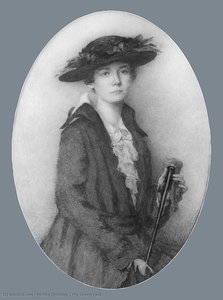
Coolidge’s artistic output centered around capturing the essence of her subjects—often affluent families and prominent figures—through miniature paintings that prioritized psychological nuance alongside technical precision. Her meticulous brushwork, combined with a masterful use of color palettes, achieved an unparalleled level of subtlety and luminosity. The resulting portraits weren't merely representations of likeness; they conveyed character, mood, and inner life—a remarkable feat considering the constraints imposed by the diminutive scale of her canvases.
A pivotal moment in Coolidge’s career arrived in 1913 with a solo exhibition at the Copley Gallery in Boston, showcasing her talent to a discerning public. Subsequent exhibitions included those at the National Academy of Design, the Art Institute of Chicago, and the Panama–Pacific International Exposition, cementing her reputation as a respected artist within the burgeoning American art scene. Notably, her painting “The Green Coat,” completed in 1916, garnered acclaim from the Dr. Bolling Lee Prize awarded by the Art Association of Newport—a recognition that underscored her artistic merit and established her place among the leading portrait miniaturists of her time.
Beyond her artistic accomplishments, Coolidge’s intellectual curiosity extended into the realm of bibliography. Following a move to New York City in 1916, she transitioned into scholarly pursuits, joining the Women Book Collectors' Club Hroswitha Club in 1944 and donating her extensive Maria Edgeworth collection to Beinecke Library at Yale University—a contribution that speaks volumes about her passion for literature and her commitment to preserving cultural heritage. Coolidge’s legacy resides not only in her captivating miniature portraits but also in her dedication to intellectual pursuits and her enduring influence on the artistic landscape of the early 20th century.