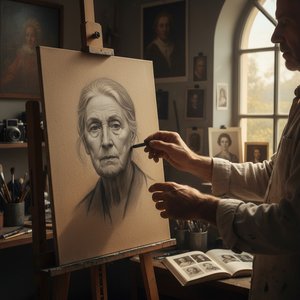
The Precision of a Neoclassical Master
Benjamin Barton Ellis stands as a distinguished figure in the history of American printmaking, a master of neoclassical engraving whose work serves as a window into the intellectual fervor of the early nineteenth century. Born in Philadelphia, United States of America, Ellis developed a reputation for extraordinary draughtsmanship, characterized by a meticulous attention to detail and a profound ability to capture the essence of his subjects. His artistry was not merely about recording physical likenesses but about translating the very spirit of an era defined by Enlightenment ideals into the permanent medium of engraving.
The hallmark of Ellis’s technique lies in his command over line work and tonal shading. In his most celebrated works, such as the portrait of Gouverneur Morris, he utilized a subdued palette of browns and grays to instill a sense of dignified restraint. This approach allowed him to achieve a level of clarity and precision that became synonymous with the neoclassical style. Through his skilled use of the engraving tool, Ellis could imbue a static image with an aura of intellectual seriousness, making his portraits feel like living embodiments of the era's philosophical pursuits.
Symbolism and the Spirit of Enlightenment
Beyond the technical mastery of his engravings, Ellis possessed a remarkable talent for incorporating subtle symbolism that enriched the narrative depth of his portraits. His work often functioned as a complex visual language, communicating the values and social standing of his subjects through carefully placed objects and compositions. In his depiction of Gouverneur Morris Jr., for instance, the inclusion of books serves to highlight the subject's erudition and engagement with philosophical discourse, while the presence of spectacles emphasizes a dedication to reasoned thought and intellectual curiosity.
This ability to weave historical context into his art allowed Ellis to capture the turbulent currents of American history. His engravings reflect the broader cultural landscape of the early 19th century, touching upon themes of economic development, social responsibility, and the shifting political tides of the nation. By focusing on the interplay between individual character and societal role, Ellis created works that transcend mere portraiture, offering instead a profound meditation on the human condition during a period of significant national transformation.
Legacy in American Engraving
The historical significance of Benjamin Barton Ellis resides in his contribution to the visual identity of a burgeoning nation. As an engraver capable of capturing both the physical and the metaphysical, he helped document the faces and the ideals of the American Enlightenment. His precise and disciplined style provided a sense of permanence to the portraits of pivotal figures, ensuring that their intellectual legacies would be preserved through the enduring medium of print.
While much of his work remains a treasure for scholars and art enthusiasts alike, the impact of his craftsmanship continues to resonate. Through his mastery of neoclassical engraving, Ellis achieved a rare feat: he captured the fleeting spirit of an age, leaving behind a body of work that invites modern viewers to rediscover the profound intellectual gravity of the past.
Q&A
Benjamin Barton Ellis의 출생 도시와 국가는 어디인가요?
Benjamin Barton Ellis은(는) United States of America Philadelphia에서 태어났습니다.
Benjamin Barton Ellis 작품의 연도별 타임라인이 있나요?
Benjamin Barton Ellis의 작품 연표를 확인해 보세요: 작품 연대기 페이지에서 작품들을 제작 날짜순으로 보실 수 있습니다.
특정 주제별로 Benjamin Barton Ellis의 작품을 어떻게 찾아볼 수 있나요?
특정 주제의 Benjamin Barton Ellis 작품을 찾으려면 키워드별로 작품이 분류된 작가의 키워드별 탐색 페이지를 이용해 보세요.
Benjamin Barton Ellis의 작품을 색상별로 찾아볼 수 있나요?
Benjamin Barton Ellis의 컬러 인덱스에서는 작가의 작품들을 색상별로 모아 보실 수 있습니다.