A Life Forged in Rebellion: The Artistic Journey of Asger Jorn
Asger Oluf Jørn, a name synonymous with artistic rebellion and avant-garde innovation, emerged from the quiet landscapes of Jutland, Denmark, in 1914. His life was not merely a chronicle of paintings and sculptures; it was a passionate engagement with the tumultuous currents of 20th-century thought, a relentless questioning of societal norms, and an unwavering commitment to artistic freedom. Born into a family of teachers, Jørn’s early years were marked by intellectual stimulation but also shadowed by loss – the death of his father when he was just twelve profoundly shaped his rebellious spirit. This formative experience ignited within him a skepticism towards authority, both religious and societal, that would become a defining characteristic of his artistic and political life. A diagnosis of tuberculosis at fifteen led to a period of convalescence on the Danish coast, fostering introspection and a deepening connection with the natural world – elements that would subtly permeate his later work. Even during these early years, Jørn’s intellectual curiosity extended beyond conventional boundaries; studies at Vinthers Seminarium were coupled with an active involvement in the Communist Party of Denmark, and a crucial mentorship under Christian Christensen, laying the groundwork for a life dedicated to challenging the status quo.From Parisian Studios to Avant-Garde Manifestos
Jørn’s artistic education began formally at the Royal Danish Academy of Fine Arts in Copenhagen (1937-1942), but it was his time in Paris that proved truly transformative. Initially drawn to the tutelage of Wassily Kandinsky, he soon found himself more aligned with the principles espoused by Fernand Léger’s Académie Contemporaine. This shift marked a decisive move away from figurative representation and towards the liberating possibilities of abstraction. The Parisian art scene, buzzing with new ideas and challenging conventions, ignited Jørn's creative fire. However, it wasn’t simply about adopting a style; it was about forging a unique artistic language that reflected his own deeply held beliefs. This quest for originality led him to co-found two pivotal avant-garde movements: COBRA (1948-1951) and the Situationist International (1957). COBRA, an acronym derived from Copenhagen, Brussels, and Amsterdam – the cities of its founders – championed spontaneous creation, experimentation, and a fusion of artistic traditions. Jørn’s involvement was instrumental in defining COBRA's ethos, advocating for an art that was raw, immediate, and unburdened by intellectual constraints. Later, his engagement with the Situationist International saw him applying his scientific and mathematical knowledge – drawing inspiration from figures like Henri Poincaré and Niels Bohr – to develop a unique ‘situlogical’ technique, further blurring the lines between art, theory, and social critique.Themes of Kitsch, Society, and Spontaneous Creation
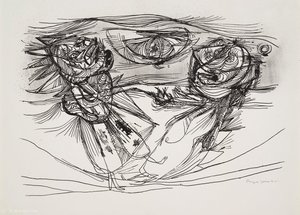
Jørn's artistic output is remarkably diverse, encompassing painting, sculpture, ceramics, and writing, yet it remains unified by a set of recurring themes and stylistic characteristics. He possessed a provocative fascination with kitsch, arguing in his influential essay "Intimate Banalities" that these often-dismissed works held greater artistic merit than conventional fine art – a bold statement challenging the established hierarchies of taste. His work frequently served as a platform for social commentary, reflecting his socialist convictions and critiques of societal structures. The monumental painting Stalingrad, a powerful depiction of the brutal battle, stands as a testament to this engagement with historical events and human suffering. Beyond explicit political statements, Jørn’s art is characterized by an embrace of experimentation – not just in materials but also in technique. He was a prolific ceramicist alongside his painting practice, constantly exploring new possibilities. Above all, spontaneity and improvisation were central to his artistic process; he rejected rigid planning in favor of intuitive creation, allowing the work to evolve organically through chance encounters and unexpected gestures.A Lasting Legacy: The Museum Jorn and Beyond
Asger Jørn’s impact on modern art is undeniable. His contributions to COBRA helped shape the development of European avant-garde movements in the post-World War II era, fostering a spirit of experimentation and collaboration that continues to inspire artists today. His involvement with the Situationist International cemented his reputation as a radical thinker who challenged conventional notions of art, society, and politics. Jørn’s legacy is powerfully preserved at the Museum Jorn in Silkeborg, Denmark – a space he generously bequeathed to the community, including his property and an extensive collection of his works. The museum serves not only as a repository of his artistic achievements but also as a vital center for research and appreciation of his multifaceted body of work. Jørn’s art continues to resonate with audiences worldwide, recognized for its unique blend of artistic innovation, social critique, and intellectual depth – a testament to the enduring power of an artist who dared to question everything and forge his own path.질의응답
Asger Jorn의 작품을 연도순으로 어디에서 볼 수 있나요?
Asger Jorn의 작품을 연도별로 정리하여 보여주는 작품 연대기 페이지입니다.
주제별로 Asger Jorn의 작품을 탐색할 수 있나요?
Asger Jorn의 주제별 아틀라스는 작가의 작품들을 주제별로 분류하여 보여주는 페이지입니다.
Asger Jorn 작가의 출신 국가는 어디인가요?
Asger Jorn은(는) Denmark에서 태어났습니다.