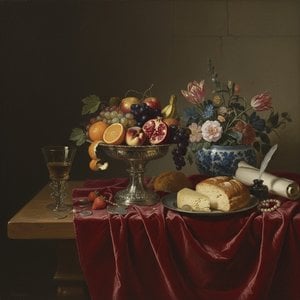
Amy Weiskopf: A Master of Still Life’s Quiet Power
Born in Chicago in 1957, Amy Weiskopf has emerged as a significant voice within the contemporary still life genre. Her work transcends mere representation, offering instead a deeply considered exploration of form, light, and texture—a testament to her rigorous training and an undeniable artistic vision. From her early studies at Washington University in St. Louis and Tyler School of Art in Philadelphia and Rome, Weiskopf’s career has been marked by a dedication to mastering traditional techniques while simultaneously pushing the boundaries of genre painting.
Weiskopf's artistic journey began with a profound appreciation for Impressionism and Post-Impressionism, particularly the work of Cézanne. As she herself noted, “Cézanne’s *Basket with Apples* which was a very early love and remains one of my favorite paintings,” profoundly influenced her approach to composition and color. This initial fascination evolved into a broader engagement with artists like Chardin, Morandi, and others who demonstrated an extraordinary ability to imbue everyday objects with a sense of quiet dignity and visual complexity. Her influences are diverse, ranging from ancient Greek and Roman art to the vibrant colors of modern painting, reflecting a constant dialogue between tradition and innovation.
Early Training and Artistic Development
Weiskopf’s formal education provided a solid foundation in artistic principles, but it was her experiences outside the classroom that truly shaped her distinctive style. A pivotal moment occurred during six summers spent painting with a group of fellow artists in Tuscany, Italy. This immersive environment fostered a spirit of collaboration and experimentation, allowing her to refine her observational skills and develop a more intuitive approach to color and composition. As she stated, “painting together all day and talking together all evening was an invaluable experience, and great fun!”
Her time at the Tyler School of Art in Philadelphia further solidified her artistic development, with Bruno Civitico making a critical impact upon her work. This period marked a shift towards a more deliberate and conceptual approach to still life painting—a move away from purely decorative representations toward explorations of light, shadow, and the inherent relationships between objects.
Recognition and Achievements
Weiskopf’s talent quickly garnered recognition within the art world. Her work has been featured in prestigious institutions such as the Metropolitan Museum of Art in New York, and she is represented by esteemed galleries including Hirschl & Adler Modern, Clark Gallery, Arthur Roger Gallery, and Winfield Gallery. Notably, her contributions to “The Marvelous Mrs. Maisel” have earned her six Primetime Emmy Awards for Outstanding Directing for a Comedy Series and Outstanding Writing for a Comedy Series – a remarkable achievement that underscores her versatility as an artist and creative collaborator.
Beyond her artistic accomplishments, Weiskopf’s work has been featured in Louisiana art publications such as 64 Parishes, highlighting her growing recognition within the regional art scene. Her paintings are characterized by their meticulous detail, evocative use of color, and a subtle sense of mystery—qualities that have captivated viewers and critics alike.
The Language of Still Life
Unlike earlier still life painters who often employed *vanitas* imagery to convey the transience of life and the futility of earthly pursuits, Weiskopf’s paintings suggest an enduring beauty. Her compositions are not about decay but rather about celebrating the inherent elegance of natural light and the quiet dignity of everyday objects. She skillfully juxtaposes shapes and textures, creating visually complex images that invite contemplation and reward careful observation.
Weiskopf's work is a testament to her ability to transform ordinary subjects into extraordinary works of art—a reflection of her artistic vision and her deep understanding of the power of still life painting. Her continued exploration of this genre promises to yield further captivating and thought-provoking creations for years to come.