Alfred Levitt: A Life Painted in Light and Shadow
Alfred Levitt (1894-2000) remains a curiously compelling figure in American art, an artist whose career spanned nearly eight decades and encompassed a remarkable range of styles and subject matter. Born in Gloucester, Massachusetts – a town inextricably linked to the sea and steeped in maritime history – Levitt’s work is deeply rooted in his surroundings, yet it transcends mere representation to explore themes of memory, spirituality, and the ephemeral nature of existence. His life itself became an extended artistic project, marked by both profound personal tragedy and an unwavering dedication to his craft, ultimately shaping a body of work that is both intensely private and surprisingly accessible.
Levitt’s early years were shaped by a complex family dynamic and a childhood spent largely in isolation. His father, a prominent physician, was emotionally distant, while his mother, a talented artist herself, provided a nurturing but ultimately limited creative environment. This early experience fostered within him a profound sense of solitude and an acute awareness of the human condition – themes that would repeatedly surface in his paintings. He initially studied at the Massachusetts College of Art, but quickly abandoned formal training, preferring to develop his own unique approach to art, largely self-taught and informed by a deep engagement with European modernism, particularly the work of Paul Cézanne and Maurice de Vlaminck.
Levitt’s artistic journey began modestly, producing primarily watercolor landscapes in the 1920s. These early works are characterized by their luminous quality, achieved through a masterful manipulation of light and color. He eschewed traditional perspective, favoring instead an expressive use of form and brushstroke to convey mood and atmosphere. During this period, he also developed a fascination with prehistoric cave paintings, believing them to be a direct link to the human psyche and a source of profound spiritual insight. This interest would later profoundly influence his work, particularly in his later years.
The Rise of Maritime Gloucester
The 1930s marked a pivotal decade for Levitt’s career, coinciding with his relocation to Gloucester, Massachusetts. The town's thriving fishing industry and its rugged coastline provided an endless source of inspiration. He became deeply embedded in the local community, forging close relationships with fishermen and sailors – individuals whose lives were inextricably linked to the rhythms of the sea. This immersion profoundly shaped his artistic vision, leading him to capture the essence of Gloucester’s maritime culture with a sensitivity rarely seen in contemporary artists.
His paintings from this period are dominated by scenes of fishing boats, weathered docks, and the ever-present gray expanse of the Atlantic Ocean. However, these aren't simply depictions of physical reality; they are imbued with a sense of melancholy and longing, reflecting Levitt’s own personal struggles and his deep connection to the natural world. He frequently employed a limited palette of blues, grays, and browns, creating paintings that possess a haunting beauty and an undeniable emotional resonance. The iconic “Cosmos” (1938), depicting a lone fishing boat silhouetted against a turbulent sky, exemplifies this style perfectly – a powerful meditation on isolation, resilience, and the sublime power of nature.
During World War II, Levitt’s artistic output slowed considerably. He served as a military censor, a role that undoubtedly impacted his creative spirit. However, he continued to paint sporadically, producing a series of intensely personal works exploring themes of loss, memory, and the fragility of human existence. These paintings are characterized by their stark simplicity and their profound emotional depth.
A Shift Towards Surrealism: The Space Invasion
In the late 1950s and early 1960s, Levitt’s work underwent a dramatic transformation. Inspired by the burgeoning field of astrophysics and the growing anxieties surrounding the Cold War, he began to incorporate surrealist imagery into his paintings – a shift that initially met with considerable resistance from the art establishment.
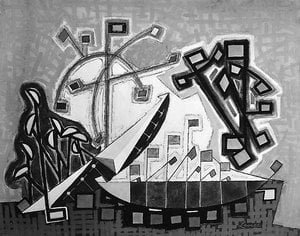
He developed a series of large-scale canvases depicting bizarre, otherworldly landscapes populated by strange, geometric figures. These “Space Invasion” paintings, as they became known, were unsettling and provocative, reflecting Levitt’s growing fascination with the unknown and his anxieties about the future. While some critics dismissed them as mere novelty, others recognized in them a profound exploration of the human psyche – a visual representation of our deepest fears and desires.
Despite this later stylistic shift, Levitt never abandoned his earlier commitment to capturing the beauty and power of the natural world. Throughout his career, he continued to paint landscapes, seascapes, and portraits, always striving to convey a sense of truth and authenticity in his work. His late paintings, often characterized by their luminous quality and their intricate detail, are considered among his finest achievements.
Legacy and Influence
Alfred Levitt died in 2000 at the remarkable age of 106, leaving behind a substantial body of work that continues to fascinate and inspire. His paintings are held in numerous public and private collections throughout North America and Europe, and his influence can be seen in the work of many contemporary artists. He is remembered not only for his technical skill but also for his unwavering integrity as an artist – a man who remained true to his own vision throughout his long and productive career.
His unique blend of realism, symbolism, and surrealism, coupled with his deep connection to the natural world, has secured his place as one of America’s most intriguing and enduring artists. Levitt's work serves as a poignant reminder of the power of art to explore the complexities of human experience and to capture the beauty and mystery of the world around us.