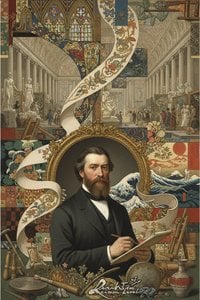
Sir Alfred Baring Garrod: A Pioneer of Medical Science
Sir Alfred Baring Garrod (3 May 1819 – 28 December 1907) was an English physician whose groundbreaking research significantly advanced the understanding and treatment of metabolic diseases, particularly gout and rheumatoid arthritis. Though not an artist in the traditional sense, his meticulous observation and scientific inquiry represent a unique form of intellectual creativity.
Early Life and Education
Born in Ipswich, United Kingdom, Garrod began his medical training as an apprentice at Ipswich Hospital. He continued his education at University College Hospital, where he earned his medical doctorate in 1843. Following this, he served as an assistant at West London Hospital and a physician at the Aldersgate Dispensary, building a foundation for his future contributions to medicine.
Career and Research
Garrod’s career progressed steadily. In 1849, he was appointed full physician at University College Hospital, and in 1863, became a professor of materia medica and therapeutics at King's College Hospital. He transitioned to an honorary fellow and consultant physician in 1874, allowing him greater freedom for research.
His most significant discovery came in 1848 when he identified an abnormally high level of uric acid in the blood of patients suffering from gout. This observation led him to propose that gout was linked to a metabolic disorder – a revolutionary idea at the time. He further investigated potential treatments, notably advocating for the use of lithium as a remedy for gout and later, exploring its application in treating mental illnesses.
Key Achievements & Contributions
- Discovery of Hyperuricemia: Garrod’s identification of elevated uric acid levels in gout patients was a pivotal moment in understanding the disease's pathology.
- Lithium Therapy Pioneer: He was among the first to suggest lithium as a treatment for both gout and mental disorders, laying groundwork for future psychopharmacological research.
- Coined “Rheumatoid Arthritis” : Garrod is credited with giving a name to what we now know as rheumatoid arthritis, distinguishing it from other forms of joint inflammation.
- Materia Medica Expertise: His work on The Essentials of Materia Medica and Therapeutics (1877) became a standard reference for medical practitioners.
Influences & Legacy
While Garrod’s work was largely driven by direct clinical observation, he built upon the emerging understanding of chemistry and physiology in the 19th century. He wasn't directly influenced by artistic movements but shared with scientists a dedication to careful observation and detailed documentation.
His legacy extends beyond specific treatments. Garrod’s emphasis on biochemical abnormalities as the root cause of disease paved the way for modern metabolic research and genetic studies. His work foreshadowed the field of inborn errors of metabolism, later formalized by Archibald Garrod (his son), who applied Mendelian genetics to inherited diseases.
Recognition & Honors
- Delivered the Goulstonian Lectures to the Royal College of Physicians (1857)
- Elected a Fellow of the Royal Society (1858)
- President of the Medical Society of London (1860)
- Gave the Lumleian Lectures (1883)
- Knighted as “Sir Alfred Baring Garrod” (1887)
- Appointed “Physician Extraordinary” to Queen Victoria (1890)
Alfred Baring Garrod’s contributions were instrumental in transforming medical practice from a largely empirical art to a more scientifically grounded discipline. His dedication to rigorous observation and innovative thinking continues to inspire medical researchers today.