

Adam Pendleton을(를) 유명하게 만든 작품은 History (Lab 1964 Grey) (2005)이며, 피츠버그에 위치한 카네기 미술관에 전시되어 있습니다. Adam Pendleton의 작품 1점 중 가장 많은 사랑을 받은 1점을 소개합니다. 각 작품은 제작 연도, 소장 미술관 및 작품의 특징과 함께 제공됩니다.
각 작품의 검색, 방문 및 주문 수를 결합한 인기 점수를 기준으로 순위를 매깁니다. 11월 2026 업데이트됨.

이 페이지에 있는 작품을 가장 많이 소장하고 있는 1개의 미술관
| 소장 미술관 | 도시 | Adam Pendleton의 작품 | 이 목록의 작품들 |
|---|---|---|---|
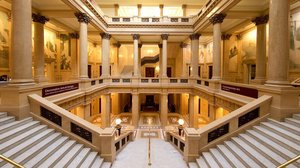 카네기 미술관 |
피츠버그 | 1 | History (Lab 1964 Grey) |
이 페이지에 있는 Adam Pendleton의 모든 연도별 명작은 2005년 작품입니다. 여기에서 확인해 보세요.
History (Lab 1964 Grey) (2005)
21세: History (Lab 1964 Grey)은(는) 2005년 작품이며, Adam Pendleton은(는) 1984년에 태어났습니다.
Adam Pendleton의 작품 1점이 카탈로그에 등록되어 있습니다.
대부분의 작품은 카네기 미술관 (피츠버그)에 소장되어 있습니다. 위 표에 각 박물관 목록이 나열되어 있습니다.
Adam Pendleton is an American conceptual artist whose diverse practice encompasses painting, silkscreen, collage, video, performance, and word art. Born in Richmond, United States, he began writing poetry at an early age and later transitioned into painting. His academic journey included studying at the Artspace Independent Study Program in Peitrasanta, Italy, before moving to New York in 2002. Currently, he divides his time between New York City and Germantown, New York.
His work often involves the investigation of language and the recontextualization of history through appropriated imagery. Pendleton's artistic output has been featured in various international exhibitions, including shows at the Museum of Modern Art, the Whitney, the New Museum, and La Triennale at the Palais de Tokyo in Paris. In 2024, he was honored with the Rosenthal Family Foundation Award for Painting from the American Academy of Arts and Letters.
A central concept in Pendleton's work is "Black Dada," a term he uses to discuss the present moment by addressing both the future and the past. This concept is exemplified in his Black Dada series of paintings, which feature partial views of Sol LeWitt's cube sculptures alongside letters derived from the phrase "Black Dada." This phrase itself originates from the 1964 poem "Black Dada Nihilismus" by Amiri Baraka.
His various series and installations explore different visual and linguistic systems: