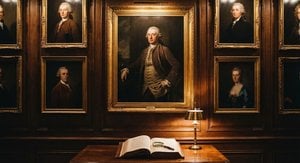
Early Life & Apprenticeship: From Plymouth Watchmaker to Reynolds’ Studio
The story of James Northcote is, at first glance, a rather improbable one for an artist who would become so closely associated with the refined circles of 18th-century British portraiture. Born in 1746 in the bustling port town of Plymouth, Devon, young James was not destined for a life wielding paintbrush and palette. His father, Samuel Northcote, was a humble watchmaker, and it seemed logical that his son would follow in his trade. However, even amidst the intricate mechanics of timepieces, a nascent artistic sensibility began to bloom within James. During the quiet hours away from the workshop, he diligently practiced drawing, fueled by an innate desire to capture the world around him on paper. This self-taught passion didn’t go unnoticed, and in 1769, at the age of twenty-three, Northcote made a pivotal decision: he abandoned his father's profession to pursue painting full-time.
The move to London four years later proved transformative. It was here, in 1773, that Northcote secured admission into the studio and household of Sir Joshua Reynolds, arguably the most influential portrait painter of the age. This apprenticeship wasn’t merely a technical education; it was an immersion into a world of artistic philosophy, social grace, and burgeoning celebrity. Reynolds, known for his captivating portraits of the aristocracy and his insightful *Discourses* on art, became Northcote's mentor, shaping not only his technique but also his understanding of portraiture as a means of capturing character and status.
The Influence of Sir Joshua Reynolds: Shaping Northcote’s Style
 James Northcote
James Northcote (1746-1831): British portrait & history painter influenced by Reynolds. Explore his Shakespeare Gallery works, insightful writings on art, and legacy.
To understand Northcote is to understand the profound impact of Reynolds. The elder master instilled in him a reverence for classical principles – a balanced composition, harmonious color palettes, and an emphasis on idealized beauty. Reynolds championed the Grand Manner portraiture, elevating his subjects through allegorical references and dramatic lighting, and Northcote initially absorbed these lessons wholeheartedly. His early works bear a striking resemblance to Reynolds’ style: elegant poses, rich fabrics, and a meticulous attention to detail that conveyed both affluence and refinement.
However, Northcote wasn't simply an imitator. While deeply respectful of his mentor, he gradually began to forge his own path, moving away from the overtly theatrical flourishes favored by Reynolds towards a more direct and psychologically astute approach. He possessed a keen observational skill, allowing him to capture subtle nuances of personality that often went unnoticed by others. This ability would become a defining characteristic of his mature style, setting him apart as an artist who sought not just to depict likeness but to reveal the inner life of his sitters.
Portraiture as Social Commentary: Capturing the Gentry and Beyond
 William Harding Of Baraset, Warwickshire
Explore 'William Harding Of Baraset' by James Northcote – a dignified 18th/19th-century portrait in neoclassical style. Discover rich browns & subtle details of this Warwickshire subject.
Northcote’s success stemmed from his ability to cater to the demands of a discerning clientele – primarily the landed gentry and emerging professional classes. His portraits weren't merely decorative; they were statements of social standing, carefully constructed images designed to project power, wealth, and respectability. He understood the unspoken language of portraiture: the significance of clothing, accessories, and even posture in conveying status and ambition.
Yet, Northcote’s work wasn't solely confined to the upper echelons of society. He also painted portraits of individuals from more modest backgrounds, often imbuing them with a dignity and humanity that challenged conventional artistic hierarchies. His depictions of military officers, like Lieutenant-general (later Field Marshal Sir) George Howard, for example, are not simply celebrations of heroism but also insightful studies of character, revealing the burdens and complexities of leadership. Similarly, his portrait of William Harding Of Baraset, Warwickshire, captures a sense of quiet strength and intellectual curiosity in its subject.
Northcote’s Shakespeare Gallery Works: History Painting and Dramatic Narrative
While primarily known as a portraitist, Northcote also aspired to excel in history painting – the most prestigious genre in the academic hierarchy. In 1786, he embarked on an ambitious project for John Boydell's Shakespeare Gallery, creating a series of paintings based on scenes from the plays of William Shakespeare. These works, including The Meeting Of Edward V, demonstrate his ability to translate dramatic narratives onto canvas.
Although Northcote’s history paintings weren’t always lauded with the same acclaim as his portraits, they reveal a growing interest in exploring themes of power, betrayal, and human fallibility. He meticulously researched historical details, striving for accuracy in costume and setting, but his primary focus remained on capturing the emotional intensity of the scene. These works, while perhaps lacking the technical brilliance of some of his contemporaries, offer a compelling glimpse into Northcote’s evolving artistic vision.
A Writer on Art: Northcote’s Critical Voice and Legacy
James Northcote was not content to simply paint; he also felt compelled to write about art. In 1813, he published *Memoirs of Sir Joshua Reynolds*, a candid and often critical account of his time with the master. The book proved controversial, revealing both Reynolds’ genius and his personal flaws. Northcote's willingness to offer honest assessments – sometimes brutally so – established him as a formidable art critic.
Later in life, his conversations were recorded by William Hazlitt, offering further insights into his pungent opinions on art, artists, and society. These recollections reveal a man of strong convictions, unafraid to challenge conventional wisdom. Northcote’s legacy extends beyond his paintings; he left behind a valuable body of writing that provides a unique perspective on the artistic landscape of late 18th-century England.
Today, James Northcote is remembered as an artist who successfully bridged the gap between Rococo elegance and early British realism. His portraits offer not only a glimpse into the lives of his sitters but also a fascinating reflection of the social and cultural values of his time. Explore the works of James Northcote at WahooArt.com, where you can discover museum-quality reproductions that capture the beauty and nuance of this remarkable artist’s oeuvre.