

Georges Braque's Fruit Dish, painted in 1908-09, isn’t merely a depiction of apples, oranges, and bananas arranged within a bowl; it’s a pivotal moment in the birth of Cubism – an artistic revolution that fundamentally altered how we perceive and represent reality. Born in Argenteuil, France, Braque's early training as a house painter instilled a deep understanding of materials and structure, a foundation he skillfully combined with his burgeoning artistic vision. This work represents a deliberate departure from traditional still life conventions, moving beyond simple representation towards an exploration of form, space, and the very nature of visual perception. The painting emerged during a period of intense experimentation within the Parisian art scene, fueled by influences ranging from Paul Cézanne’s geometric explorations to the radical ideas circulating amongst Picasso and other avant-garde artists.
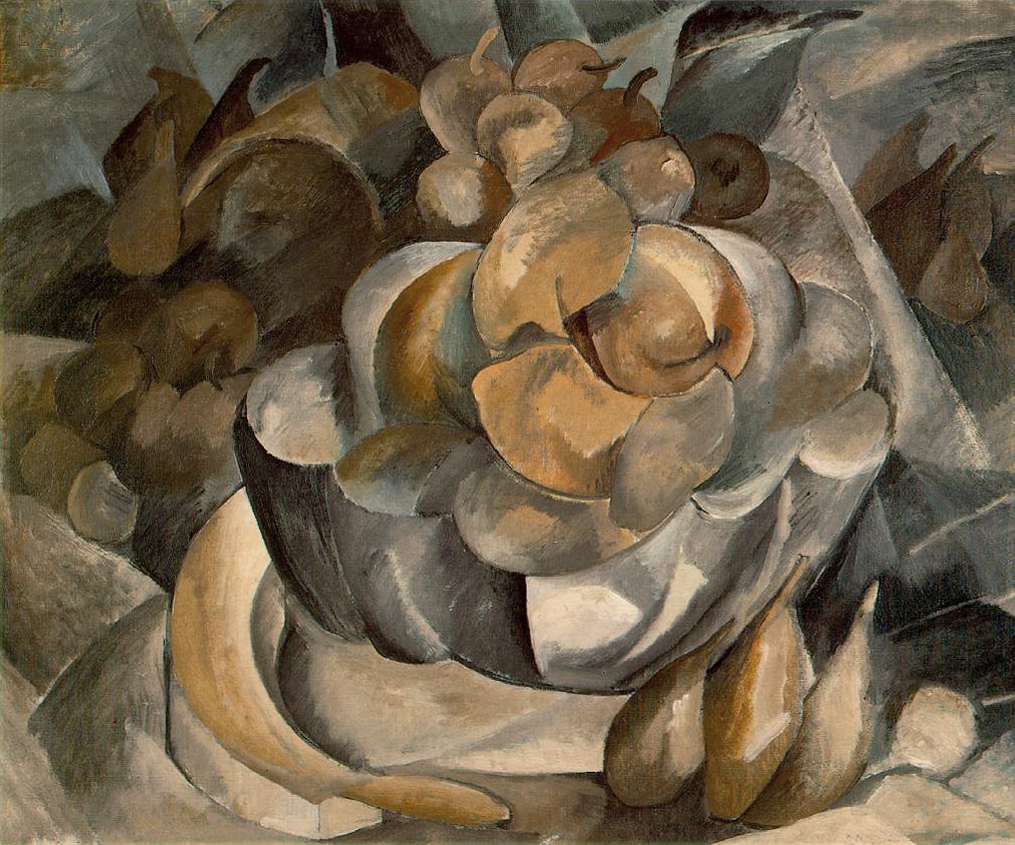
What truly distinguishes Fruit Dish is its innovative use of papier collé – a technique that would become inextricably linked to the development of Synthetic Cubism. Braque, while traveling with his friend Pablo Picasso, stumbled upon a roll of faux bois wallpaper depicting stylized oak panels at a shop in Avignon. Recognizing its potential, he meticulously cut and pasted fragments of this printed paper onto a canvas, layering it with charcoal lines and gouache. This seemingly simple addition dramatically transformed the painting, introducing an element of artificiality and challenging the illusion of depth traditionally achieved through perspective. The wallpaper’s inherent flatness – a deliberate contrast to the painted fruit – forces the viewer to reconsider their relationship with the image, questioning what is “real” and what is constructed.
Beyond its technical innovations, Fruit Dish is rich in symbolic meaning. The arrangement of the fruits – apples, oranges, and bananas – can be interpreted as representing abundance, nourishment, and perhaps even a subtle commentary on consumer culture. The bowl itself acts as a central organizing element, yet it’s fragmented and distorted, mirroring the fractured perspective characteristic of Cubism. Braque wasn't simply depicting objects; he was dissecting them, breaking them down into their essential geometric components and reassembling them in an entirely new way. The inclusion of the potted plant on the left side adds a touch of nature, grounding the still life within a broader context while simultaneously highlighting its artificiality.
Fruit Dish stands as a landmark work in the history of modern art. It’s not just a beautiful painting; it's a demonstration of Braque’s intellectual rigor and his willingness to push the boundaries of artistic convention. The techniques he pioneered – particularly the use of papier collé – would profoundly influence artists like Picasso, Matisse, and others, shaping the trajectory of 20th-century art. Reproductions of this iconic piece offer a remarkable opportunity to experience firsthand the genesis of Cubism and appreciate Braque’s groundbreaking contribution to our understanding of form, space, and perception. Its enduring appeal lies in its ability to simultaneously challenge and delight, inviting viewers to engage with the image on multiple levels.
Synthetic Cubism 양식의 작품 "Fruit Dish"은 프랑스에서 태어난 작가에 의해 제작되었습니다.
브라크의 "Fruit Dish"의 X-Ray 뷰는 작품의 X선 분석 페이지에서 확인하실 수 있습니다. 이 페이지에서는 11개의 광학 레이어를 통해 이미지를 인터랙티브하게 살펴볼 수 있습니다.
브라크의 "Fruit Dish"은(는) Earthy 색조의 팔레트를 사용합니다. 이 팔레트는 작품 전체의 색채적 특징을 집약적으로 보여줍니다.
브라크는 쿠비즘의 선구자이자 화가입니다. 특히 '하우스 아츠 라 에스타크', 콜라주 기법으로 혁신적인 작품들을 통해 현대 미술사에 큰 영향을 미쳤습니다.

 실제 크기로 보기
 Print
Print 보내기
보내기 공유하기
공유하기
 가이드 보기

 이미지 다운로드
 유사 작품 더 보기
 X-레이
X-레이 슬라이드 쇼 보기
 Q&A
Q&A 통계 정보
통계 정보
