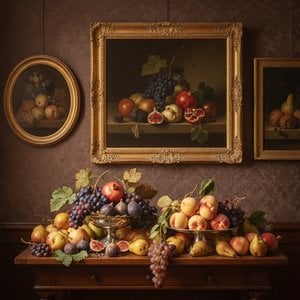
Still Life with a Red Rug: A Fauvist Masterpiece by Henri Matisse
- Artist: Henri Matisse
- Year: 1906
- Medium: Oil on Canvas
- Dimensions: 89 x 116 cm
- Location: Musée National d'Art Moderne, Paris
Subject and Composition
“Still Life with a Red Rug” is a quintessential example of Henri Matisse’s exploration of color and form within the still life genre. The painting depicts an arrangement of everyday objects – fruits (apples and pears), a banana, two books, and a chair – placed upon a table draped with a vibrant red rug. A partially obscured figure can be seen in the background, adding a subtle human element to the scene. Matisse’s genius lies not in meticulous realism but in his ability to transform these ordinary items into a dynamic composition brimming with energy and emotion.
Fauvism: Embracing Bold Color
This artwork is deeply rooted in the Fauvist movement, which translates to "wild beasts." Matisse was a leading figure in this revolutionary art style that emerged around 1905. Fauvism rejected traditional representational techniques, prioritizing instead the expressive use of color and simplified forms. In “Still Life with a Red Rug,” Matisse employs intense, non-naturalistic colors – the fiery red of the rug contrasts dramatically with the yellows, greens, and oranges of the fruit, creating a visually striking effect. The brushstrokes are loose and visible, further emphasizing the painting's expressive quality rather than photographic accuracy.
Historical Context and Influences
The early 20th century was a period of significant artistic experimentation. Matisse’s work was heavily influenced by the late paintings of Paul Cézanne, particularly those exhibited at the Salon d'Automne in 1904. Cézanne’s emphasis on structure and form paved the way for Matisse’s exploration of color as an independent element. The Fauvist movement itself challenged established artistic conventions and helped pave the way for subsequent modern art movements like Cubism and Expressionism.
Symbolism and Emotional Impact
While seemingly a simple depiction of everyday objects, “Still Life with a Red Rug” evokes a sense of joy, vitality, and sensory pleasure. The vibrant colors create an atmosphere of warmth and exuberance. The red rug acts as a unifying element, tying together the disparate objects and creating a harmonious whole. Matisse’s focus on color and form transcends mere representation; it aims to convey a feeling – a celebration of life's simple pleasures through the power of artistic expression. The painting invites viewers to appreciate the beauty inherent in ordinary moments and to experience the world through a lens of vibrant, emotional intensity.
질의응답
거실 공간에 "붉은 행판 정물" 작품을 어떤 사이즈로 배치하는 것이 가장 좋을까요?
거실 공간 공간에는 앙리 마티스의 "붉은 행판 정물" 작품을 대형 크기로 인쇄하시는 것을 추천합니다.
"붉은 행판 정물"은(는) 빛과 어둠의 균형을 어떻게 맞추고 있나요?
앙리 마티스의 "붉은 행판 정물"의 측정된 수치는 다음과 같습니다: 밝기 중간 정도의 밝기, 휘도 부드러운 그림자.
"붉은 행판 정물"을(를) 더 자세히 살펴볼 수 있을까요?
"붉은 행판 정물"은 작품의 X선 분석 페이지에서 층별로 자세히 살펴볼 수 있습니다. 이 뷰어는 보존 과학자의 라이트 벤치(light bench)에서 영감을 얻었으며, 이미지의 11가지 광학적 판독값을 제공합니다.