A Quiet Voice Amidst the Flemish Renaissance
Arnt van Tricht remains a figure shrouded in relative obscurity compared to his more famous contemporaries, such as Pieter Bruegel the Elder or Hans Holbein the Younger. Yet, for those who look closely at the artistic landscape of the mid-16th century, his contribution to the cultural fabric of Antwerp and Cologne is undeniable. Born around 1530, Van Tricht’s formative years coincided with a period of intense intellectual ferment, fueled by humanist scholarship and a profound rediscovery of classical ideals. While precise biographical details regarding his early upbringing are scarce, evidence suggests he was a master of both wood and stone, honing his skills in the prestigious workshops of the Lower Rhine region.
His artistic journey likely began under the guidance of Hendrick Douverman, a prominent sculptor of the era. This early training instilled in him a meticulous craftsmanship that would define his career. Though he may have had roots in Utrecht—as suggested by the stylistic similarities between his work and the influential sculptors of that city—he established much of his reputation in Kalkar. In these early years, Van Tricht was a prolific wood-carver, often creating innovative adaptations of late Gothic models. However, as the winds of the Reformation began to sweep through Northern Europe, his medium shifted. The religious upheavals necessitated a change in artistic focus, leading him to specialize in stone relief carving, memorial tablets, and exquisite chimney-pieces that blended durability with profound spiritual narrative.
The Mastery of Form and Devotion
By the mid-1560s, Van Tricht had relocated to Antwerp, a vibrant, bustling hub of international trade and artistic innovation. This move proved pivotal, as the Antwerp patronage system encouraged artists to push the boundaries of their medium. It was during this period that his work began to reflect the sophisticated influences of the High Renaissance and Mannerism. He absorbed the grace of Italian masters like Andrea del Piero della Francesca and the subtle emotional depth of Leonardo da Century, incorporating elements of idealized beauty into his sculptural reliefs.
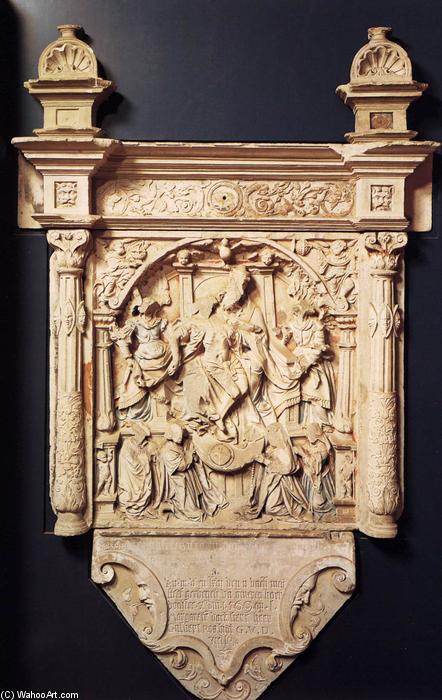
His most celebrated achievement remains the Ros Family Epitaphs, a series of monumental funerary sculptures commissioned for St. Elisabeth’s Church in Antwerp. Executed in fine Carrara marble, these works transcend mere decoration to become profound theological contemplations. In these pieces, one can witness a masterful command of chiaroscuro—the dramatic interplay of light and shadow—carved directly into the stone. The central figures, often depicting divine grace through the presentation of Christ, are rendered with such precision that the folds of drapery and the nuances of facial expression seem almost palpable. These works served as a microcosm of the era's anxieties, capturing the tension between religious devotion and the looming threat of iconoclasm.
Legacy and Historical Significance
The tragedy of Van Tricht’s legacy is inextricably linked to the turbulent history of Antwerp itself. The Iconoclasm of 1578, a period of violent Protestant reform, saw many of his most precious works targeted by zealous soldiers. The Ros Family Epitaph, for instance, suffered the heartbreak of defaced figures, with heads shattered in an act of religious defiance. Despite such destruction, the surviving fragments of his oeuvre continue to speak volumes about the transition from late Gothic traditions to the sophisticated humanist ideals of the Renaissance.
Today, Arnt van Tricht is remembered not just as a sculptor, but as a bridge between eras. His ability to pivot from the intricate wood-carving of the North to the monumental stone reliefs of the South demonstrates a remarkable versatility and resilience. His work stands as a testament to:
- Technical Versatility: The seamless transition from late Gothic woodcraft to Renaissance marble carving.
- Cultural Synthesis: The blending of Netherlandish precision with Italianate Mannerist elegance.
- Historical Endurance: The survival of profound religious artistry through the most transformative and violent periods of European history.
Through his hands, the stone and wood were given a voice—a quiet, enduring voice that continues to resonate within the halls of art history.
Q&A
Arnt Van Tricht가 그린 모든 주제를 한눈에 볼 수 있는 개요가 있나요?
Arnt Van Tricht의 작품은 작가의 주제별 작품 모음 페이지에서 주제별로 찾아보실 수 있습니다.
Arnt Van Tricht의 다른 이름이나 별칭에는 무엇이 있나요?
Arnt Van Tricht은(는) Master Arnt Of Kalkar라는 이름으로도 활동하고 있습니다.
Arnt Van Tricht의 예술 세계는 시간이 흐름에 따라 어떻게 진화했나요?
Arnt Van Tricht의 연대기는 작가의 활동 시기별로 분류된 작품들을 연대순으로 보여주는 스크롤 방식의 타임라인입니다.