A Life Etched in Ink: The Calligraphy of Yang Xian
The name Yang Xian resonates through the annals of Chinese calligraphy, though disentangling the threads of his life requires navigating a complex historical landscape and acknowledging multiple figures bearing the same name. Our focus lies primarily on Yang Xian (1321–1370), a pivotal official during the early Ming dynasty whose mastery of clerical script—
lishu—became intertwined with the political currents of his time. Born Yang Bi, he adopted the courtesy name Xiwu and rose to prominence amidst the tumultuous transition from Yuan to Ming rule. His story is not merely one of artistic skill but a testament to the power of calligraphy as both an aesthetic pursuit and a tool for navigating the treacherous waters of imperial court life.
From Bureaucrat to Brush Master
Yang Xian’s ascent began with his allegiance to Zhu Yuanzhang, the future Hongwu Emperor. Joining Zhu's ranks in 1356 after the capture of Jiankang (modern Nanjing), he quickly demonstrated a keen political acumen. His early successes were rooted in shrewd accusations—notably against Zhang Chang, whom he denounced for harboring loyalty to the fallen Yuan dynasty—actions that earned him favor with his new patron. This initial period reveals a pragmatic side to Yang Xian, suggesting his calligraphy wasn’t born in isolation but developed alongside a career built on astute observation and strategic maneuvering within the imperial bureaucracy. He was appointed Assistant Administrator of the Imperial Secretariat in 1368, swiftly followed by promotion to Vice Chancellor of the Right the following year. It was during this period that Yang Xian truly began to leave his mark as a calligrapher, though his rise wasn’t without controversy.
The Art of Clerical Script and Political Allegiances
Yang Xian's signature style centered on
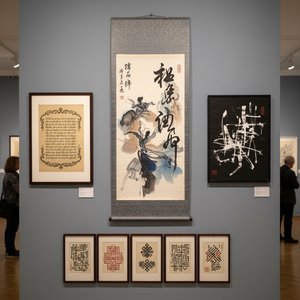
lishu, a script characterized by its bold, angular forms and deliberate structure. Unlike the flowing grace of cursive or standard scripts, clerical script possesses a grounded solidity, reflecting a sense of order and authority. This aesthetic choice wasn’t accidental; it mirrored Yang Xian’s own personality and political stance. He was known for his uncompromising nature, a trait that both propelled him forward and ultimately contributed to his downfall. His calligraphy often served as a vehicle for expressing these convictions, imbued with a forceful energy that resonated with the Hongwu Emperor's desire for strong governance. He famously impeached Vice Chancellor of the Left, Wang Guangyang, on grounds he deemed morally lacking—a demonstration of his willingness to challenge established figures and uphold what he perceived as righteous standards. His works, such as “Calligraphy Couplet in Clerical Script,” exemplify this aesthetic and ideological blend; each stroke is deliberate, conveying a sense of unwavering conviction and refined scholarship.
A Tragic Fall and Lasting Legacy
The very qualities that had elevated Yang Xian—his acute judgment and uncompromising nature—ultimately led to his demise. In 1370, he was appointed Vice Chancellor of the Left, but accusations leveled by Li Shanchang – charges of “false accusations against a minister” and “wanton treachery”—sealed his fate. He was executed, becoming a casualty in the escalating power struggles between the East Zhe faction (to which Yang Xian belonged) and the West Huai faction led by Li Shanchang and Hu Weiyong. His death intensified this rivalry, ultimately leading to the complete dominance of the West Huai faction within the Ming court. Despite his tragic end, Yang Xian’s influence on calligraphy endured. He left behind a body of work that continues to be admired for its technical brilliance and expressive power. His mastery of
lishu served as an inspiration to subsequent generations of calligraphers, solidifying his place in the history of Chinese art.
Beyond the Brush: Symbolism and Historical Context
To understand Yang Xian’s work fully, one must consider the broader cultural context of the Ming dynasty. The early years of the Ming were marked by a conscious effort to revive traditional Chinese values after decades of Mongol rule. Calligraphy, deeply intertwined with Confucian ideals of self-cultivation and moral rectitude, played a central role in this revival. Yang Xian’s choice of
lishu, a script associated with earlier periods of strong governance, can be seen as part of this broader project—a deliberate attempt to connect the new dynasty with its glorious past. Furthermore, his calligraphy often incorporated Taoist symbolism, reflecting a desire for harmony and balance in both personal life and state affairs. His works weren’t simply beautiful objects; they were imbued with layers of meaning, serving as expressions of philosophical beliefs and political aspirations. While multiple Yang Xians existed throughout Chinese history—including a singer from Taiwan and an economist from Singapore—the Ming dynasty official remains the most significant figure for his contributions to calligraphy and his complex role in shaping the early years of one of China’s most enduring dynasties.
Q&A
Yang Xianの作品を、ムード別に探すにはどこへ行けばよいですか?
Yang Xianのムード別ルームは、アーティストの作品をムード別にまとめたページです。
Yang Xianの作品を年代順に鑑賞できる場所はどこですか?
Yang Xianの作品は、アーティストの作品の年表ページにて、制作年代順にご覧いただけます。
Yang Xianの作品を技法別に閲覧することはできますか?
Yang Xianの作品は、アーティストの全技法ページにて、技法別に閲覧いただけます。