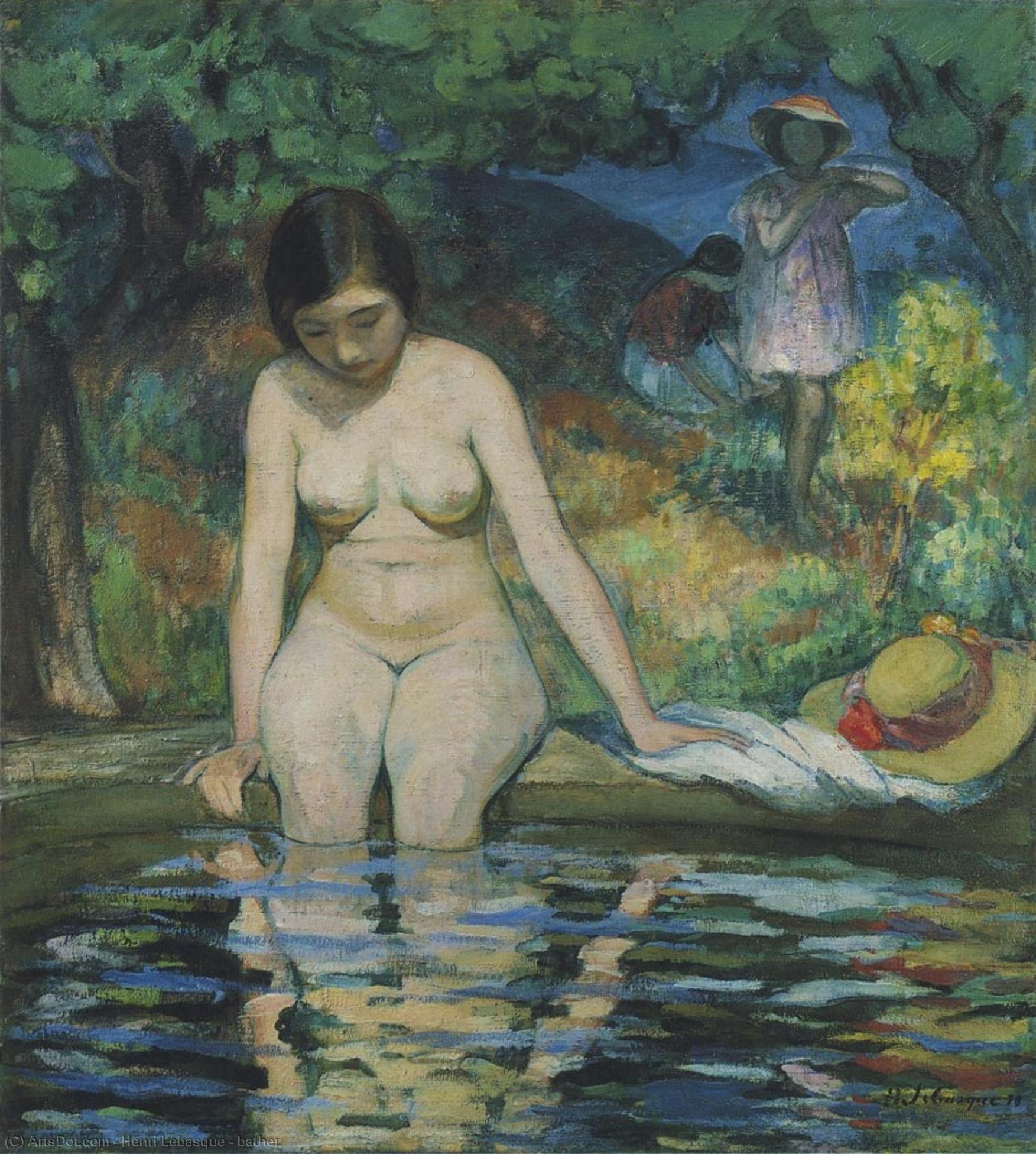
アンリ・ルバスク:略歴
A Painter of Joy and Light: The Life and Art of Henri Lebasque
Henri Lebasque, a name perhaps less immediately recognized than some of his Post-Impressionist contemporaries, nevertheless occupies a significant place in the artistic landscape of early 20th-century France. Born in Champigné, Maine-et-Loire, in 1865, Lebasque’s journey toward becoming a celebrated painter was one marked by diligent study, evolving influences, and an unwavering commitment to capturing beauty in everyday life. His early education at the École régionale des beaux-arts d'Angers provided a foundational grounding, but it was his move to Paris in 1886 that truly ignited his artistic development. There, under the tutelage of Léon Bonnat and through assisting Ferdinand Humbert with decorative murals at the Panthéon, he honed his technical skills while immersing himself in the vibrant Parisian art scene. This period proved crucial, bringing him into contact with pivotal figures like Camille Pissarro and Auguste Renoir, whose emphasis on light and color would profoundly shape his aesthetic sensibilities.
Early Influences and Artistic Formation
Lebasque’s formative years were steeped in artistic tradition. He initially pursued classical studies at the École supérieure des beaux-arts de Paris, absorbing the lessons of academic painting—a discipline that prioritized meticulous detail and idealized representations. However, it was his encounter with Impressionism – particularly the work of Claude Monet and Pierre-Auguste Renoir – that irrevocably altered his artistic trajectory. The Impressionists’ revolutionary technique of capturing fleeting moments of light and color challenged the conventions of realism, prompting Lebasque to experiment with looser brushstrokes and brighter hues. This exposure instilled in him a fascination for atmospheric perspective and an appreciation for the expressive potential of color—elements that would become integral to his distinctive style.
The Embrace of Les Nabis: A Dialogue with Intimacy
Around 1890, Lebasque joined Les Nabis – a group of artists who championed a radically different aesthetic vision. Led by Édouard Vuillard and Pierre Bonnard, the Nabis rejected grand narratives and monumental scale, instead focusing on domestic interiors and intimate portraits—scenes that conveyed profound emotional resonance. This affiliation profoundly impacted Lebasque’s artistic sensibilities, fostering in him a desire to depict human experience with sensitivity and nuance. The Nabis' meticulous attention to detail—particularly their use of muted colors and flattened forms—served as a catalyst for Lebasque’s own stylistic innovations. He meticulously observed the subtleties of light and shadow, striving to capture the essence of his subjects with remarkable accuracy.
Chromatic Harmony: Technique and Artistic Vision
Lebasque's artistic technique was characterized by a masterful command of color—a cornerstone of both Impressionism and Chromoluminarism. He employed a layered approach, applying thin washes of pigment over multiple coats to achieve luminous effects that defied conventional representation. Lebasque skillfully utilized complementary color pairings – blues and oranges, reds and greens – to create visual excitement while maintaining an overall sense of balance and harmony. This meticulous attention to color theory—influenced by the theories of Georges Seurat and Paul Signac—allowed him to imbue his canvases with an extraordinary vibrancy and depth. His brushstrokes were deliberate and expressive, conveying emotion through subtle variations in texture and tone.
A Legacy of Serenity: Recognition and Artistic Significance
Throughout his prolific career, Lebasque garnered considerable acclaim for his artistic achievements. He participated in numerous Salon exhibitions—including the Salon d’Automne, which he helped establish alongside Henri Matisse—and secured commissions for decorative murals at prestigious venues such as the Champs-Élysées theatre and on transatlantic liners. His paintings are now housed in prominent museums across France and internationally—demonstrating his enduring artistic influence and securing his place among the most celebrated figures of Post-Impressionism. Lebasque’s unwavering commitment to capturing beauty in everyday life—his ability to convey profound emotion through simple compositions—continues to inspire artists and viewers alike, cementing his legacy as a painter of joy and light.
アンリ・ルバスクによる全 539点の作品 →