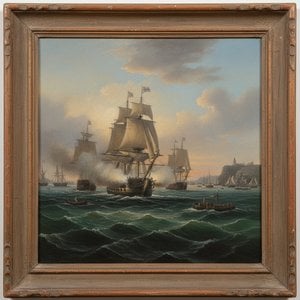
Thomas Buttersworth: A Sailor Painter of Napoleonic Splendor
Thomas Buttersworth (5 May 1768 – November 1842) stands as a testament to the intersection of seafaring adventure and artistic talent during Britain’s Napoleonic era. Though largely overlooked by art historians of his time, Buttersworth produced a remarkable body of marine paintings that offer invaluable glimpses into naval life and artistic sensibilities of the period—a legacy now being rediscovered thanks to recent scholarship.
- Early Life & Naval Service
- Notable Paintings: Capturing Battle Scenes & Ship Portraits
- Influence & Artistic Style
- Legacy & Rediscovery
Early Life & Naval Service
Born on the Isle of Wight, Buttersworth embarked upon a life defined by maritime pursuits from a young age. He enlisted in the Royal Navy in London in 1795, joining HMS Caroline during the tumultuous years of conflict with France—a pivotal moment shaping his artistic trajectory. Serving bravely aboard Caroline and later transferring to HMS Menorca, he endured hardships typical of naval service, including illness, demonstrating resilience and fortitude beyond mere profession. These experiences instilled a profound understanding of the sea and its dramatic realities, informing his future artistic endeavors.
Notable Paintings: Capturing Battle Scenes & Ship Portraits
Buttersworth’s fame rests primarily on his prolific output of marine paintings commissioned by institutions like the East India Company and subsequently by Queen Victoria herself. His canvases vividly depict naval engagements—particularly scenes from the Battle of Cadiz in 1797—capturing the dynamism and terror of combat with meticulous detail. Paintings such as “British Frigate in Pursuit of a French Frigate” exemplify his mastery of composition and perspective, conveying not just visual accuracy but also emotional intensity. Furthermore, he produced numerous ship portraits, showcasing impressive skill in portraying vessels and their crews with realism and sensitivity—works now housed in prestigious collections like the Mariners’ Museum.
Influence & Artistic Style
Buttersworth's artistic style aligns closely with the prevailing Romantic aesthetic of his era. He favored watercolor as his medium, skillfully blending pigments to achieve luminous effects and conveying atmospheric conditions with remarkable precision. His compositions often prioritized dramatic lighting and dynamic movement, reflecting the turbulent seas he witnessed firsthand. While Buttersworth’s oeuvre remained relatively obscure during his lifetime—limited exhibitions hampered recognition—his work nonetheless embodies the spirit of Romantic naval art, prioritizing emotional resonance alongside technical virtuosity.
Legacy & Rediscovery
Recent research has unearthed evidence suggesting Buttersworth continued to paint well into his later years, culminating in a portrait of Queen Victoria’s visit to Edinburgh in 1842—a final testament to his artistic dedication. His son, James Edward Buttersworth, followed in his father's footsteps as a marine painter, perpetuating the family tradition and contributing to the broader artistic landscape of the Victorian period. Today, Buttersworth’s paintings are gaining renewed appreciation thanks to ongoing scholarly investigation and museum exhibitions—solidifying his position as an important figure in British maritime art history.