The Luminous Legacy of Piero Dorazio
Piero Dorazio stands as a pivotal figure in the pantheon of Italian abstract art, a master whose brushstrokes helped redefine the boundaries of color field painting and geometric abstraction. Born in Rome in 1927, Dorazio’s early life was steeped in an atmosphere of intellectual curiosity; his father served as a civil servant while his mother possessed a profound passion for history and art. This dual heritage of structure and aesthetic sensitivity laid the foundation for a career dedicated to exploring the universal language of form. The turbulence of the Second World War, which forced his family to seek refuge in the Abruzzo region, instilled in him a resilience that would later manifest in his ability to navigate and reshape the shifting landscapes of the mid-20th-century art world.
Following the liberation, Dorazio’s path took an architectural turn as he studied at the University of Rome. It was during this period that he began to grapple with the heavy shadows of Futurism. While he found inspiration in the dynamic energy of masters like Gino Severini, Antonio Corpora, and Giacommo Balla, he felt a profound ideological disconnect from their right-wing political leanings. This tension drove him toward a more progressive, left-leaning circle of artists, including Renato Guttuso. In 1947, Dorazio became a founding member of the Forma I collective alongside Pietro Consagra, Achille Perilli, and Giulio Turcato. This group was revolutionary, seeking to reclaim abstraction from the rigid dogmas of the past and propose a new, universal visual language that eschewed political realism in favor of pure, emotive form.
A Journey Through Light and Line
The trajectory of Dorazio’s career was significantly expanded by his time in Paris, facilitated by a prestigious scholarship from the French government. Immersed in the vibrant discourse of the École des Beaux-Arts, he refined a technique that would become his hallmark: the delicate interplay of light, color, and texture. His time in France also led to the creation of L'Age d'Or in 1950, a bookstore and gallery space that served as a vital hub for abstract art. This period of intense experimentation allowed him to move beyond mere geometry into the realm of lyrical abstraction, where color was no longer just a component of shape but the very soul of the composition.
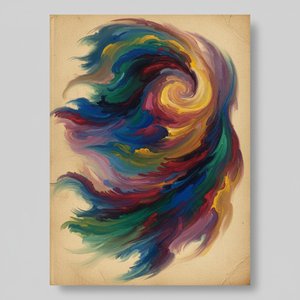
As his career progressed, Dorazio’s explorations took him across the Atlantic. His stay in New York City during the mid-1950s placed him at the heart of the Abstract Expressionist movement, offering him new perspectives on scale and spontaneity. His work began to exhibit a mesmerizing ability to balance controlled chaos with rhythmic precision. Whether through the vibrant reds and oranges found in pieces like Kasimiro Medio or the intricate, dot-filled patterns of his Untitled series, Dorazio mastered the art of creating depth through density. He utilized fine lines and overlapping planes to create a sense of infinite space, inviting the viewer to lose themselves in a rhythmic dance of pigment.
Historical Significance and Artistic Triumph
The enduring impact of Piero Dorazio lies in his ability to bridge the gap between the structured logic of geometry and the emotional fluidity of color. He did not merely paint shapes; he orchestrated light. His contributions to the Origin foundation and his editorial work for Arti Visive solidified his role as an intellectual leader within the Italian avant-garde. Through his meticulous layering of color, he achieved a translucent quality that made his canvases appear to breathe, capturing the ephemeral nature of perception itself.
Today, Dorazio is remembered not just as a painter, but as a pioneer who helped steer Italian art away from the weight of historical tradition and toward a bright, abstract future. His legacy remains visible in:
- The Evolution of Color Field Painting: His ability to use color as a primary structural element.
- The Formation of Forma I: A movement that redefined the purpose of abstraction in post-war Italy.
- Universal Visual Language: The creation of works that transcend linguistic and political boundaries through pure aesthetic experience.
Q&A
特定のテーマに基づいたPiero Dorazioの作品を探すには、どうすればよいですか?
Piero Dorazioの作品は、アーティストのキーワード別ページからキーワード別に探すことができます。各キーワードには関連する作品がまとめられています。
Piero Dorazioのキャリアは、どのように時代ごとに分けられていますか?
Piero Dorazioのクロニクルは、スクロールに合わせて展開するタイムライン形式となっており、アーティストのキャリアを時代ごとに章立てし、その作品群を時系列に沿ってご紹介しています。
Piero Dorazioの作品を、芸術運動(ムーブメント)別に閲覧することはできますか?
Piero Dorazioの作品は、アーティストのすべてのムーブメントページから、各ムーブメント(芸術運動)別に閲覧いただけます。