Nicholas Thomas Dall: A Scandinavian Visionist of the English Countryside
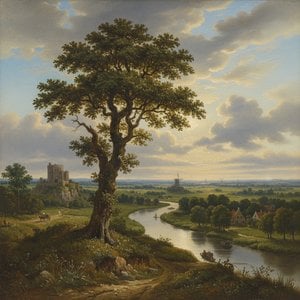
Nicholas Thomas Dall (c. 1706 – 1776), a figure shrouded in intriguing fragments of biographical detail, emerges from the annals of 18th-century British art as a remarkably consistent and quietly influential landscape painter. Born likely in Scandinavia—the precise location remains debated, with Denmark frequently cited—Dall’s journey led him to London around 1760, where he established himself not merely as a painter but as a skilled scene designer for the burgeoning Covent Garden Theatre. This dual role profoundly shaped his artistic practice, demanding both technical proficiency and an acute understanding of theatrical illusionism, ultimately influencing the serene, almost dreamlike quality that characterizes much of his work.
Dall’s early career is somewhat elusive, yet evidence suggests a formative period spent in Bologna during the 1740s. There, he likely studied classical art and landscape techniques—a foundation that would later inform his meticulous attention to detail and his embrace of idealized compositions. His arrival in London coincided with a flourishing of decorative arts and a growing demand for scenic backdrops for plays and operas. This experience proved invaluable, honing his ability to create convincing illusions of space and atmosphere – skills he subsequently applied to his landscape paintings.
The Shugborough Legacy: Classical Harmony and Architectural Integration
Dall’s most celebrated works are undoubtedly those created for the grand estates of England, particularly Shugborough Hall in Staffordshire. His 1768 painting, “The West Front of Shugborough,” exemplifies his signature style—a harmonious blend of classical ideals and meticulous observation of the English countryside. The composition is carefully balanced, with the imposing façade of the hall anchoring a vista of rolling hills, meticulously rendered trees, and a subtly atmospheric sky. Dall’s ability to integrate architecture seamlessly into the landscape demonstrates a sophisticated understanding of perspective and light, creating an image that feels both timeless and deeply rooted in its specific location.
Further examples of his work at Shugborough include “An Extensive View of Shugborough Park and Its Monuments,” showcasing similar compositional principles. These paintings weren’t simply depictions of scenery; they were carefully constructed narratives, designed to evoke a sense of grandeur and tranquility. Dall's meticulous attention to detail—the texture of bark on trees, the shimmer of water in streams—imbues his landscapes with a remarkable realism that belies their idealized nature.
Technique and Influences: A Blend of Dutch Masters and English Tradition
Dall’s artistic style reveals a fascinating synthesis of influences. While he undoubtedly admired the meticulous detail and atmospheric perspective of Dutch landscape painters like Jacob van Ruisdael, his work also reflects the growing interest in classical art and idealized landscapes that characterized 18th-century England. His use of light is particularly noteworthy—often diffused and soft, creating a sense of quiet contemplation. Dall’s brushwork is generally smooth and controlled, prioritizing clarity and precision over expressive gestures.
It's important to note that Dall was not solely reliant on established artistic conventions. He possessed an innate ability to capture the unique character of each location he painted, imbuing his landscapes with a sense of place—a subtle awareness of local flora, fauna, and topography. This sensitivity distinguishes him from many of his contemporaries, who often produced more generalized or formulaic depictions of the countryside.
A Forgotten Figure: Dall’s Place in British Art History
Despite his considerable talent and prolific output, Nicholas Thomas Dall remains a relatively obscure figure in the history of British art. His career was largely defined by his work for the theatre and as a decorative painter, roles that often overshadowed his contributions to the landscape genre. However, recent scholarship has begun to reassess his importance, recognizing him as a key player in the development of English landscape painting during the mid-18th century.
His paintings at Shugborough, Harewood House and Moor Park offer a valuable glimpse into the tastes and aspirations of the landed gentry—a class increasingly interested in cultivating their estates and creating idyllic representations of rural life. Dall’s work serves as both a testament to his artistic skill and a reflection of the broader cultural landscape of 18th-century England, offering a serene and evocative vision of the countryside that continues to captivate viewers today.
アーティストへのQ&A
Nicholas Thomas Dallの作品は、時とともにどのように進化を遂げてきたのでしょうか?
Nicholas Thomas Dallのアーティスト・クロニクルは、スクロールに合わせて展開するタイムライン形式となっており、アーティストのキャリアを時代ごとに章立てし、その作品群を時系列に沿ってご紹介しています。
Nicholas Thomas Dallの作品は、どのようなムードを表現していますか?
アーティストのムードで探すページでは、Nicholas Thomas Dallの作品をその雰囲気に合わせてご紹介しています。
Nicholas Thomas Dall氏の作品のカラープロファイルはどこで確認できますか?
本サイトに掲載されている作品群におけるNicholas Thomas Dallの色彩表現は、アーティストのパレット・ゲノムページで詳しくご覧いただけます。