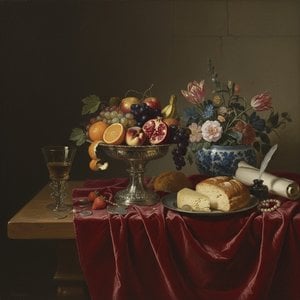
The Quiet Mastery of Michal Čičvák
In the heart of Slovakia, amidst the cultural currents of Košice, the life and work of Michal Čičvák (1955–2010) unfolded as a profound meditation on the beauty of the overlooked. Born in Sobrance, Čičvák did not merely paint objects; he breathed life into them, transforming the mundane elements of a still life into vessels of deep emotional resonance. His journey was one of steadfast devotion to the classical tradition, a path that saw him emerge as a singular voice capable of distilling complex human sentiments into the deceptively simple arrangement of fruit, porcelain, and light.
His artistic evolution was rooted in a rigorous formal education that provided the technical scaffolding for his later triumphs. Moving from his formative years into the vibrant cultural milieu of Košice, Čičvák quickly distinguished himself through an uncanny ability to capture texture and form. While many of his contemporaries sought refuge or rebellion in the fleeting trends of avant-garde movements, Čičvák found his strength in the enduring principles of classical painting. He looked backward to move forward, finding inspiration in the masters who understood that true innovation often lies in the perfection of observation.
A Symphony of Light and Texture
The essence of Čičvák’s oeuvre lies in his profound engagement with the genre of still life, a choice that served as both an aesthetic preference and a philosophical inquiry into perception. To gaze upon a Čičvák painting is to enter a world of quiet contemplation, where every brushstroke serves a purpose. He was deeply influenced by the structural brilliance of Cézanne and the dramatic, chiaroscuro-driven mastery of Rembrandt. From these legends, he inherited a fascination with how light interacts with surface, allowing him to render the velvety sheen of a ripening fruit or the cold, smooth contour of a ceramic tea-pot with breathtaking accuracy.
His technique was characterized by an exceptional eye for detail that bordered on the miraculous. He possessed the rare ability to manipulate muted color palettes to evoke a sense of tranquility, using subtle shifts in tone to create depth and atmosphere. In his hands, a simple composition—such as Still life with a tea-pot—becomes a study in balance and weight, inviting the viewer to slow down and appreciate the tactile reality of the subject matter. This meticulous approach ensured that his work was never merely decorative; it was an invitation to witness the dignity inherent in all physical things.
Legacy and Artistic Significance
Throughout his career, Čičvák’s ability to translate complex emotions into visual representations earned him widespread acclaim across Slovakia. His exhibitions were not just displays of skill, but experiences of stillness in a rapidly changing world. By prioritizing meticulous observation over experimental abstraction, he preserved a vital link to the traditions of fine art, ensuring that the language of classical realism remained vibrant and relevant within the Slovak landscape.
The historical significance of Michal Čičvák resides in his role as a guardian of the contemplative gaze. His work remains a cornerstone of the Košice art scene, serving as a reminder of the power of the focused eye. Today, his legacy continues to inspire both artists and scholars, standing as a testament to a life dedicated to finding the extraordinary within the ordinary. His contributions to Slovak painting are marked by:
- Technical Precision: A masterful command of light, shadow, and texture that elevated the still life genre.
- Philosophical Depth: The use of everyday objects to explore themes of permanence, decay, and perception.
- Cultural Impact: A lasting influence on the regional art history of Slovakia through his commitment to classical excellence.