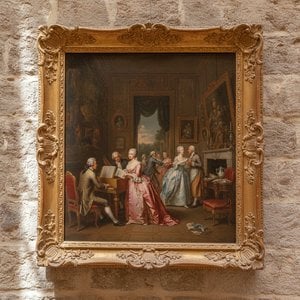
Louis de Moni (1698 – 1771): A Dutch Master of Genre Painting
Louis de Moni was born in Breda, Netherlands, around 1698. While biographical details remain somewhat sparse—information about his early life and family is limited—he emerged as a prominent figure within the Dutch Golden Age artistic landscape, primarily recognized for his captivating genre paintings that captured everyday scenes with remarkable sensitivity and detail. His artistic journey began under the tutelage of Philip van Dijk at the Hague drawing academy, where he honed his skills alongside other aspiring artists. This formative period instilled in him an appreciation for observation and a dedication to portraying human experience with nuanced realism.
- Influences: De Moni’s artistic vision was profoundly shaped by contemporaries like Gerard Dou and Frans van Mieris the Elder, whose masterful techniques of chiaroscuro—the dramatic interplay of light and shadow—served as inspiration for his own compositions. He meticulously studied their works, absorbing their stylistic approaches and striving to emulate their ability to convey emotion through subtle visual cues.
- Early Career: Following his studies at the Hague academy, De Moni traveled extensively with Philip van Dijk to Kassel in 1726, immersing himself in the artistic milieu of German Baroque culture. This experience broadened his horizons and exposed him to diverse artistic traditions, enriching his understanding of visual storytelling.
- Settlement in Leiden: Recognizing Leiden as a fertile ground for artistic pursuits, De Moni established residency there in 1725, where he continued to develop his craft and cultivate relationships with fellow artists and patrons. He remained active until his death in 1771, leaving behind a legacy of enduring artworks that continue to resonate with audiences today.
Style and Technique: Soap Bubble Art and Psychological Depth
De Moni’s artistic style is characterized by its understated elegance and remarkable psychological insight—a hallmark of what has come to be known as “soap bubble art.” Unlike the grand narratives favored by many Baroque painters, De Moni focused on depicting scenes from ordinary life with a quiet grace that belied their profound emotional resonance. His canvases often portray domestic interiors populated by figures engaged in commonplace activities—watering flowers, lacemaking, or simply gazing out windows—yet these seemingly unremarkable subjects are imbued with an atmosphere of contemplative stillness and subtle emotion.
- Chiaroscuro Mastery: De Moni skillfully employed chiaroscuro—the technique of dramatic lighting—to sculpt forms and convey mood. He meticulously manipulated light sources to create shadows that delineate contours, heighten visual depth, and subtly suggest inner feelings. This masterful use of light contributes significantly to the expressive power of his paintings.
- Realistic Detail: De Moni’s meticulous attention to detail is evident throughout his oeuvre. He painstakingly rendered textures—fabric folds, flower petals, skin surfaces—with astonishing accuracy, capturing the materiality of his subjects and enhancing their visual realism.
Notable Works and Recognition
Among De Moni’s most celebrated paintings are “A Woman Watering Flowers,” housed in the Rijksmuseum Amsterdam; “The Lacemaker,” residing at the Mauritshuis in The Hague; “Scene galante” displayed in the Palais des Beaux-Arts de Lille; “A Family Scene” adorning the Louvre Museum in Paris; and “A Fish-Woman and The Bon Vivant,” showcased in St. Petersburg’s Hermitage Museum. These artworks exemplify De Moni's ability to distill complex human emotions into deceptively simple visual representations—a testament to his artistic genius. His paintings are recognized for their beauty, psychological depth, and masterful execution.
Legacy and Historical Significance
Louis de Moni’s contribution to Dutch genre painting is undeniable. He stands alongside other masters of the era—such as Johannes Vermeer and Rembrandt van Rijn—as a pivotal figure in shaping the artistic sensibilities of his time. His work continues to inspire artists and scholars alike, serving as an enduring symbol of Dutch Baroque artistry and demonstrating the transformative power of observation and psychological exploration within visual art. De Moni’s legacy persists through reproductions in museums worldwide, ensuring that his evocative depictions of everyday life endure for generations to come.