A World Reconstructed: The Art of Lai Chiu-Chen
Born in the picturesque coastal town of Jiufen, Taiwan, in 1970, Lai Chiu-chen emerged as a distinctive voice in contemporary art—a painter who deftly navigates the currents of pop culture while grounding his work in the timeless concerns of artistic representation. His journey began with formal training at the National Institute of Arts in Taipei, followed by an M.F.A. from the prestigious Taipei National University of Arts. However, Lai’s education extended far beyond academic walls; it was a continuous immersion into the visual language of his surroundings and a critical engagement with art history itself.
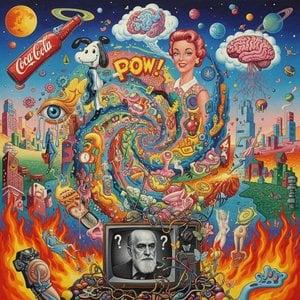
Lai Chiu-chen's artistic practice is characterized by a fascinating interplay between seemingly disparate elements: the vibrant energy of animation, the immediate accessibility of comic book aesthetics, and the profound historical weight of painting traditions. He doesn’t simply *depict* pop culture; he dissects it, reconfigures it, and ultimately uses its visual vocabulary to explore fundamental questions about simulation, reconstruction, and the very nature of image-making. His canvases are not windows onto a world but rather meticulously constructed surfaces that reveal the layers of appropriation and imitation inherent in artistic creation.
Early Influences and Development
The artist’s early work signaled a departure from conventional approaches to painting. Instead of focusing on traditional subjects, Lai turned his attention to the ubiquitous imagery of consumer culture—toy heads, cartoon characters, and fragments of everyday life. This wasn't merely an embrace of contemporary trends; it was a deliberate strategy to challenge established hierarchies within the art world. He consciously shifted the focus from *what* was being painted to *how* it was being painted, emphasizing the act of painting itself as a subject matter. This approach resonated with the ideas of Bohemian-Austrian poet and critic Rainer Maria Rilke, who observed that artistic liberation often arises from contradictions between prevailing fashions and an artist’s unique worldview.
His methodology can be described as highly “controlled,” involving a careful pruning of extraneous details—compositional elements, perspective, brushstrokes—to reveal the underlying structure of the image. This process isn't about eliminating emotion but rather about isolating it, presenting a smooth, cooling sensation that invites contemplation. The resulting works possess a peculiar tension between flatness and depth, coldness and richness, inviting viewers to question their own perceptions and assumptions.
Themes and Symbolism
Recurring motifs in Lai’s paintings—such as toy heads—function as potent symbols of birth, growth, and the cyclical nature of history. These images are not simply nostalgic references but rather specimens from life, carefully selected and reassembled to create a new visual order. The artist's work often evokes a sense of *déjà vu*, a feeling that one has encountered these images before, perhaps in dreams or fragmented memories. This is intentional; Lai seeks to tap into the collective unconscious, creating paintings that resonate on a subconscious level.
His exploration of “simulation and reproduction” extends beyond mere stylistic imitation. He delves into the very mechanisms by which images are created, circulated, and consumed, questioning the authenticity of experience in an increasingly mediated world. The repetitive layering of color upon his canvases is not simply a technical exercise but rather a metaphor for the constant bombardment of information that characterizes contemporary life.
Major Achievements and Recognition
Lai Chiu-chen’s work has garnered significant international attention, with exhibitions at prominent galleries such as Lin & Lin Gallery in Taipei and Eli Klein Gallery in New York. His inclusion in the Taiwan Biennial further solidified his position as a leading figure in contemporary Chinese art. His paintings have been acquired by major museums including the Long Museum (Shanghai), the Taipei Fine Arts Museum, and the National Taiwan Museum of Fine Arts, attesting to their artistic merit and cultural significance.
He has received numerous awards throughout his career, including the First Prize of the Taipei Arts Award and the Dr. Stanley Ho Foundation Art Award, recognizing his innovative approach to painting and his commitment to pushing the boundaries of contemporary art. His solo exhibitions—such as “Bubble Kabushiki Kaisha” and “The Twelve Apostles”—have been widely praised for their conceptual depth and visual impact.
Historical Significance
Lai Chiu-chen’s contribution to contemporary art lies in his ability to seamlessly blend seemingly contradictory elements—pop culture, animation, ancient themes—into a cohesive and intellectually stimulating body of work. He challenges the traditional notion of artistic originality by embracing appropriation and imitation as legitimate creative strategies. His paintings are not simply reflections of contemporary society but rather critical interventions that force viewers to question their own perceptions and assumptions about art, image-making, and the nature of reality.
He stands as a pivotal figure in bridging Eastern and Western artistic traditions, offering a unique perspective on the globalized world. His work continues to inspire artists and scholars alike, solidifying his legacy as one of Taiwan’s most important contemporary painters—a master reconstructor of worlds, both real and imagined.