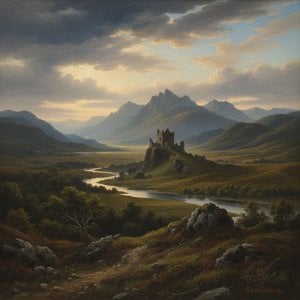
Joseph Calder Smith: A Vision of Scottish Landscapes
The canvases of Joseph Calder Smith (1876-1953) are more than mere depictions of Scotland’s breathtaking lochs and rugged Hebridean coastlines; they are imbued with a profound sense of place, a quiet reverence for the natural world, and an almost palpable feeling of solitude. Born in Philadelphia, his artistic journey took him across continents before he ultimately settled in the Scottish Highlands, where he spent the latter half of his life capturing its elemental beauty with a distinctive, deeply personal style. Smith’s work represents a fascinating confluence of influences – from the early Impressionists and Whistler to the Romantic landscape painters who sought to evoke emotion through their depictions of nature—resulting in a unique visual language that continues to resonate today.
Smith's formative years were steeped in artistic tradition. His father, Alexander Milne Calder, was a renowned sculptor, and his family’s home was filled with the tools and techniques of the craft. This early exposure instilled in him an appreciation for form and texture, while his mother, Margaret Stirling, was a talented artist herself. He initially studied at the Pennsylvania Academy of the Fine Arts, absorbing the rigorous training and classical influences prevalent there. However, it was his travels to Europe – particularly Paris – that truly ignited his artistic sensibilities. He immersed himself in the vibrant art scene, studying with masters like Jean-Léon Gérôme and Henri Seguy, absorbing their techniques and broadening his understanding of composition and color theory. This period marked a crucial shift towards a more observational approach, laying the groundwork for his later focus on capturing the nuances of the Scottish landscape.
Upon returning to America, Smith’s career took an unexpected turn when he was commissioned to sculpt for the 1915 Panama-Pacific Exposition in San Francisco. This project, alongside other significant commissions including the Swann Memorial Fountain in Philadelphia and the Depew Memorial Fountain in Indianapolis, showcased his technical skill and ability to create monumental works of public art. However, it was his move to Scotland in 1910 that proved transformative. Drawn by the dramatic landscapes and the relative peace and quiet, he established a studio in Croton-on-Hudson, New York, and began dedicating himself entirely to painting. The Highlands offered an unparalleled source of inspiration – the ever-changing light on the lochs, the stark beauty of the mountains, and the sense of timelessness that permeated the region all found their way onto his canvases.
The Language of Light and Color
Smith’s paintings are characterized by a masterful manipulation of light and color. He wasn't interested in dramatic sunsets or bold contrasts; instead, he meticulously observed how light transformed the landscape throughout the day, capturing the subtle shifts in hue and tone with remarkable accuracy. His palette was predominantly muted – dominated by shades of grey, blue, green, and brown—reflecting the somber beauty of the Highlands. He employed a broken brushstroke technique, layering thin washes of color to create an atmospheric effect that conveyed both depth and luminosity. This approach, reminiscent of Whistler’s use of tonal harmony, allowed him to evoke a sense of mood and atmosphere rather than simply replicating visual reality.
Furthermore, Smith's understanding of composition was deeply rooted in the principles of Japanese art, which he had studied extensively during his time in Paris. He favored asymmetrical arrangements and negative space, creating a sense of balance and tranquility within each painting. His compositions often feature a single focal point – a loch reflecting the sky, a solitary farmhouse nestled amongst the hills—drawing the viewer’s eye into the heart of the scene. The use of atmospheric perspective—the gradual blurring of details with distance—further enhanced the illusion of depth and space, transporting the viewer to the remote landscapes he so meticulously depicted.
Key Works and Influences
Among Smith's most celebrated works are his series of paintings depicting Loch Alsh and Kylerhea, capturing the dramatic interplay of light and water on this iconic loch in the Scottish Highlands. His depictions of Eilean Donan Castle, perched dramatically on a rocky outcrop overlooking Loch Duich, exemplify his ability to convey both the grandeur of the castle and the wild beauty of its surroundings. “Flower Piece” is another notable example, showcasing his interest in capturing the delicate details of nature—the vibrant colors of wildflowers against the backdrop of a rugged landscape.
Smith’s artistic development was undoubtedly influenced by several key figures. The Impressionists, with their emphasis on capturing fleeting moments and the effects of light, provided him with a foundational understanding of color theory and brushwork. Whistler's tonal landscapes served as a model for his own approach to atmospheric perspective and harmony. However, Smith’s work also possesses a distinctly Romantic sensibility—a deep appreciation for the sublime beauty of nature and a desire to evoke emotion through his depictions of the landscape. This is evident in his paintings of the vast, desolate Highlands, which convey a sense of awe and wonder.
Legacy and Significance
Joseph Calder Smith’s legacy lies not only in the quality of his art but also in his unwavering dedication to capturing the essence of Scotland's landscapes. His paintings offer a profound meditation on the relationship between humanity and nature, inviting viewers to contemplate the beauty and solitude of the Highlands. While he may not be as widely recognized as some of his contemporaries, Smith’s work continues to be appreciated for its technical skill, atmospheric quality, and deeply personal vision. His paintings are held in numerous public and private collections throughout Scotland and beyond, ensuring that his artistic legacy will endure for generations to come.
His influence can also be seen in later Scottish landscape artists who followed in his footsteps, demonstrating the lasting impact of his unique approach to depicting the Highlands. Smith’s work serves as a reminder of the power of art to capture not just what we see but also what we feel—the quiet beauty and profound sense of peace that can be found in the heart of Scotland's wild landscapes.