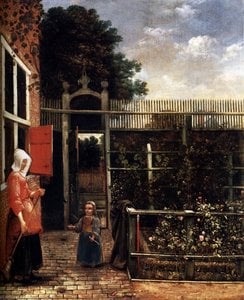
The Quiet Observer of the Dutch Golden Age
In the vibrant, bustling era of the Dutch Golden Age, where grand landscapes and dramatic portraits often commanded the spotlight, Hendrick van der Burgh carved out a unique and intimate niche. A painter of the Delft School, Van der and Burch possessed a rare gift for finding the extraordinary within the ordinary. While his contemporaries might have sought the epic or the heroic, he turned his gaze toward the quiet corners of domestic life, capturing the subtle rhythms of existence that often go unnoticed. Born in 1627 and baptized in the village of Naaldwijk near Delft, his early years were steeped in the atmosphere of a nation experiencing unprecedented prosperity and artistic flourishing.
The artist’s connection to the great masters of his time adds a layer of fascinating intimacy to his biography. He was, in fact, related to the celebrated Pieter de Hooch, serving as his step-brother following the marriage of his sister, Jannetge, to De Hooch. This familial link placed him at the very heart of the Delft artistic community, a circle defined by meticulous observation and a profound respect for light and space. Though his recorded life remains somewhat elusive—with confirmed residencies in Leiden between 1658 and 1659—his presence in the annals of art history is firmly established through his distinctive "hvb" monogram, which adorns many of his prints and portraits.
A Mastery of Domestic Intimacy
Van der Burgh’s oeuvre is a testament to the beauty of the mundane. He specialized in genre scenes—paintings that act as windows into the daily lives of the 17th-century Dutch people. His subjects were not kings or deities, but rather ordinary individuals engaged in the humble tasks of survival and social interaction. One might find himself transported to a sunlit barn during milking time, or seated at a table amidst a merry company sharing a meal. He even ventured into more peculiar corners of society, such as documenting the clinical, yet strangely human, scene of a dentist’s consultation.
Technically, his work is characterized by a remarkable sense of restraint and atmospheric depth. Eschewing the heavy, dramatic chiaroscuro that defined much of the Baroque period, Van der Burgh preferred a softer, more diffused light. This choice allowed him to focus on the delicate textures of his subjects: the rough weave of a woolen garment, the cool sheen of a polished copper milk can, or the gentle translucency of skin. His palette was often muted, relying on earthy tones and soft hues to create a sense of calm and stability. Through this subtle approach, he achieved a profound psychological depth, capturing fleeting expressions of emotion that resonate with viewers centuries later.
Legacy and Artistic Significance
The historical significance of Hendrick van der Burgh lies in his contribution to the evolution of genre painting. He was part of a movement that shifted the artistic focus from religious and mythological narratives toward a celebration of national identity and middle-class values. His work reflects the burgeoning sense of pride in the Dutch Republic, where the sanctity of family life, piety, and industriousness were held in high regard. By elevating the domestic sphere to the level of fine art, he helped define the visual language of an entire era.
Though his total artistic output was relatively small compared to some of his more prolific peers, the enduring quality of his vision remains undiminished. His ability to weave together:
- Meticulous Realism: A dedication to the accurate rendering of light, texture, and form.
- Emotional Resonance: The capacity to imbue simple scenes with a palpable sense of human presence and atmosphere.
- Cultural Documentation: Providing a vital visual record of the social customs and domestic landscapes of the 17th-century Netherlands.
Today, Van der Burgh stands as a master of the quiet moment, reminding us that there is profound beauty to be found in the stillness of everyday life.
アーティストへのQ&A
Hendrick van der Burghの作品を展示したバーチャルミュージアムを訪れることはできますか?
Hendrick van der Burghの作品は、アーティストの3Dギャラリーページにある3Dギャラリーでご覧いただけます。
Hendrick van der Burghの作品を、カラースペクトラム(色相)ごとに探すことはできますか?
カラーインデックスでは、Hendrick van der Burghの作品を色別に分類してご紹介しています。
Hendrick van der Burghは、どの時代に活動していましたか?
Hendrick van der BurghはEarly Modernに活動していました。この時代背景は、その画家の足跡を歴史の中に位置づけるものです。