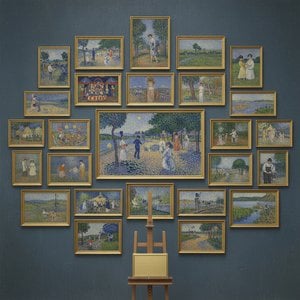
George Haddow: A Scottish Vision of the Highlands
The landscape paintings of George Haddow (1816-1864) offer a profoundly intimate and atmospheric glimpse into the heart of 19th-century Scotland. More than mere depictions of scenery, his works—particularly those capturing the lochs, mountains, and coastal regions of the Highlands—are imbued with a palpable sense of mood, light, and the enduring spirit of the land. Born in Edinburgh, Haddow’s artistic journey was shaped by a deep connection to his native country and a keen observation of its dramatic natural beauty. His career unfolded during a period of significant change for Britain, marked by industrialization and social upheaval, yet he remained steadfastly committed to portraying the timeless allure of Scotland's wild spaces.
Haddow’s early artistic training remains somewhat shrouded in mystery, though it is believed he initially studied under John Thomson, a prominent Scottish landscape painter. This mentorship undoubtedly instilled within him a respect for tonal harmony and an appreciation for capturing subtle shifts in light and atmosphere – qualities that would become hallmarks of his distinctive style. However, Haddow quickly developed his own unique approach, prioritizing emotional resonance over precise topographical detail. He wasn’t interested in creating photographic representations; instead, he sought to evoke the feeling of being *within* a landscape—to transport the viewer into its quiet grandeur and contemplative solitude.
The Language of Light and Shadow
Haddow's technique is characterized by an extraordinary mastery of light and shadow. He employed a muted palette – predominantly blues, greens, greys, and browns – to create a sense of depth and atmosphere that is both subtle and profoundly moving. Rather than relying on bright highlights or dramatic contrasts, he built up his compositions through layers of delicate washes and carefully blended tones. This approach allowed him to capture the ethereal quality of Highland light—the way it filters through mist, dances across water surfaces, and casts long shadows in valleys. His paintings are not about showing *what* a landscape looks like; they’re about conveying *how* it feels.
Consider his “Lady Haddo,” a captivating depiction of a woman standing before a loch. The figure is rendered with remarkable sensitivity, her form almost dissolving into the surrounding landscape. The water itself seems to shimmer and breathe, reflecting the shifting light and creating an illusion of movement. It’s not simply a portrait; it's a meditation on the relationship between humanity and nature—a poignant reminder of our place within the vastness of the Scottish wilderness.
Influences and Artistic Context
Haddow’s work resonates with several key artistic currents of his time. Like many Romantic landscape painters, he was deeply influenced by the Sublime – a concept that emphasized the awe-inspiring power and beauty of nature. However, Haddow's approach to the Sublime differs from that of some of his contemporaries. He avoids bombast and melodrama, instead opting for a quiet, understated expression of wonder. His paintings possess a contemplative quality that invites viewers to pause and reflect on their own connection to the natural world.
Furthermore, Haddow’s work shares affinities with the Hudson River School painters in America, who similarly sought to capture the grandeur and spirituality of American landscapes. Both groups prioritized atmospheric effects over detailed representation, and both aimed to evoke a sense of emotional resonance within their viewers. However, Haddow's focus remained firmly rooted in Scotland—his paintings are uniquely shaped by the specific character of his homeland.
Key Works and Legacy
Among Haddow’s most celebrated works is “Hagar and the Angel,” an evocative interpretation of a scene from the Book of Genesis. While drawing inspiration from Claude Lorrain's classical composition, Haddow imbues the painting with a distinctly Scottish sensibility—the rugged beauty of the Highland landscape serves as a powerful backdrop for this biblical narrative. His "View from St Leonard’s Park" further exemplifies his ability to capture the essence of Scotland’s iconic scenery.
Despite facing financial challenges and battling illness throughout his life, Haddow continued to paint until his death in 1864. He left behind a significant body of work—over two hundred paintings—that are now treasured for their atmospheric beauty and profound emotional depth. George Haddow’s legacy endures as one of Scotland's most important landscape painters, a master of light, shadow, and the evocative power of nature.
Haddo House: A Reflection of His Life
George Haddow’s life was inextricably linked to Haddo House, the family estate near Tarves in Aberdeenshire. The house itself—a grand but somewhat austere building—became a focal point for his artistic endeavors and a testament to his connection with Scotland's cultural heritage. As a prominent member of the Gordon family, Haddow played a significant role in preserving the history and traditions of Haddo House, which served as a gathering place for Scottish nobility and intellectuals. The house’s transformation into a maternity hospital during World War II further underscores Haddow’s commitment to his community and his enduring legacy.
Q&A
What other names is George Haddo known by?
George Haddo appears under the alternate names Lord Haddo, George Hamilton-Gordon.
George Haddoの作品を色別に並べ替えることはできますか?
George Haddoの色彩インデックスは、アーティストの作品を色別に整理したページです。
George Haddoの作品を展示したバーチャルミュージアムを訪れることはできますか?
George Haddoの作品は、アーティストの3Dミュージアムページにある3Dギャラリーでご覧いただけます。
特定のテーマに基づいたGeorge Haddoの作品を探すには、どうすればよいですか?
George Haddoの作品は、アーティストのキーワード別ページからキーワード別に探すことができます。各キーワードには関連する作品がまとめられています。
George Haddoの全作品を通じた色彩の使い方を詳しく知ることはできますか?
George Haddoの作品のカラープロファイルは、アーティストのパレット・ゲノムページでご確認いただけます。
George Haddoは、どの時代に活動していましたか?
George Haddoは19th Centuryに活動していました。この時代背景は、その画家の活動を歴史の中に位置づけるものです。
George Haddoの作品を技法別に閲覧することはできますか?
特定の技法によるGeorge Haddoの全作品をご覧いただくには、アーティストの全技法ページをご利用ください。
George Haddoの作品一覧はすべて確認できますか?
当サイトにおけるGeorge Haddoのすべての作品は、アーティストのすべての作品一覧ページからご覧いただけます。