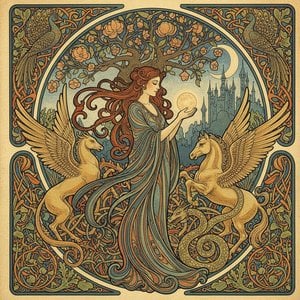
Fletcher Ransom: Weaver of Lincoln and Echoes of the Victorian Era
Fletcher Charles Ransom, a name perhaps less familiar than many of his contemporaries, nevertheless holds a significant place in late 19th and early 20th-century British illustration. Born in Alamo, Michigan, in 1870, Ransom’s artistic journey began not amidst the bustling studios of New York but within the quiet rhythms of rural life – a formative experience that would profoundly shape his distinctive style and thematic concerns. His family recognized his innate talent early on, fostering an appreciation for art that led him to study at the Art Institute of Chicago and subsequently the prestigious Academy of Fine Arts in New York City. These initial training grounds instilled in him a solid technical foundation, but it was his relocation to London and subsequent work for prominent magazines like *Harper’s Weekly*, *Scribner’s Magazine*, and *The Saturday Evening Post* that truly defined his career trajectory. Ransom wasn't merely an illustrator; he was a storyteller, meticulously crafting images that captured the spirit of their time – a period marked by rapid industrialization, social change, and a burgeoning interest in both historical narratives and contemporary life.
A Victorian Soul in a Modern World: Early Influences and Artistic Style
Ransom’s artistic style is often described as distinctly Victorian, yet imbued with a subtle modernity. He inherited the meticulous detail and rich color palettes characteristic of the era, reminiscent of artists like William Bouguereau and John Singer Sargent. However, unlike his contemporaries who embraced purely academic styles, Ransom injected a sense of narrative depth and psychological insight into his work. His illustrations frequently featured solitary figures – often men – contemplating complex emotions or engaging in quiet moments of reflection. This tendency toward introspective portraiture is particularly evident in his series of paintings depicting Abraham Lincoln, works that transcend mere historical representation to explore the weight of leadership and the burdens of responsibility. The use of muted tones, atmospheric lighting, and carefully rendered textures contributes to a mood of melancholic beauty, reflecting the anxieties and uncertainties of the late Victorian period. His work also shows an influence from the Pre-Raphaelites, particularly in his attention to detail and romanticized depictions of nature.
Lincoln’s Legacy: The Paintings That Defined His Career
Ransom's most enduring legacy lies undoubtedly in his series of paintings depicting Abraham Lincoln. Commissioned by the Chicago & Midland & Illinois Railroad Company in 1930, these fourteen canvases offered a poignant and multifaceted portrait of the former president – not as a grand historical figure, but as a man grappling with the complexities of his time. The “Postmaster Lincoln” painting, arguably his most famous work, captures Lincoln in a moment of quiet contemplation amidst a snowy landscape, conveying a sense of profound sadness and resilience. The "Pioneer Education" piece, depicting a lone figure against a vast, desolate backdrop, speaks to themes of isolation, perseverance, and the challenges faced by pioneers. These paintings weren’t simply illustrations; they were carefully constructed narratives designed to evoke empathy and understanding. The meticulous detail with which Ransom rendered Lincoln's face – his furrowed brow, his thoughtful gaze – invites viewers to connect with the man on a deeply personal level. The series cemented Ransom’s reputation as an artist capable of capturing not just likeness but also character and emotion.
Beyond Lincoln: Calendar Art, Satire, and the Gerlach-Barklow Legacy
While his work on Abraham Lincoln brought him considerable recognition, Ransom's career extended far beyond this singular project. He was a prolific illustrator of books and magazines throughout the early 20th century, contributing to publications ranging from *Youth’s Companion* to *McClure’s*. Perhaps most notably, he spent seventeen years working for the Gerlach Barklow Company, producing calendars that became immensely popular during the period. These calendar paintings often featured scenes of rural life, historical events, and portraits of notable figures – a testament to Ransom's versatility as an artist. In 1910, he penned and illustrated “My Policies in Jungleland,” a satirical critique of Theodore Roosevelt’s presidency, demonstrating his willingness to engage with contemporary political issues through the medium of illustration. His later years were marked by a shift towards quieter subjects, including scenes of rural life and portraits of ordinary people, reflecting a growing sense of contentment and perhaps a desire for respite from the demands of commercial art.
A Lasting Impact: Ransom’s Place in Illustration History
Fletcher Ransom's contribution to illustration history is often overlooked, yet his work deserves recognition as a significant example of late Victorian and early 20th-century artistic expression. His meticulous technique, evocative imagery, and profound understanding of human psychology set him apart from many of his contemporaries. The enduring appeal of his Lincoln paintings – which continue to be exhibited in museums and reproduced in books – serves as a testament to the power of his art. Ransom’s legacy extends beyond individual works; he represents a generation of illustrators who sought to elevate the medium from mere decoration to a form of sophisticated storytelling. His work offers a valuable window into the social, cultural, and political landscape of his time, reminding us of the enduring relevance of art as a means of understanding ourselves and the world around us.
WahooArt.com 編集部
アート・クイズ
各質問の正解は1つだけです。
問題 1:
Fletcher Ransom is best known for his illustrations of which historical figure?
問題 2:
During which period did Fletcher Ransom primarily work as a calendar illustrator?
問題 3:
What type of artwork was Fletcher Ransom commissioned to produce for the Chicago & Midland Railroad?
問題 4:
Which of the following best describes Fletcher Ransom’s artistic style?
問題 5:
What is the name of the painting by Fletcher Ransom that sold for $48,000 at auction in 2016?
Explore 10 defining American Realism masterpieces – Hopper, Homer & more. Discover the stories behind these iconic paintings and bring timeless art to your home with WahooArt's museum-quality reproductions. Explore the full collection online.
Explore the captivating world of Edmund Dulac, a master of Golden Age illustration! Discover his enchanting fairy tales, Art Nouveau style, and lasting influence on art & design. Learn about *The Rubaiyat* and more.
Explore the captivating world of Angelo Chiacchio, a master of mid-century American illustration. Discover his evolution, signature style, and lasting impact on commercial art & design. Learn about his legacy at the Museum of American Illustration.