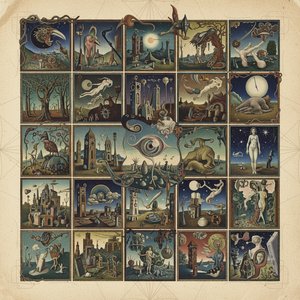
Early Life and the Seeds of Surrealism
Dorothea Margaret Tanning, born August 25, 1910, in Galesburg, Illinois, emerged from a lineage of Swedish immigrants, inheriting a quiet fortitude that would subtly underpin her boldly imaginative art. Her childhood wasn’t one of conventional artistic nurturing; rather, it was marked by an unconventional education and a precocious independence. Skipping two grades proved formative, though she later confessed to a lifelong struggle with arithmetic—a curious counterpoint to the complex symbolic calculations within her paintings. A brief stint at Knox College in 1928-30 gave way to the allure of Chicago and then, in 1935, the vibrant energy of New York City. There, she sustained herself as a commercial artist, honing technical skills while secretly cultivating a deeply personal artistic vision. The pivotal moment arrived in 1936 with the Museum of Modern Art’s exhibition “Fantastic Art, Dada, and Surrealism.” This encounter wasn't merely an exposure to new styles; it was a revelation—a validation of the dreamlike imagery and psychological explorations already stirring within her. It unlocked a pathway toward expressing the hidden landscapes of the mind.
A Partnership Forged in Dreams: Tanning and Ernst
Tanning’s early work, imbued with this newfound surrealist sensibility, quickly garnered attention. Exhibitions organized by Julien Levy in 1944 and 1948 provided a platform for her unique voice. It was during this period that she created *Birthday* (1942), an iconic self-portrait that would irrevocably alter the course of her life. The painting captivated Max Ernst, already a towering figure within the surrealist movement. Their connection wasn’t simply artistic admiration; it blossomed into a profound love affair and a remarkably influential partnership. They married in 1946 in a double ceremony alongside Man Ray and Juliet Browner, solidifying their place within the avant-garde circles of the time. Together, they sought refuge from the bustling art world, establishing a home in Sedona, Arizona. This isolated landscape became a haven for creativity, attracting fellow artists and writers like Henri Cartier-Bresson, Lee Miller, Roland Penrose, Yves Tanguy, Kay Sage, Pavel Tchelitchew, George Balanchine, and Dylan Thomas—a testament to the couple’s magnetic presence and shared artistic vision. Their time was also divided between France, specifically Paris and Touraine, returning periodically to Sedona.
Beyond Surrealism: Fragmentation and Transformation
While initially celebrated as a surrealist painter, Tanning refused to be confined by labels. Around 1955, she described a radical shift in her work—a sense of canvases “literally splintering.” This wasn’t a rejection of the past but an evolution toward greater abstraction and psychological depth. The explicit dream imagery began to fragment, giving way to prismatic forms and suggestive representations of the female form. Works like *Insomnias* (1957) exemplify this transition—a move away from narrative representation towards evocative suggestion. This period also saw her venture into three-dimensional art, creating soft fabric sculptures that blurred the boundaries between painting and sculpture. The culmination of this exploration was *Hôtel du Pavot, chambre 202* (1970–73), a fully immersive installation now housed at the Musée national d'art moderne in Paris—a testament to her ambition and willingness to experiment with form and space. During her time in France, she became a prolific printmaker, collaborating with various ateliers and poets on limited edition artists’ books, further expanding her artistic repertoire.
Late Flourishing: Writing, Reflection, and Enduring Legacy
Following Ernst's death in 1976, Tanning experienced a creative resurgence, returning to New York with renewed energy. She embraced painting, drawing, collage, and printmaking, continuing to explore the themes that had captivated her throughout her career. However, the later decades of her life also saw a blossoming of her literary talents. She turned to writing and poetry, publishing works that revealed a sharp wit and introspective sensibility. Throughout her long and multifaceted career, Tanning remained remarkably versatile, designing sets and costumes for George Balanchine’s ballets and even appearing in avant-garde films by Hans Richter. She continued to create until the very end of her life, passing away on January 31, 2012, at the age of 101. Dorothea Tanning's legacy extends far beyond any single movement or style. Her six decades of artistic exploration demonstrate a remarkable capacity for innovation and self-reinvention. She transcended the boundaries of surrealism to forge her own distinct voice—one characterized by dreamlike imagery, psychological depth, and an unwavering commitment to exploring the complexities of the human experience. Her work continues to inspire and captivate audiences worldwide, solidifying her place as a significant figure in 20th-century art.