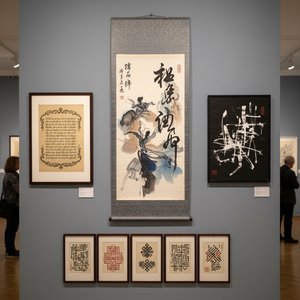
A Visionary of the Iraqi Canvas
In the vast tapestry of mid-century modernism, few artists capture the raw, pulsating energy of human connection quite like Saad Abdel Qader Al-Kaabi. Born in Kufa, Iraq, Al-Kaabi emerged as a pivotal figure in the landscape of Iraqi art, serving as a pioneer of the Hurufiyya movement—a profound aesthetic tradition where the elegance of calligraphy meets the bold abstractions of modernism. His work is characterized by an expressive yet stylized approach, often weaving together the threads of personal identity with the broader, sweeping narratives of social and political transformation.
Al-Kaabi’s artistic journey is a meditation on the boundaries between reality and perception. Through his mastery of form and line, he created works that serve as windows into pivotal eras of history. Whether exploring the collective spirit of a gathering crowd or the solitary introspection of a single figure, his canvases possess a rhythmic movement that pulls the viewer into a shared historical heartbeat. His ability to balance intricate individual expressions with grand, sweeping compositions allows his art to resonate both as intimate psychological studies and as monumental historical documents.
Symbolism and the Language of Form
The brilliance of Al-Kaabi lies in his unique ability to blend traditional figuration with a symbolic, almost surrealist language. His paintings often function as intricate tableaux where the ancient and the contemporary dissolve into one another. In his most evocative works, one might find:
- The Interplay of Light and Shadow: A masterful use of contrast that creates a sculptural quality, breathing life into silhouettes and lending a tangible texture to the surfaces of his subjects.
- Temporal Anchors: The deliberate use of anachronisms, such as the inclusion of clocks within ancient settings, to challenge the viewer's perception of time and heritage.
- Calligraphic Influence: A structural depth derived from the Hurufiyya movement, where the rhythmic beauty of script informs the very architecture of his compositions.
- Existential Duality: The exploration of fragmented identity, often depicting figures caught between the physical world and spectral projections of thought or spirit.
In masterpieces such as The Nationalization, Al-Kaabi captures the weight of a changing nation, using central protagonists to bridge the gap between earthly struggles and spiritual destiny. His work does not merely depict scenes; it invites the observer into a psychological landscape where every brushstroke whispers of mystery and the eternal nature of human existence.
Legacy and Historical Significance
As an Iraqi pioneer, Saad Abdel Qader Al-Kaabi left an indelible mark on the evolution of modern Middle Eastern art. His technical execution—ranging from the meticulous detail found in his more expansive, historical works to the stark, monochromatic intensity of his explorations into the surreal—demonstrates a profound versatility. By navigating the tension between the enduring stillness of nature and the fleeting, vibrant motion of humanity, he created a visual legacy that continues to offer intellectual stimulation and emotional gravity.
His contribution to the Hurufiyya movement remains a cornerstone of his historical significance, as he successfully integrated linguistic depth into figurative subjects. For the contemporary observer, Al-Kaabi’s oeuvre stands as a testament to the power of visual metaphor, bridging the gap between traditional heritage and the abstract, symbolic language of global modernism.