Daan Lemaire: A Dutch Abstract Expressionist’s Journey Through Color and Light
Born in Naarden, Netherlands, in 1942, Daan Lemaire emerged as a significant figure within the evolving landscape of Dutch abstract expressionism. His artistic journey, spanning several decades and encompassing both painting and glass sculpture, is characterized by a profound exploration of color, light, and symbolic imagery—a dialogue between the tangible world and the realm of emotion. Initially influenced by the surrealist techniques he encountered during his youth, Lemaire ultimately forged a distinctive style rooted in introspection and a deep connection to nature.
Lemaire’s early years were shaped by an artistic milieu. His parents, involved in the Amsterdam theater and film scenes, exposed him to creative circles from a young age. A formative influence came through his association with Willy Boers, a contemporary painter already experimenting with abstraction, who imparted valuable insights into color theory and the expressive potential of gouache. This early exposure laid the groundwork for Lemaire’s later embrace of abstract forms. His formal artistic education was initially disrupted; after a year at the Academy of Fine Arts St. Joost in Breda, he was expelled due to personal circumstances—a poignant reflection of the societal constraints faced by artists during that era.
The Emergence of Style: From Surrealism to Abstraction
Following his expulsion from the academy, Lemaire’s artistic practice underwent a significant transformation. He began experimenting with various mediums, including oil painting and gouache, developing a distinctive style characterized by layered washes of color and evocative imagery. Initially influenced by surrealist principles—a legacy of his early encounters with Willy Boers—Lemaire gradually moved towards a more purely abstract approach in the late 1970s and early 1980s. This shift wasn’t abrupt; rather, it represented a deepening engagement with color as a primary means of expression, moving beyond representational forms to convey emotional states and inner landscapes.
His work during this period is often described as meditative—a slow, deliberate process of building up layers of paint to create luminous surfaces. He frequently employed techniques such as glazing and scumbling, allowing colors to bleed into one another, creating a sense of depth and atmosphere. Recurring motifs – birds, landscapes, and symbolic figures – emerged within his abstract compositions, hinting at narratives and inviting interpretation.
Key Works and Themes
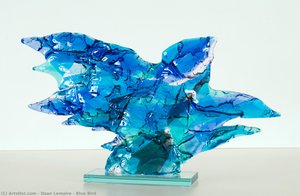
Several works stand out as particularly representative of Lemaire’s artistic development. “Golden Autumn” (circa 1978) exemplifies his mastery of color and texture, capturing the fleeting beauty of a seasonal landscape through an explosion of warm hues. “Blue Bird” (circa 1980), similarly, showcases his ability to evoke mood and emotion through carefully orchestrated color combinations. These pieces, alongside numerous other works in his oeuvre, demonstrate a consistent commitment to exploring the expressive potential of abstraction.
Beyond landscape, Lemaire also ventured into glass sculpture, creating translucent forms that refracted light and created mesmerizing visual effects. This dual focus—painting and sculpture—allowed him to explore different facets of his artistic vision, demonstrating a versatility and a willingness to push the boundaries of his creative practice. His work frequently explores themes of nature, memory, and the human condition, often imbued with a sense of melancholy and introspection.
Legacy and Influence
Daan Lemaire’s contribution to Dutch abstract expressionism is considerable. He stands as a key figure in the movement's evolution, demonstrating a unique approach to color and symbolism. While he may not be as widely recognized as some of his contemporaries—such as Karel Appel or Barnett Newman—his work possesses a quiet intensity and a profound emotional resonance that continues to captivate viewers. His legacy lies not only in his individual artworks but also in his influence on subsequent generations of artists who have embraced abstraction as a means of exploring the inner world.
Today, Lemaire’s paintings are held in private collections and displayed in galleries across Europe, ensuring that his distinctive artistic vision continues to be appreciated for its beauty, complexity, and enduring power. His work serves as a testament to the transformative potential of art—a journey through color, light, and the depths of human experience.
Q&A
Daan Lemaireによる作品の中で、最も閲覧数が多いのはどれですか?
Daan Lemaireの統計情報ページでは、当サイトに掲載されているアーティストの作品から算出された統計データをご覧いただけます。
Daan Lemaireには、他にどのような別名や通称がありますか?
Daan Lemaireは、Jan Lemaire Jr.という名でも知られています。
Daan Lemaireは、どの時代に活動していましたか?
Daan LemaireはModernに活動していました。この時代背景は、その画家の活動を歴史の中に位置づけるものです。