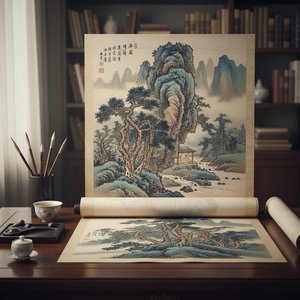
Chou Wen-chu: Echoes of the Tang in Monochrome
The world of classical Chinese painting often feels like a vast, shimmering ocean, filled with legendary figures and elusive works. Among those whose names remain somewhat veiled in mystery is Chou Wen-chu – also known as Zhou Wenju – a painter who flourished during the turbulent Five Dynasties and Ten Kingdoms period (907–960). Born in Jurong, China, around 942, his life was inextricably linked to the remnants of the Tang Dynasty’s artistic legacy, a time of profound political upheaval yet also remarkable cultural continuity. While precise details about his birth and death remain uncertain, Chou Wen-chu's contribution to monochrome painting is undeniable, offering us glimpses into a world of refined aesthetics and subtle emotional expression.
Chou Wen-chu’s career unfolded within the vibrant, albeit precarious, environment of the Southern Tang court. He served as a painter in attendance at the esteemed painting academy, an institution dedicated to preserving and innovating upon the traditions established during the earlier Tang Dynasty. This placement provided him with invaluable access to materials, techniques, and artistic discourse – a crucial foundation for his work. A significant event marking his career was his participation in a grand banquet held by Emperor Yuanzong of Southern Tang on New Year’s Day in 947. Records indicate that he contributed to a collaborative painting project at this auspicious occasion, highlighting his recognition within the court and solidifying his position as an artist of considerable skill.
Chou Wen-chu's artistic style is most notably characterized by his mastery of monochrome painting – specifically, ink wash techniques on silk. This approach, deeply rooted in Tang Dynasty precedents, demanded a profound understanding of brushwork, tonal variation, and the expressive potential of black ink. Unlike the vibrant colors often associated with Chinese art, Chou Wen-chu’s palette was deliberately restrained, focusing instead on capturing essence through subtle shifts in darkness and light. His figures are rendered with an understated elegance, conveying a sense of quiet dignity and introspection. He followed closely in the footsteps of Tang Dynasty master Fang Weiyan, absorbing his techniques and philosophical approach to painting.
Despite the considerable scholarly interest in his work, attributing specific paintings definitively to Chou Wen-chu presents a persistent challenge. Many works attributed to him are believed to be later copies or misattributions – a common issue when dealing with artists from this period whose output was not meticulously documented. However, four scroll monochrome paintings, dating back before 1140, offer compelling evidence of his artistic capabilities and represent some of the most enduring examples of his oeuvre. Notably, one such scroll is housed in the Metropolitan Museum of Art, providing a tangible link to this enigmatic artist. These scrolls demonstrate a remarkable control over brushwork, composition, and the evocative power of monochrome, revealing a painter deeply attuned to the nuances of human form and emotion.
Chou Wen-chu’s significance lies not merely in the individual works he produced but also as a representative figure within a transitional artistic landscape. He embodies the efforts to maintain Tang aesthetic ideals amidst political fragmentation and social change. His dedication to monochrome painting, coupled with his connection to the Southern Tang court, makes him a fascinating subject for art historians and enthusiasts alike. His legacy continues to resonate through these surviving scrolls, offering us a quiet yet profound window into the world of 10th-century Chinese painting – a testament to an artist whose name may be veiled in mystery, but whose artistic spirit endures.