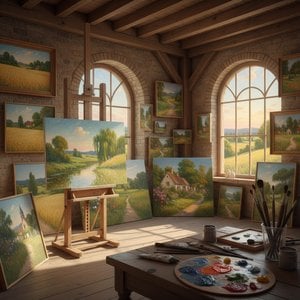
A Life Painted in Watercolors: The Serene World of Anne Gordon
Anne Gordon, born Jennifer Anne Gordon in Glasgow, Scotland, in 1941, was an artist whose life and work were deeply intertwined with the landscapes that surrounded her. Though she passed away in 2005, her legacy continues to resonate through the delicate beauty of her watercolor paintings, particularly those capturing the rural charm of both her native Scotland and the sun-drenched scenes of Portugal. Gordon’s artistic journey wasn't one of immediate acclaim but a gradual unfolding, nurtured by formal education at the prestigious Glasgow School of Art and years spent sharing her passion as an art teacher in local schools. This period of teaching undoubtedly honed her observational skills and deepened her understanding of color and form – qualities that would become hallmarks of her distinctive style. It wasn’t until she settled in West Stirlingshire, however, that her artistic voice truly found its expression, inspired by the rolling hills, quiet lochs, and ever-changing light of the Scottish countryside.
From Scottish Highlands to Portuguese Plains
Gordon's early work focused primarily on the landscapes of Scotland, rendered with a sensitivity that captured not just the visual appearance of the scenery but also its atmosphere and emotional resonance. Her watercolors possess a remarkable ability to evoke a sense of place – you can almost feel the cool mist rising from a glen or smell the heather blooming on the moorland. However, her artistic horizons broadened through travel, most notably with repeated visits to Portugal. The light-filled landscapes of the Alentejo region proved particularly captivating, offering a different palette and mood than those she was accustomed to. Her paintings of Portugal, such as “Nowaday in Portalegre,” demonstrate a masterful adaptation to new surroundings. While retaining her signature delicate touch, Gordon embraced warmer tones and broader compositions to reflect the unique character of the Portuguese countryside. This shift wasn’t a departure from her core aesthetic but rather an expansion of it, showcasing her versatility and ability to find beauty in diverse environments.
Technique and Style: A Subtle Mastery
Anne Gordon's technique was characterized by its subtlety and restraint. She rarely employed bold or dramatic brushstrokes, instead favoring layered washes of color that created a luminous quality in her paintings. Her watercolors are not about precise representation but rather about capturing the *essence* of a scene – the play of light on water, the texture of foliage, the overall mood and atmosphere.
She was a master of atmospheric perspective, using delicate gradations of color to create depth and distance.
Her palette, though often muted, was surprisingly rich and nuanced, reflecting her keen observation of natural light and shadow. The influence of traditional British watercolorists is evident in her work, but Gordon developed a style that was uniquely her own – one characterized by its quiet elegance and emotional depth.
Legacy and Historical Significance
While not widely known during her lifetime, Anne Gordon’s work has gained increasing recognition since her death. Her paintings offer a poignant glimpse into the beauty of rural landscapes, both in Scotland and Portugal, at a time when these environments were undergoing significant change.
- Her ability to capture the emotional resonance of place
- Her mastery of watercolor technique
- Her sensitivity to light and atmosphere
make her work particularly appealing to collectors and art enthusiasts seeking a connection with nature. Gordon’s paintings serve as a reminder of the importance of slowing down, observing the world around us, and appreciating the simple beauty that often goes unnoticed. Her legacy lies not in grand statements or revolutionary techniques but in the quiet power of her watercolors – images that continue to evoke a sense of peace, tranquility, and connection with the natural world. She stands as an example of an artist who found profound inspiration in everyday surroundings and translated that inspiration into works of enduring beauty.