Early Life and Artistic Formation
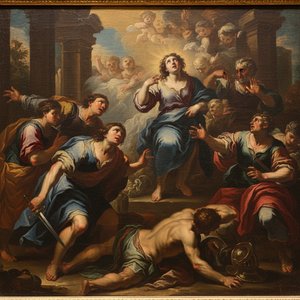
Andrea Pozzo, born Andreas Puteus in Trento, Italy, in 1642, emerged into a world poised between the waning Renaissance and the burgeoning Baroque. His initial exposure to artistic pursuits was fostered within the structured environment of the local Jesuit High School, where he received a grounding in humanities that would later subtly inform the narrative depth of his work. At seventeen, Pozzo embarked on formal training with an as-yet unidentified artist in Trento, laying the foundation for skills that would eventually captivate Europe. This early apprenticeship was followed by a period of exploration and refinement within the workshops of other painters—artists trained in the style of Andrea Sacchi—immersing him in the principles of Roman High Baroque. Journeys to Como and Milan further broadened his artistic horizons, exposing him to diverse influences and solidifying his technical abilities. These formative years were crucial, shaping not only his hand but also his eye for composition, color, and the dramatic interplay of light and shadow.
A Life Dedicated to Faith and Illusion
A pivotal moment arrived in 1665 when Pozzo entered the Jesuit Order as a lay brother. This decision irrevocably intertwined his artistic vocation with the spiritual mission of the Society of Jesus. His talent was immediately put into service, decorating churches and religious buildings across Italy—Modena, Bologna, Arezzo, Mondovì, and Turin all bore witness to his burgeoning skill. Early works reveal the influence of the Lombard School, characterized by a rich palette and striking *chiaroscuro*. However, it wasn’t long before Pozzo began developing the signature illusionistic techniques that would define his legacy: meticulously rendered fake gilding, convincingly sculpted bronze-colored statues, realistically veined marbled columns, and—most famously—the breathtaking *trompe l'œil* domes painted onto flat ceilings. These weren’t merely decorative flourishes; they were carefully calculated strategies to inspire awe and reinforce the power of faith, central tenets of the Counter-Reformation.
The Triumph of Quadratura: Sant'Ignazio and Beyond
Pozzo’s masterpiece, and arguably one of the most celebrated achievements of Baroque art, is the nave ceiling of the Church of Sant'Ignazio in Rome. Completed between 1685 and 1694, this monumental fresco exemplifies his mastery of *quadratura*—a technique employing mathematical perspective and dramatic foreshortening to create the illusion of vast, soaring architectural spaces where none physically exist. The ceiling appears to open up into a boundless heaven, populated by figures representing saints, angels, and allegorical representations of Jesuit missionary work. The effect is profoundly disorienting yet deeply moving, drawing the viewer into a spiritual realm that transcends earthly limitations. This wasn’t simply about technical skill; it was about creating an immersive experience designed to evoke religious fervor. Pozzo didn't limit his contributions to painting; he also provided architectural plans for Ljubljana Cathedral in 1700, demonstrating a holistic vision where art and architecture were seamlessly integrated. His innovative use of *di sotto in su*—viewing structures from below—further enhanced the illusion of grandeur and depth.
Legacy and Theoretical Contributions
Andrea Pozzo’s influence extended far beyond his completed commissions. He wasn't merely a practitioner of illusionistic art; he was also a theorist who sought to codify its principles for future generations. In 1693, and again in 1700, he published *Perspectiva Pictorum et Architectorum* (Perspective for Painters and Architects), a treatise that meticulously detailed his techniques and became an essential resource for artists throughout Europe. This work cemented his position as a leading intellectual figure of the Baroque period. Pozzo also championed the concept of *Gesamtkunst*—total art—advocating for the unification of architecture, painting, and sculpture into a single, harmonious artistic experience. His work stands as a testament to the power of illusion, not as deception, but as a means of elevating the spirit and celebrating the glory of God. He died in Vienna in 1709, leaving behind a legacy that continues to inspire awe and wonder centuries later—a Baroque master who redefined the boundaries between reality and representation.