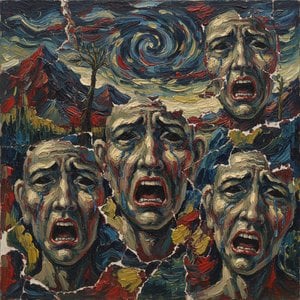
A Portrait of Presence: The Art of Margarida Fleming
Born in the quiet Portuguese town of São Pedro do Sul in 1988, Ana Margarida Fleming José—known to the art world simply as Margarida Fleming—emerged not from a traditional artistic lineage but through an intensely personal and self-directed journey. Her early spark was evident at just nine years old when she captured recognition in a painting competition linked to the momentous Expo '98 in Lisbon, a formative experience that likely instilled within her a sense of possibility and connection to the wider world. While her formal education led her toward the structured disciplines of architecture and graphic design, culminating in a master's degree from the University of Beira Interior, her true calling lay beyond the blueprints. This academic background, however, subtly informs her artistic sensibility; a structural clarity underlies even her most emotionally charged works, hinting at an architect's eye for composition and spatial relationships.
Fleming’s work is characterized by a striking intimacy, offering a sense that we are encountering figures caught in moments of quiet contemplation or unspoken emotion. Her portraits are far more than mere likenesses; they are profound explorations of presence itself. The women she depicts often seem to exist on the threshold between visibility and invisibility, their gazes both inviting and guarded. There is a raw vulnerability in her subjects, appearing almost uncovered, as if stripped bare by the viewer’s gaze. As an autodidact, Fleming admits to learning from mistakes, a philosophy that has allowed her to develop a style that rejects polished perfection in favor of a visceral honesty. Her characters can appear haughty or defiant, their facial expressions serving as the focal point for powerful messages regarding the female experience and the complexities of identity.
Technique and the Language of Texture
The physical creation of Fleming's art is an intuitive process, built upon layers of quick, expressive gestures. She embraces materials like acrylic and oil pastel for their immediacy and their capacity to convey raw, unbridled emotion. The texture of these materials remains visible on the canvas, contributing to a sense of depth and complexity that mirrors the psychological depth of her subjects. Her brushstrokes are often dense, thick, and characterized by an element of unrestrained errantness. This deliberate use of heavy, expressive marks breaks down the boundary between the artist and the audience, creating a connection that feels deeply authentic. By mixing various media and constantly exploring new options, she maintains a state of perpetual experimentation, ensuring that each piece remains a living, breathing entity.
Beyond the traditional canvas, Fleming has also made her mark through the medium of street art, bringing her evocative imagery to the urban landscape. Her participation in projects such as A Lata Delas demonstrates her ability to translate intimate portraiture into large-scale public interventions. This expansion from the private space of the studio to the public walls of Lisbon allows her work to engage with a broader social dialogue, transforming urban environments through the power of color and form.
Legacy and Artistic Significance
The significance of Margarida Fleming’s contribution to contemporary Portuguese art lies in her ability to communicate profound truths through a highly personal lens. Her work serves as a starting point for vital discussions about what it means to be a woman in the modern world, using the face as a landscape of social and emotional reflection. Through her unique blend of architectural precision and expressive spontaneity, she has carved out a space that is uniquely hers—a space where the following elements converge:
- The intersection of disciplines: The marriage of architectural structuralism with the freedom of street art and fine art painting.
- Emotional immediacy: A commitment to using texture and visible gesture to bypass superficiality and reach a deeper psychological truth.
- Social resonance: The use of portraiture to explore themes of vulnerability, strength, and the female gaze within both private and public spheres.
As her career continues to evolve, Fleming remains a vital voice in the contemporary scene, reminding us that art is not merely about what is seen, but about the profound presence of the soul behind the eyes.
アーティストへのQ&A
Ana Margarida Fleming Joséの作品を、芸術運動(ムーブメント)別に閲覧することはできますか?
全ムーブメントページでは、Ana Margarida Fleming Joséの作品を美術様式別にまとめてご紹介しています。
Ana Margarida Fleming Joséの作品の中で、最も閲覧数が多いのはどれですか?
Ana Margarida Fleming Joséの作品に関する統計情報は、アーティストの閲覧統計ページでご確認いただけます。
Ana Margarida Fleming José氏の作品のカラープロファイルはどこで確認できますか?
Ana Margarida Fleming Joséのパレット・ゲノムでは、そのアーティストの作品群を構成するカラープロファイルをご覧いただけます。