Introduction
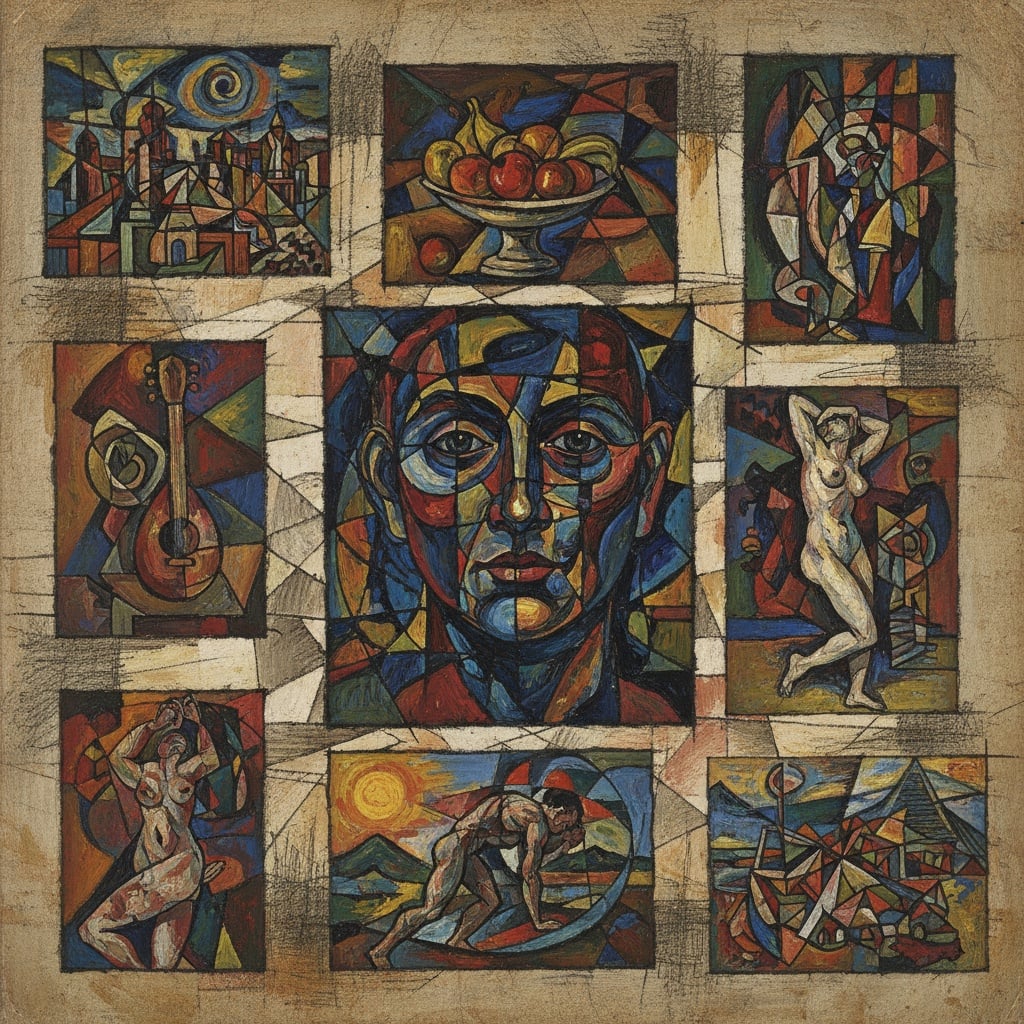
To gaze upon these ten masterpieces is to enter a realm where reality fractures, emotions surge, and the very foundations of artistic representation are gloriously dismantled. The Cubist Expressionism movement, born in the early 20th century, wasn't merely a style; it was a seismic shift in how artists perceived and portrayed the world – and, by extension, how we perceive ourselves.
Emerging from the vibrant, often turbulent atmosphere of post-industrial Europe, Cubist Expressionism arose as a response to rapid societal changes, technological advancements, and a growing sense of alienation. Artists like Picasso and Braque, initially exploring the possibilities of geometric form in Cubism, found themselves increasingly drawn to conveying raw emotional intensity. This fusion – the intellectual deconstruction of Cubism with the visceral power of Expressionism – birthed a new visual language.
The early 1900s were marked by anxieties about modernity, the horrors of war looming large, and a questioning of traditional values. Artists sought to express not just *what* they saw, but *how* they felt about what they saw. They abandoned conventional perspective, fragmented objects into abstract shapes, and employed bold, often jarring color palettes to evoke psychological states. This wasn't about replicating the external world; it was about revealing the internal one.
These ten works represent pivotal moments in this evolution – each a testament to the artists’ courage to break from convention and forge their own paths. They challenged viewers to confront uncomfortable truths, explore the depths of human experience, and question the nature of reality itself. More than a century later, these paintings continue to resonate with us because they tap into universal emotions: anxiety, alienation, joy, and the enduring search for meaning in a fragmented world.
Prepare to embark on a journey through ten extraordinary canvases – each one a window into the soul of a movement that forever altered the course of art history. We will explore not just the techniques employed, but also the stories behind these iconic works and the profound impact they continue to have on our understanding of art and life.
Fire at Full Moon - Paul Klee
 Fire at Full Moon - Paul Klee
Paul Klee’s “Fire at Full Moon,” painted in 1933, isn't simply a depiction of a night scene; it’s an echo of the soul. A quiet contemplation rendered in geometric form and luminous color, it captures that peculiar feeling when darkness feels both comforting and unsettling – a moment suspended between dream and reality.
This work earns its place among the Top 10 masterpieces of Cubist Expressionism for Klee’s unique ability to synthesize diverse influences. He wasn't merely *applying* Cubist principles; he was using them as a vehicle for deeply personal expression, layering shapes and colors to evoke psychological states rather than represent physical objects. The fractured grid, the cool blues and purples punctuated by the fiery red, speak to an internal landscape of emotion – a delicate balance between serenity and turmoil.
The moon, a recurring symbol in Klee’s work, radiates a gentle clarity amidst the darkness, while the blaze suggests passion or perhaps even destruction. It's this ambiguity, this invitation to interpret, that makes “Fire at Full Moon” so enduringly powerful. Klee believed art should be a conduit for emotion, and he achieved this with remarkable subtlety.
At WahooArt, we understand the importance of preserving that emotional resonance. Our faithful reproductions of “Fire at Full Moon,” meticulously hand-painted on canvas, capture not just the colors and forms but also the delicate textures and nuanced brushwork that define Klee’s style. Bring this captivating piece into your home and experience the quiet power of Cubist Expressionism firsthand – a timeless masterpiece accessible to all.
Portrait of Anna Zborowska - Amedeo Clemente Modigliani
 Portrait of Anna Zborowska - Amedeo Clemente Modigliani
Amedeo Modigliani’s “Portrait of Anna Zborowska,” painted in 1917, is more than a likeness; it's an encounter. The quiet intensity of Anna’s gaze draws you in, inviting contemplation and revealing a depth that transcends the canvas. It’s a portrait not just *of* a woman, but of a spirit – a testament to Modigliani’s extraordinary ability to capture inner life.
This work rightfully claims its place among the Top 10 masterpieces of Cubist Expressionism for its radical redefinition of beauty. Modigliani elongated forms and simplified features weren't about distortion, but about distilling essence – stripping away superficiality to reveal a raw emotional truth. The almond-shaped eyes, the subtly curved lips, become vessels of feeling, conveying a sense of melancholy and profound introspection.
The thick impasto technique adds another layer of richness, capturing light in unexpected ways and creating a palpable texture that draws you closer. It’s this masterful manipulation of form and surface that sets Modigliani apart – his ability to imbue paint with emotion itself. The painting reflects the artist's response to the anxieties of pre-war Italy, yet its themes of isolation and longing remain universally resonant.
At WahooArt, we believe in bringing such profound beauty into your everyday life. Our hand-painted reproductions of “Portrait of Anna Zborowska” faithfully capture the nuances of Modigliani’s technique – the texture, the color, the very soul of the original. Allow this iconic portrait to grace your home and become a source of quiet contemplation and enduring inspiration.
Compositional Study for ‘To Russia, to the Asses and Others’ - Marc Chagall
 Compositional Study for ‘To Russia, to the Asses and Others’ - Marc Chagall
Marc Chagall’s “Compositional Study for ‘To Russia, to the Asses and Others’” isn't simply a preparatory sketch; it’s a fragment of a dream made visible. This intimate work from 1912 pulsates with the vibrant energy of his formative years – a joyous collision of color and form that feels both deeply personal and universally evocative.
Its inclusion among the Top 10 masterpieces of Cubist Expressionism stems from Chagall’s unique ability to synthesize folklore, memory, and modern artistic currents. Rooted in his Belarusian heritage, yet infused with the spirit of Montparnasse, this painting transcends stylistic boundaries. The floating figures, the symbolic animals, and the dreamlike landscapes aren't merely decorative; they are vessels of emotion – a visual language that speaks directly to the subconscious.
The study offers a tantalizing glimpse into the creation of his larger work, “To Russia, Asses and Others,” revealing Chagall’s deliberate process of layering meaning and symbolism. It's a testament to his belief in art as a conduit for personal narrative – a way to explore identity, belonging, and the enduring power of memory.
At WahooArt, we are dedicated to preserving that emotional resonance. Our hand-painted reproductions capture not just the colors and forms of this captivating study, but also the delicate textures and whimsical spirit that define Chagall’s style. Bring a touch of his magic into your home – a reminder that even in the midst of chaos, beauty can be found in the fragments of our dreams.
Young Woman in a Shirt, 1918 - Amedeo Clemente Modigliani
 Young Woman in a Shirt, 1918 - Amedeo Clemente Modigliani
Amedeo Modigliani’s “Young Woman in a Shirt,” painted in 1918, isn't merely a portrait; it’s an echo of quiet melancholy. The elongated form and haunting gaze capture a stillness that resonates deeply – a profound introspection rendered with meticulous detail and imbued with an atmosphere of subtle sadness.
Its inclusion among the Top 10 masterpieces of Cubist Expressionism lies in Modigliani’s radical synthesis of influences. He seamlessly blended African sculpture's geometric abstraction, Renaissance portraiture’s emphasis on idealized beauty, and the burgeoning currents of modernism to forge a uniquely expressive style. The signature elongated neck and stylized features aren’t distortions but deliberate explorations of psychological states.
The subdued palette – greens, pinks, creams – creates a velvety texture that draws you closer, inviting contemplation. This painting reflects the anxieties of post-war Europe, yet its themes of solitude and longing remain universally resonant. It's a testament to Modigliani’s ability to capture not just *what* he saw, but *how* it felt.
At WahooArt, we believe in bringing such enduring beauty into your home. Our hand-painted reproductions faithfully capture the nuances of Modigliani’s technique – the texture, the color, and the haunting emotion that defines this iconic portrait. Allow “Young Woman in a Shirt” to grace your space and become a source of quiet reflection.
Twin Tower - Paul Klee
 Twin Tower - Paul Klee
Paul Klee’s “Twin Tower,” created between 1932 and 1940, isn't simply an architectural study; it’s a meditation on order and dynamism. This watercolor on paper piece embodies Klee’s unwavering commitment to abstraction while simultaneously hinting at the grandeur of human creation – a visual poem rendered in meticulously crafted color and form.
Its inclusion among the Top 10 masterpieces of Cubist Expressionism stems from Klee’s unique ability to synthesize diverse influences. He wasn't merely depicting buildings; he was exploring universal themes of spirituality, contemplation, and the interplay between structure and freedom. The grid-like arrangement, punctuated by vibrant hues ranging from deep purples to earthy greens, creates a sense of harmony that belies an underlying energy.
The deliberate layering of watercolor washes and the absence of traditional perspective invite you into Klee’s world – a space where color speaks louder than form. The ‘towers’ themselves emerge organically from the surrounding field, suggesting a connection between humanity and the natural world. It's a testament to his belief that art should be a conduit for emotion, not simply representation.
At WahooArt, we are dedicated to preserving this emotional resonance. Our hand-painted reproductions capture not just the colors and forms of “Twin Tower,” but also the delicate textures and nuanced brushwork that define Klee’s style. Bring this captivating piece into your home – a timeless reminder of the beauty found in simplicity and contemplation.
Woman Knitting - Paul Klee
 Woman Knitting - Paul Klee
Paul Klee’s “Woman Knitting,” born from the quietude of 1915 Switzerland, is more than a depiction of domesticity; it's an exploration of form and emotional resonance. This watercolor and charcoal drawing isn’t about *what* she does, but *how* Klee perceives her – a carefully constructed visual puzzle that speaks to universal themes of labor, care, and the beauty found in everyday life.
Its inclusion among the Top 10 masterpieces of Cubist Expressionism lies in Klee’s masterful synthesis of diverse influences. He seamlessly blended Cubist principles with elements of folk art aesthetics, creating a uniquely expressive language that transcends stylistic boundaries. The angular lines and geometric shapes aren't merely decorative; they are vessels of emotion – conveying a sense of serenity and contemplation.
The restrained palette—shades of gray, black, and white—underscores Klee’s fascination with monochrome as a vehicle for emotional depth. It invites you to look closer, to appreciate the subtle tonal variations and tactile qualities that bring this image to life. “Woman Knitting” reminds us that beauty can be found in simplicity – in the quiet gestures of daily existence.
At WahooArt, we believe in bringing such enduring artistry into your home. Our hand-painted reproductions capture not just the colors and forms of Klee’s masterpiece, but also the delicate textures and nuanced brushwork that define his style. Allow “Woman Knitting” to grace your space – a timeless reminder of the power of art to elevate the ordinary.
Two Horses - Franz Marc
 Two Horses - Franz Marc
Franz Marc’s “Two Horses,” painted in 1912, isn't simply a depiction of animals; it’s a vibrant hymn to the spiritual connection between humanity and nature. The striking red and blue hues aren’t merely aesthetic choices – they are expressions of inner states, reflecting Marc’s belief in color theory as a conduit for emotional resonance.
Its inclusion among the Top 10 masterpieces of Cubist Expressionism stems from Marc’s unique ability to synthesize philosophical inquiry with breathtaking visual form. The fractured planes and bold colors represent a departure from traditional representation, prioritizing instead the conveyance of essence – the nobility, strength, and spiritual aspiration embodied by these creatures.
The painting evokes a feeling of quiet wonder, inviting contemplation on our relationship with the natural world. The horses aren’t isolated figures; they are part of a larger ecosystem, harmoniously coexisting with humanity—represented by the flanking figures and the calmly resting dog. It's a testament to Marc’s belief in a transcendent unity.
At WahooArt, we believe in bringing such profound beauty into your home. Our hand-painted reproductions capture not just the colors and forms of “Two Horses,” but also the textural richness and emotional depth that define Marc’s style. Allow this captivating piece to grace your space – a timeless reminder of the power of art to inspire reverence for the divine.
Mujer con vela, combate entre el toro y el caballo - Pablo Picasso
 Mujer con vela, combate entre el toro y el caballo - Pablo Picasso
Unveiling Pablo Picasso’s “Mujer con vela, combate entre el toro y el caballo” is to encounter a raw distillation of primal energy and emotional conflict. This engraving isn't merely an image; it’s a visceral experience – a testament to the artist’s unparalleled ability to capture the turbulent spirit of his time.
Its inclusion among the Top 10 masterpieces of Cubist Expressionism stems from Picasso’s groundbreaking synthesis of stylistic influences. The dense cross-hatching and strong lines, characteristic of Expressionism, convey a sense of movement and tension that is both captivating and unsettling. Simultaneously, elements of Cubism – fragmented forms and multiple perspectives – add layers of complexity to the composition.
The dynamic confrontation between the bull and horse isn’t simply a depiction of physical struggle; it's a metaphor for life itself—a dance between power and vulnerability, instinct and control. The woman’s presence adds an enigmatic layer, inviting contemplation on humanity’s role in this primal drama.
At WahooArt, we believe in bringing such enduring artistry into your home. Our faithful reproductions capture not just the colors and forms of Picasso’s masterpiece, but also the textural richness and emotional depth that define his style. Allow “Mujer con vela, combate entre el toro y el caballo” to grace your space – a timeless reminder of the power of art to provoke thought and inspire emotion.
Minotaur attacking an amazone - Pablo Picasso
 Minotaur attacking an amazone - Pablo Picasso
A descent into mythic violence—that is what awaits you within Pablo Picasso’s “Minotaur attacking an amazone.” This 1933 etching isn't simply a depiction of conflict; it’s a raw, unsettling exploration of primal forces and the fragility of human existence.
Its place among the Top 10 masterpieces of Cubist Expressionism is secured by Picasso’s masterful synthesis of stylistic innovation and symbolic depth. The fractured forms, flattened perspective, and stark monochrome palette—achieved through meticulous hatching and crosshatching—create a visceral sense of tension and chaos.
The Minotaur, representing untamed instinct, dominates the composition, relentlessly pursuing the Amazon warrior – a symbol of courage and defiance. Their intertwined bodies underscore the struggle between opposing forces, mirroring broader anxieties about vulnerability in the face of overwhelming power. The artwork’s emotional resonance transcends its mythological subject matter.
At WahooArt, we believe in bringing such enduring artistry into your home. Our faithful reproductions capture not just the colors and forms of Picasso’s masterpiece, but also the textural richness and unsettling energy that define his style. Allow “Minotaur attacking an amazone” to grace your space – a timeless reminder of the power of art to provoke thought and inspire introspection.
Mujer desnuda delante de una estatua - Pablo Picasso
 Mujer desnuda delante de una estatua - Pablo Picasso
A quiet resonance emanates from Pablo Picasso’s “Mujer desnuda delante de una estatua,” a drawing that feels less like an observation and more like a whispered confession.
Its inclusion among the Top 10 masterpieces of Cubist Expressionism stems not from overt revolution, but from its subtle power—a profound exploration of vulnerability, perception, and the interplay between strength and stillness. The stark contrast between the dynamic nude figure and the contemplative seated woman speaks volumes about Picasso’s evolving visual language.
The masterful manipulation of line – dense cross-hatching building volume and shadow versus flowing outlines suggesting grace—creates a captivating tension. This deliberate asymmetry isn't merely stylistic; it reflects an inner dialogue, a meditation on opposing forces within the human psyche.
At WahooArt, we believe in bringing such enduring artistry into your home. Our faithful reproductions capture not just the colors and forms of Picasso’s masterpiece, but also the textural richness and emotional depth that define his style. Allow “Mujer desnuda delante de una estatua” to grace your space – a timeless reminder of the power of art to inspire introspection and evoke quiet beauty.
Conclusion
As the echoes of these ten masterpieces—Picasso’s fractured visions, Braque’s analytical geometries, and Gris’s poetic still lifes—linger, we are reminded that art is not merely a record of history, but a living presence. These works transcend their time, continuing to move hearts, challenge perceptions, and ignite the imagination.
They speak to us across generations, offering glimpses into the complexities of human emotion, the beauty of form, and the power of perspective. To encounter them is to engage in a silent dialogue—a conversation with the artists themselves, their struggles, their triumphs, and their enduring quest for truth.
At WahooArt.com, we believe that this connection should be accessible to all. Our hand-painted reproductions are not simply copies; they are reborn expressions of these iconic works, crafted by skilled artists who honor the original’s soul and detail. Each brushstroke is a testament to their passion, each canvas a portal to another world.
We invite you to explore our full collection of Cubist Expressionism paintings and discover the masterpiece that resonates with your own heart. Allow these timeless visions to grace your space, inspiring creativity, sparking conversation, and enriching your life for years to come.