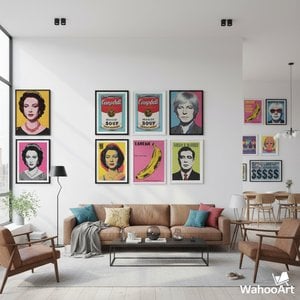
The Genesis of Pop: From Post-War Rebellion to Artistic Innovation
 Just what is it that makes today’s homes so different, so appealing.
Explore Richard Hamilton’s iconic 'Just What Is It?' collage! A groundbreaking Pop Art masterpiece blending surrealism & consumer culture. Discover its symbolism and historical significance.
The mid-20th century witnessed a seismic shift in the art world, a deliberate turning away from the introspective depths of Abstract Expressionism towards the vibrant, often brash realities of popular culture. This wasn’t merely a change in subject matter; it was a fundamental questioning of what constituted ‘art’ itself. Emerging simultaneously in Britain and the United States, Pop Art arose as a direct response to the burgeoning consumer society that followed World War II – an era defined by mass production, advertising, and the rise of celebrity. Before Warhol's soup cans and Lichtenstein’s comic panels, however, lay a crucial intellectual foundation laid by artists like Eduardo Paolozzi in London. His 1947 collage, *I Was a Rich Man’s Plaything*, is often cited as the first true Pop Art work, containing the nascent spark of the movement – the word “Pop!” bursting forth from a chaotic assemblage of American magazine imagery. This wasn't simply an aesthetic choice; it was a provocation, a challenge to the established hierarchies of taste and artistic value.
The Independent Group, Paolozzi’s collective in London, engaged in rigorous discussions about the impact of mass media on post-war life. They weren’t celebrating consumerism *per se*, but rather dissecting its power, analyzing how advertising manipulated desires and shaped perceptions. This critical distance is often overlooked when Pop Art is reduced to a simple embrace of kitsch. Simultaneously, across the Atlantic, artists like Jasper Johns and Robert Rauschenberg were beginning to incorporate everyday objects – flags, targets, newspapers – into their work, blurring the lines between painting and sculpture, art and life. These early explorations paved the way for the explosion of Pop Art in the 1960s.
Key Figures & Defining Techniques: Warhol, Lichtenstein, Paolozzi & Beyond
 Sir Eduardo Paolozzi
Discover Eduardo Paolozzi (1924-2005), Scottish Pop Art pioneer! Explore his innovative sculptures, prints & collages inspired by technology and post-war culture.
While many artists contributed to the movement’s development, a handful became synonymous with its aesthetic and philosophical core. Andy Warhol, perhaps the most recognizable figure of Pop Art, transformed mundane objects like Campbell's Soup cans and Coca-Cola bottles into iconic symbols of American consumerism. His silkscreen printing technique – borrowed from commercial production – allowed for mass replication, further emphasizing the movement’s engagement with industrial processes. Roy Lichtenstein, on the other hand, appropriated imagery directly from comic books, meticulously recreating Ben-Day dots and bold outlines to create paintings that simultaneously celebrated and critiqued popular narrative forms. His work wasn't simply a reproduction of comics; it was an examination of their visual language, their emotional impact, and their role in shaping American culture.
Eduardo Paolozzi continued to explore the intersection of technology and mass media through sculpture and printmaking, often incorporating fragmented imagery and futuristic themes. Beyond these central figures, artists like James Rosenquist employed billboard painting techniques on a grand scale, creating visually arresting compositions that reflected the overwhelming bombardment of advertising in modern life. A defining characteristic across all Pop Art practices was the use of mechanical reproduction – silkscreening, lithography, collage – which challenged the traditional notion of artistic authorship and originality. This wasn’t about technical skill in the conventional sense; it was about embracing the aesthetics of mass production and questioning the very definition of ‘the artwork.’
Pop Art's Critique of Consumer Culture: Irony, Appropriation & Mass Media
Pop art is an art movement that emerged in the United Kingdom and the United States during the mid- to late 1950s. The movement presented a challenge to traditions of fine art by including imagery from popular and mass culture, such as advertising, c...
To label Pop Art as simply a celebration of consumerism is to fundamentally misunderstand its complexities. While the movement undeniably engaged with the imagery of advertising, packaging, and celebrity culture, it did so with a critical eye. Irony was a key tool – artists often presented these images in a detached, almost clinical manner, forcing viewers to confront their own relationship with consumer goods. Appropriation, the act of borrowing imagery from existing sources, was central to Pop Art’s methodology. By taking familiar images out of context and re-presenting them as art, artists challenged notions of originality and authorship.
The sheer volume of mass media – television commercials, magazine advertisements, comic books – became a source of inspiration and subject matter. Artists weren't necessarily endorsing these images; they were reflecting the pervasive influence of consumer culture on everyday life. Consider Lichtenstein’s *Thinking of Him*, a poignant depiction of unrequited love rendered in the style of a comic book panel. The Ben-Day dots, while visually striking, also serve as a reminder of the mechanical reproduction process and the artificiality of emotional representation. Pop Art held up a mirror to society, revealing its obsessions, contradictions, and anxieties.
Global Impact and Regional Variations: British Pop vs. American Pop
 Roy Lichtenstein
Roy Lichtenstein (1923-1997): Pioneering Pop Artist famed for Ben-Day dots, comic strip inspiration & bold commentary on consumer culture. Explore 'Whaam!' & more.
While both Britain and the United States served as fertile ground for the development of Pop Art, distinct regional variations emerged. British Pop, rooted in the intellectual inquiries of the Independent Group, often exhibited a more critical and detached perspective on American culture. Artists like Richard Hamilton dissected the seductive power of advertising and consumerism from a distance, analyzing its impact on British society. There was a sense of observing an external force – America’s cultural dominance – rather than being fully immersed in it.
American Pop, conversely, was more directly engaged with the realities of American life. Warhol's silkscreens of celebrities and consumer products reflected the obsession with fame and mass consumption that characterized post-war America. Lichtenstein’s comic book paintings tapped into a distinctly American vernacular – the visual language of popular narrative forms. The scale of American Pop Art was also often larger, reflecting the expansive nature of American culture itself. While both branches shared common themes and techniques, their approaches differed significantly, shaped by their respective cultural contexts.
The Enduring Legacy of Pop Art: Influence on Contemporary Artists & Design
Pop Art’s influence continues to resonate in contemporary art and design today. Its embrace of appropriation, its challenge to traditional artistic hierarchies, and its engagement with popular culture have paved the way for countless artists working across a wide range of media. From Jeff Koons’s large-scale sculptures to Takashi Murakami’s vibrant anime-inspired paintings, Pop Art’s legacy is evident in the work of numerous contemporary artists.
Beyond the art world, Pop Art has had a profound impact on graphic design, fashion, and advertising. Its bold colors, iconic imagery, and playful aesthetic continue to be widely employed in commercial contexts. The movement's emphasis on accessibility and its rejection of elitism have also contributed to a broader democratization of art – making it more approachable and relevant to wider audiences. Pop Art wasn’t just an artistic style; it was a cultural phenomenon that continues to shape our visual landscape.
At WahooArt.com, we celebrate the enduring power of Pop Art by offering high-quality reproductions of iconic works by Warhol, Lichtenstein, Paolozzi and others. Explore our collection today and discover how these groundbreaking artists continue to inspire and challenge us. From custom paintings tailored to your specifications to museum-quality prints, we bring the vibrancy and energy of Pop Art into your home.