The Dawn of American Impressionism: A Break from Tradition
Following the Civil War, a sense of unprecedented international political and economic confidence swept through the United States. This burgeoning national identity found expression not only in literature and music but also, profoundly, in art. While European artistic movements had long held sway, a distinctly American voice began to emerge in painting during the late 19th century – one that would become known as American Impressionism. It wasn’t simply a wholesale adoption of French techniques; rather, it was a nuanced adaptation, filtered through the unique landscapes and societal values of a rapidly changing nation. Artists, initially trained in the established academic traditions, began to question the rigid constraints imposed upon them, seeking instead to capture the fleeting moments of modern life with an emphasis on light, color, and personal perception.
The initial exposure to Impressionism came through exhibitions showcasing works by French masters like Monet, Renoir, and Degas. These displays, particularly those organized in Boston and New York in the 1880s, ignited a spark of curiosity – and sometimes controversy – among American audiences. While some were captivated by the vibrancy and freshness of the style, others found it unsettlingly loose and unfinished compared to the meticulously detailed paintings they were accustomed to. Nevertheless, the seeds of change had been sown, prompting a generation of artists to embark on their own explorations of Impressionist principles.
En Plein Air & The Pursuit of Light in the New World
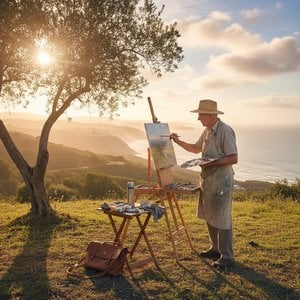
En plein air (pronounced [ɑ̃ plɛ.n‿ɛʁ]; French for 'outdoors'), or plein-air painting, is the act of painting outdoors. This method contrasts with studio painting or academic rules that might create a predetermined look. The theory of 'En plein air' ...
Central to the Impressionist ethos was the practice of en plein air, or painting outdoors. This revolutionary approach, championed by figures like Pierre-Henri de Valenciennes, allowed artists to directly observe and record the ever-shifting effects of light and atmosphere on their surroundings. For American painters, this meant venturing beyond the confines of studios and embracing the vastness and diversity of the American landscape. From the bustling parks of New York City, as captured by William Merritt Chase, to the serene countryside of Pennsylvania and Connecticut, artists sought to translate the immediacy of experience onto canvas.
The invention of portable paint tubes further facilitated this shift towards outdoor painting, enabling artists to work with greater freedom and spontaneity. However, simply replicating French scenes wasn’t the goal. American Impressionists adapted the technique to their own environment, focusing on uniquely American subjects – the shimmering light on coastal waters, the vibrant hues of autumn foliage, and the quiet domesticity of middle-class life. This pursuit of capturing “the fleeting moment” required a new sensitivity to color mixing, brushwork, and composition, prioritizing visual sensation over precise representation.
Key Figures: Pioneering Artists of the American Scene
Several artists stand out as pivotal figures in the development of American Impressionism. William Merritt Chase, often considered the first major American painter to embrace the style, paved the way with his luminous depictions of urban life and landscapes. Mary Cassatt, though spending much of her career in France, played a crucial role in introducing Impressionist principles to American patrons and collectors through her connections and advocacy. Childe Hassam, captivated by the light and atmosphere of New England, became renowned for his evocative paintings of coastal scenes and cityscapes.
Beyond these prominent names, artists like Theodore Robinson, Guy Rose, and John Henry Twachtman each contributed unique perspectives to the movement. Robinson’s work often reflected a poetic sensibility, while Rose masterfully captured the serene beauty of Giverny – a testament to the enduring influence of French Impressionism. Twachtman, known for his atmospheric landscapes, explored the subtle nuances of light and color with remarkable sensitivity. These artists, along with many others, collectively shaped the distinctive character of American Impressionism.
Beyond Landscapes: Domestic Life and Portraiture in American Impressionism
While landscape painting was a dominant theme, American Impressionists also turned their attention to scenes of domestic life and portraiture. Unlike their European counterparts who often depicted working-class subjects, American artists frequently focused on the quiet moments of middle-class existence – families enjoying leisure time, women engaged in everyday activities, and intimate portraits that captured the personality and character of their sitters. Maurice Brazil Prendergast’s “Handkerchief Point,” for example, beautifully illustrates this focus on joyful glimpses of leisure and nature.
This emphasis on domesticity reflected the values and aspirations of a growing American middle class – a desire for comfort, stability, and connection with family and community. Artists like Cassatt further challenged traditional gender roles through their depictions of women in intimate settings, portraying them as independent individuals rather than simply objects of beauty or symbols of virtue. Henry Ossawa Tanner’s “Country Road in France” exemplifies the serene beauty found within rural life, a theme resonating deeply with audiences seeking respite from the rapid pace of industrialization.
American Impressionism vs. Post-Impressionism: A Comparative Study
As American Impressionism flourished, it inevitably encountered the emerging currents of Post-Impressionism. While both movements shared a rejection of academic realism and an emphasis on subjective experience, they differed significantly in their approach to form, color, and composition. Post-Impressionists like Cézanne, Van Gogh, and Gauguin sought to move beyond the purely optical effects of Impressionism, exploring more abstract qualities and symbolic content.
American artists were not immune to these influences. Some experimented with pointillist techniques, while others embraced a more structured approach to composition inspired by Cézanne. However, American Impressionism largely retained its focus on capturing the fleeting moments of light and atmosphere, even as it incorporated elements of Post-Impressionist expression. This unique blend resulted in a style that was both vibrant and lyrical, characterized by visible brushstrokes, pure color, and a deep appreciation for the beauty of the natural world.
The Enduring Legacy & Modern Interpretations of a Beloved Style
Though its period of peak activity spanned only a few decades, American Impressionism left an indelible mark on the history of art. Its influence can be seen in subsequent movements such as Abstract Expressionism and Color Field painting, which continued to explore the expressive potential of color and form. Today, American Impressionist paintings are highly sought after by collectors and museums alike, prized for their beauty, vibrancy, and historical significance.
At WahooArt, we celebrate the enduring legacy of American Impressionism by offering high-quality reproductions of masterpieces from this beloved period. Whether you’re seeking a stunning landscape to adorn your home or a thoughtful gift for an art enthusiast, our collection provides access to the beauty and inspiration of these remarkable works. Explore our selection today and discover the captivating world of American Impressionism – a testament to the power of light, color, and personal vision.