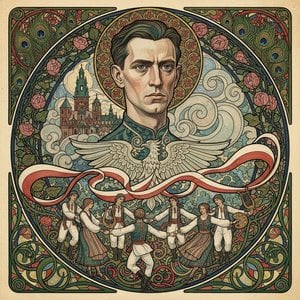
Kazimierz Stabrowski (1869-1929): A Dreamer of Symbolism
Kazimierz Stabrowski, a luminary of Polish art and thought, was born in Kruglany near Nowogródek, Belarus, on November 21, 1869. His familial roots lay deep within the Polish landed gentry (*ziemiaństwo*), shaping his worldview and fostering an appreciation for tradition alongside artistic ambition. From a young age, Stabrowski demonstrated exceptional talent, propelling him towards studies at Białystok’s Real School before embarking on a transformative journey to St Petersburg's Imperial Academy of Arts in 1887. There, under the tutelage of Pavel Chistyakov and later Ilya Repin, he honed his skills and absorbed the intellectual currents of his time—a period marked by burgeoning Symbolism and Romantic idealism.Artistic Style and Notable Works
Stabrowski’s artistic vision distinguished itself through a profound preoccupation with symbolism and emotion. He eschewed mere representation, striving instead to convey intangible concepts and moods – a characteristic that would define his oeuvre for decades to come. Perhaps his most iconic creation is *The Snow Maiden* (1891), a masterpiece of Symbolist painting that captures the ethereal beauty of winter landscapes while simultaneously exploring themes of melancholy and spiritual yearning. This artwork exemplifies Stabrowski’s ability to infuse visual imagery with psychological depth, resonating powerfully with audiences even today. Beyond this singular achievement, Stabrowski produced numerous other evocative pieces—including *Trees* (47 x 63 cm), a pastel that embodies the spirit of Romanticism—demonstrating his versatility and unwavering commitment to artistic experimentation.Founding the Theosophical Society in Poland
Stabrowski’s intellectual curiosity extended far beyond the realm of painting, influencing him to establish the first lodges of the Theosophical Society in Poland. This pivotal undertaking reflected his belief in esoteric knowledge and spiritual enlightenment—a conviction that would shape his personal life and artistic endeavors. Joining forces with Rudolf Steiner and other prominent thinkers, Stabrowski fostered a vibrant intellectual community dedicated to exploring universal truths and challenging conventional dogma. His involvement in this movement underscored his multifaceted character as an artist and humanist.A Legacy Etched in Polish Art
Kazimierz Stabrowski passed away peacefully in Garwolin, Poland, on June 10, 1929. Though his life was tragically curtailed, his influence endured—leaving an indelible mark on the landscape of Polish art and culture. He served as director of Warsaw’s Academy of Fine Arts until 1909, nurturing a new generation of artists and shaping the artistic sensibilities of his era. His works continue to inspire admiration for their lyrical beauty and symbolic richness, securing his place among Poland's most celebrated painters—a testament to his enduring contribution to the visual arts.Museums Featuring Stabrowski’s Art
Several notable artworks by Kazimierz Stabrowski are housed in Lithuanian Art Fund (Vilnius), Lithuania. Explore these treasures and immerse yourself in the captivating world of Polish Symbolism!Domande e risposte
Posso esplorare le opere di Kazimierz Stabrowski in base allo spettro dei colori?
Le opere di Kazimierz Stabrowski possono essere esplorate per colore nella pagina Indice dei colori dell'artista.
Posso sfogliare le opere di Kazimierz Stabrowski in base alla palette di colori?
La pagina Per palette di colori raggruppa le opere di Kazimierz Stabrowski in base alle loro palette di colori.
Dove posso esplorare le opere di Kazimierz Stabrowski suddivise per soggetto?
L'Catalogo per soggetti di Kazimierz Stabrowski è una pagina che organizza le opere dell'artista in base ai loro soggetti.