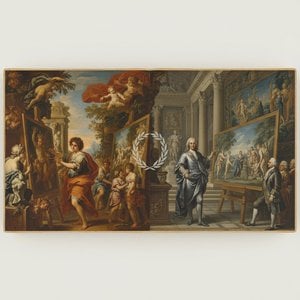
Jacopo Guarana (1720 – 1808): The Last Tiepolesque Heir
Jacopo Guarana, born in Verona in 1720, stands as a poignant emblem of the waning grandeur of Venetian Baroque art. He emerged from the shadow of Giovanni Battista Tiepolo’s legacy—a tradition he diligently upheld and subtly adapted—establishing himself as one of the foremost fresco painters of his time and securing a place among the most respected artists of his era. His artistic journey was marked by meticulous study under Ricci and Tiepolo, shaping him into a craftsman deeply rooted in Venetian stylistic conventions yet possessing an individual vision that distinguishes him from his predecessors.
Early Life and Artistic Training
Guarana’s formative years were spent absorbing the techniques and philosophies of celebrated masters like Sebastiano Ricci and Giovanni Battista Tiepolo. Ricci's influence instilled in Guarana a profound understanding of disegno—the careful observation and rendering of natural forms—a cornerstone of Venetian artistic excellence. Simultaneously, Guarana embraced Tiepolo’s expansive compositional approach and masterful use of illusionistic painting, techniques that would become hallmarks of his own oeuvre. This dual mentorship ensured he was equipped with the foundational skills necessary to navigate the complexities of Baroque artistry. He began his artistic training in Venice under Ricci and Tiepolo, absorbing their stylistic precepts and mastering the art of disegno—a meticulous attention to detail and accurate representation of nature—essential for achieving Venetian artistic grandeur.
Notable Commissions and Artistic Output
Guarana's prolific career yielded a remarkable body of work spanning across Venice and its surrounding territories. He undertook prestigious commissions for prominent Venetian families, notably decorating Ca’ Rezzonico and San Tomà churches with monumental frescoes that showcased his technical prowess and artistic sensibility. His involvement in the Villa Contarini at Cinto Euganeo and the Villa Pisani at Stra further cemented his reputation as a versatile artist capable of adapting to diverse architectural contexts. Among his most celebrated achievements are the ceiling paintings in the Concert Hall of the Ospedaletto, where he collaborated with Agostino Mengozzi Colonna, demonstrating an exceptional command of quadratura—the art of creating illusionistic architectural space—a technique perfected by Tiepolo himself. The Palazzo Balbi, Palazzo Boldù and Palazzo Mocenigo also benefited from his artistic intervention. Guarana’s frescoes are characterized by luminous colors—particularly blues and golds—applied with remarkable precision, capturing atmospheric effects and conveying profound emotional depth. He skillfully employed hatching and shading techniques to achieve textural realism, mirroring the Venetian aesthetic of his time.
Style and Technique: A Delicate Balance
Guarana’s style embodies a harmonious blend of Venetian Baroque tradition and subtle innovation. Unlike the flamboyant grandeur often associated with Tiepolo's work, Guarana favored a more restrained palette and meticulous attention to detail. His frescoes are characterized by luminous colors—particularly blues and golds—applied with remarkable precision, capturing atmospheric effects and conveying profound emotional depth. He skillfully employed hatching and shading techniques to achieve textural realism, mirroring the Venetian aesthetic of his time. The etching “A Youth With A Velvet Beret” exemplifies Guarana’s refined artistic sensibilities and demonstrates a masterful grasp of graphic art.
Legacy and Historical Significance
Jacopo Guarana's contribution to Venetian art is undeniable. He represents the final vestige of Tiepolesque artistry—a style that had dominated Venetian painting for decades prior to his emergence. His work serves as a testament to the enduring power of artistic heritage and underscores the importance of preserving traditions while embracing stylistic evolution. Guarana’s son, Vincenzo Guarana, continued the family artistic legacy, ensuring that the Guarana name remained synonymous with excellence in Venetian art. He is remembered not merely as a painter but as a custodian of a bygone era—a figure whose artistry continues to inspire admiration and scholarly inquiry.