Early Life and Artistic Beginnings
Charles Henry Buckius Demuth, born on November 8, 1883, in Lancaster, Pennsylvania, was a figure deeply intertwined with the spirit of his hometown. His early life unfolded within the historic brick row house at 120 East King Street, a building that had served as a tavern during its colonial days and remained the family’s home for generations. This unique setting—a blend of history and everyday life—would profoundly shape Demuth's artistic vision. He received his initial education at Franklin & Marshall Academy before pursuing further studies at Drexel University and, crucially, the Pennsylvania Academy of Fine Arts in Philadelphia. It was during his time at PAFA that he encountered William Carlos Williams, a poet whose work would become a significant source of inspiration for Demuth’s art. Their friendship fostered a shared appreciation for observation, detail, and the beauty found in the ordinary—a foundation upon which Demuth's distinctive style would be built. The challenges of his physical health, including a childhood illness and later diabetes, subtly influenced his artistic choices, leading him to focus on subjects that could be rendered with meticulous precision and emotional depth.The Rise of Precisionism
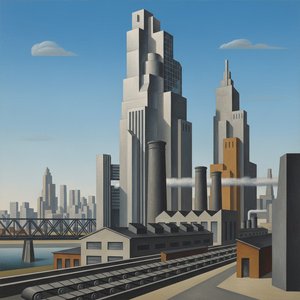
Demuth’s artistic journey truly took shape after his return from Paris, where he immersed himself in the vibrant avant-garde art scene. He studied at Académie Colarossi and Académie Julian, absorbing the innovative techniques and philosophies of European modernism. However, it was upon returning to America that Demuth developed his own unique style—Precisionism. This movement, emerging in the early 20th century, sought to capture the essence of American industrial life with a remarkable clarity and objectivity. Unlike Impressionism’s focus on fleeting moments of light and color, Precisionism employed sharp lines, flat planes of color, and a deliberate lack of figures to depict urban and rural landscapes—bridges, factories, grain elevators, and other symbols of America's burgeoning industry. Demuth’s work became synonymous with this style, reflecting his deep connection to Lancaster and its industrial heritage. His paintings weren’t merely representations of these structures; they were meditations on their form, texture, and the energy they embodied.Notable Works and Artistic Themes
Among Demuth's most celebrated works is *The Figure Five in Gold*, a painting inspired by William Carlos Williams’ poem of the same name. This iconic piece exemplifies Precisionism’s distinctive aesthetic—a carefully constructed composition of geometric shapes and bold colors that evoke a sense of both order and dynamism. Other notable paintings include *Tree Forms 1916*, which captures the intricate details of a tree trunk, and a series of “Poster Portraits” dedicated to prominent writers and artists of his time. These portraits weren’t simply likenesses; they were symbolic representations, imbued with layers of meaning and reflecting Demuth's personal relationships and artistic philosophies. His work frequently explored themes of industrialization, urban life, and the relationship between humanity and nature—often juxtaposing the stark geometry of factories with the organic forms of trees and flowers. The use of color was particularly significant, with Demuth employing a limited palette of muted tones to create a sense of quiet intensity and understated beauty.Legacy and Enduring Influence
Charles Demuth’s contributions to American art are undeniable. He played a pivotal role in introducing European modernism to the United States, shaping the course of 20th-century painting. His meticulous attention to detail, his innovative use of color, and his unique perspective on industrial landscapes have left an enduring legacy. The Demuth Museum, located in his childhood home in Lancaster, Pennsylvania, serves as a testament to his life’s work and continues to inspire visitors with its collection of paintings, drawings, and photographs. His influence can be seen in the works of subsequent generations of American artists, who continue to explore themes of industrialization, urbanity, and the beauty found in everyday objects. Demuth's art remains a powerful reminder of the transformative potential of observation, precision, and artistic vision—a legacy that continues to resonate today.Domande e risposte
Di dove è Charles Demuth?
Charles Demuth è nato/a in Stati Uniti d'America.
Posso sfogliare le opere di Charles Demuth in base all'umore?
La Stanze d'atmosfera di Charles Demuth è una pagina che organizza le opere dell'artista in base all'umore.
Posso ordinare le opere di Charles Demuth per colore?
L'indice spettrale di Charles Demuth, consultabile tramite Indice Spettrale, è una pagina che organizza le opere dell'artista in base ai loro colori.
Quali sono il luogo e l'anno di nascita di Charles Demuth?
Charles Demuth è nato a Lancaster nel 1883.
È disponibile un tour virtuale 3D delle opere di Charles Demuth?
È possibile effettuare una visita virtuale: la pagina Museo 3D di Charles Demuth presenta le opere dell'artista in una galleria tridimensionale.
In quale periodo storico ha operato Charles Demuth?
Charles Demuth ha operato nel periodo Età Moderna. Tale epoca colloca storicamente l'attività dell'artista.
In quale città e in quale paese è nato/a Charles Demuth?
Charles Demuth è nato a Lancaster, in Stati Uniti d'America.