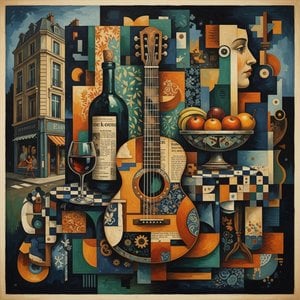
Violin by Pablo Picasso
Pablo Picasso, one of the most influential artists of the 20th century, captivated audiences worldwide with his groundbreaking vision of art and reality. Among his prolific oeuvre stands “Violin,” a seminal work born from the crucible of Synthetic Cubism—a movement that irrevocably altered the course of modern artistic expression. This painting transcends mere representation; it’s an invitation to delve into Picasso's intellectual exploration of form, color, and perception.
Background and Context: The Birth of Synthetic Cubism
Synthetic Cubism emerged in the early 1910s as a radical departure from its predecessor, Proto-Cubism. Spearheaded by Picasso and Georges Braque, this artistic revolution sought to dismantle traditional perspective and embrace fragmentation—a technique inspired by Cézanne’s explorations of volume and spatial relationships. Artists aimed to depict subjects simultaneously from multiple viewpoints, creating an illusionistic effect that defied conventional visual conventions. The goal wasn't to reproduce the world faithfully but rather to convey its essence through geometric abstraction.
Composition and Elements: A Dialogue Between Planes
Measuring 46 x 38 cm, “Violin” is executed with meticulous precision using collage techniques—a hallmark of Synthetic Cubism. At first glance, the painting presents a violin dominating the central space, its neck extending upwards towards the upper right corner as if striving for elevation. However, this seemingly straightforward arrangement conceals a complex interplay of intersecting planes and textures. Below the violin lies a boat, rendered in muted tones—a deliberate contrast that underscores the fragmentation inherent in the style. Scattered throughout the canvas are additional elements: cups positioned near the lower left and center, a bottle subtly integrated into the mid-left area, and a bowl strategically placed on the upper right side. These objects aren’t merely decorative; they contribute to the overall visual dynamism and reinforce the concept of simultaneous viewpoints.
Artistic Movement: Challenging Conventions
Synthetic Cubism represented a decisive step away from earlier artistic movements—particularly Impressionism and Neo-Impressionism—which prioritized capturing fleeting moments of light and color. Instead, Picasso and Braque embraced geometric abstraction as a means of conveying emotion and intellectual thought. The resulting artworks are characterized by flattened surfaces, simplified forms, and the use of bold colors—often juxtaposed in unexpected combinations—to create an arresting visual experience. This stylistic innovation profoundly influenced subsequent artistic trends, paving the way for movements like Orphism and Surrealism.
Artist's Influence: Picasso’s Legacy
Pablo Picasso (1881-1973) remains arguably the most recognizable artist of the 20th century—a titan whose impact on art history is undeniable. His relentless experimentation with diverse mediums—painting, sculpture, printmaking, ceramics—established him as a visionary innovator who consistently pushed the boundaries of artistic expression. “Violin,” alongside his numerous other masterpieces, exemplifies Picasso’s unwavering commitment to challenging conventions and redefining aesthetic standards. It stands as a testament to his genius and continues to inspire artists and collectors alike.
Pablo Picasso: Violin is available for viewing on WahooArt. To learn more about Synthetic Cubism and its influence on modern art, refer to the following resources:
-
Synthetic Cubism Art Movement
-
Cubism
Domande e risposte
In che modo "Violin" si inserisce nei temi e nello stile di Pablo Picasso?
"Violin" appartiene all'opera Synthetic Cubism di Pablo Picasso, i cui temi ricorrenti includono geometric abstraction, european avant-garde, formal experimentation, picasso’s stylistic evolution, cubist innovation.
Come posso acquistare una stampa di "Violin" di Pablo Picasso?
Per ordinare una stampa di "Violin" di Pablo Picasso, ti basta procedere con l'ordine su questa pagina: una stampa fine art su tela di cotone o carta canvas d'archivio.
Quale tecnica è stata utilizzata per "Violin" e quando è stata realizzata?
"Violin" è stata realizzata nel 1912, con la tecnica Collage.
Posso vedere una vista ai raggi X di "Violin" di Pablo Picasso?
La pagina Raggi X di "Violin" di Pablo Picasso è un visualizzatore interattivo che permette di scorrere tra undici livelli ottici dell'immagine dell'opera, inclusa una vista in stile raggi X.
Quale uso e quale spazio si consigliano per "Violin" di Pablo Picasso?
L'uso (Accento cromatico) e lo spazio (Zona giorno) sono le due raccomandazioni indicate per "Violin" di Pablo Picasso.
In quale anno e all'interno di quale movimento è stata realizzata "Violin"?
"Violin" è stata realizzata nel 1912, all'interno del movimento Synthetic Cubism.
A quale fase della carriera di Pablo Picasso corrisponde la data del 1912 di "Violin"?
"Violin", realizzata nel 1912, appartiene al Synthetic Cubism della carriera di Pablo Picasso.
"Violin" di Pablo Picasso è un dipinto, un disegno o una stampa?
"Violin" è un'opera di tipo Opere da parete.



 Anteprima in scala reale
 Passa alle stampe
 Condividi
 Condividi
 Dettagli
 Guida stampabile

 Scarica
 Articoli simili
 Radiografia
 Slideshow
 Statistiche


 Leggi tutto






































 L'opzione vetro è disponibile solo per dimensioni inferiori a 110 cm