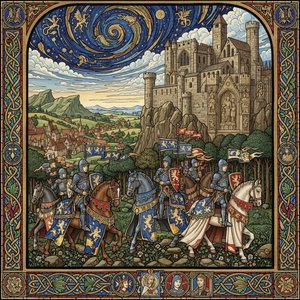
The Dual Reign: Magnus Sigurdsson and Sigurd Haraldsson – Kings Amidst Civil Strife
The 12th century in Norway was a period defined by fractured loyalties, ambitious claimants, and the relentless pursuit of power. At the heart of this tumultuous era stood two figures inextricably linked: Magnus Sigurdsson, known as Magnus the Blind, and Sigurd Haraldsson, often called Sigurd Munn. Though reigning at different times – and sometimes concurrently – their stories are interwoven, representing a pivotal chapter in Norwegian history and the dawn of its prolonged civil war period. Born in Oslo around 1115, both were sons of Harald Gille, a king whose own ascent to the throne was steeped in controversy, and his mistress Thora Guttormsdotter. This unconventional parentage would cast a long shadow over their claims and fuel much of the conflict that characterized their lives.
Early Lives and Contested Claims
Magnus Sigurdsson’s early life remains somewhat shrouded in historical ambiguity, but it is clear he was recognized as a legitimate heir by Harald Gille. Upon his father's death, Magnus ascended to the throne in 1130. However, his reign was immediately challenged by rival claimants, most notably Inge Haraldsson, another son of Harald Gille. The ensuing years were marked by shifting alliances and brutal skirmishes, with Magnus struggling to maintain control amidst a deeply divided kingdom. He faced accusations of illegitimacy, skillfully countered through displays of power and strategic political maneuvering. Sigurd Haraldsson’s early life was similarly fraught with uncertainty. While acknowledged as Harald Gille's son, he initially played a less prominent role in the succession struggles. It wasn’t until after Magnus’ initial deposition in 1135 that Sigurd began to assert his own claim, capitalizing on the instability and forging alliances of his own.
A Kingdom Divided: Reign and Rivalry
The period between 1130 and 1155 witnessed a complex interplay of power struggles, betrayals, and temporary truces. Magnus was restored to the throne in 1137, but his second reign proved equally precarious. He shared the kingship with Inge Haraldsson, an uneasy co-existence that ultimately collapsed into renewed conflict. Sigurd, meanwhile, steadily consolidated his own position, gaining support from powerful regional chieftains and skillfully exploiting the weaknesses of his rivals. In 1136, he was crowned king, initiating a period of parallel rule alongside Magnus and Inge. This tripartite kingship was unprecedented and inherently unstable, reflecting the deep fissures within Norwegian society. The lack of a clear, undisputed heir created a vacuum that ambitious lords readily exploited, transforming Norway into a battleground for personal gain.
The Legacy of Conflict: Shaping Medieval Norway
Neither Magnus Sigurdsson nor Sigurd Haraldsson achieved absolute dominance during their reigns. Their periods as kings were characterized by constant negotiation, military campaigns, and the forging – and breaking – of alliances. While they lacked the long-term stability enjoyed by some of their predecessors, their struggles had a profound impact on the development of medieval Norway. The prolonged civil war era that began during their time fundamentally altered the political landscape, weakening central authority and empowering regional lords. The concept of shared kingship, though ultimately unsuccessful, represented an attempt to address the challenges of succession in a fragmented kingdom. Their reigns also saw increased reliance on birkebeiners and baglers – two factions that emerged during the civil wars, further complicating the political situation. The constant warfare led to significant social disruption, economic hardship, and a decline in royal prestige.
Historical Significance and Enduring Impact
Magnus Sigurdsson died in 1139, leaving behind a kingdom teetering on the brink of chaos. Sigurd Haraldsson continued to rule until his death in 1155, navigating the treacherous political waters with considerable skill but ultimately failing to resolve the underlying conflicts. Their legacy is not one of glorious victories or peaceful consolidation, but rather of prolonged strife and the erosion of royal power. However, their struggles laid the groundwork for the eventual unification of Norway under more capable rulers in the following decades.
They represent a critical transition period in Norwegian history.
Their reigns highlight the challenges of succession and maintaining authority in a decentralized kingdom.
The emergence of birkebeiners and baglers during their time had lasting consequences for Norwegian politics.
They are remembered as figures who, despite their best efforts, could not prevent Norway from descending into a prolonged period of civil war.
The stories of Magnus Sigurdsson and Sigurd Haraldsson serve as a potent reminder of the fragility of power and the enduring impact of internal conflict on the course of history. Their dual reign, though marked by turmoil, remains a fascinating and crucial chapter in the saga of medieval Norway.
Embark on a visual journey through Early Medieval art. Explore the profound beauty of illuminated manuscripts, sacred symbols, and golden light through an expert historical lens, celebrating the enduring legacy of medieval craftsmanship and divine artistry.
Explore the profound beauty of medieval art through the lens of history. Discover the symbolism of knights, the divine frescoes of Giotto, and how legendary masterpieces continue to inspire modern collectors and lovers of chivalric heritage.
Embark on a scholarly journey through the spiritual grandeur of Late Medieval art. Discover the intricate symbolism, technical mastery, and profound religious narratives that define the Gothic era in this expert-led guide for art enthusiasts and collectors.