The Soldier and the Studio
Johan Per Södermark stands at a crossroads between military duty and the fine arts. Born in Mossebro, Karlsborg Municipality, on 5 June 1822, his early life follows the disciplined path of his father, Olof Johan Södermark. He enters the military as an Underlöjtnant in 1843, a role that demands precision and observation. The rigidity of service defines his youth, yet the brush remains present. His training begins under his father's guidance before moving to the Royal Swedish Academy of Fine Arts, where he achieves the status of agré in 1848.
The year 1848 brings a sudden shift. He resigns from active military service. The death of his father leaves him with more than just a memory; he inherits a studio. At first, Södermark sustains himself through the labor of copying his father's existing works. This period of imitation acts as a bridge, transitioning him from a man of arms to a man of lithography and paint.
Travels and Technical Evolution
Movement defines his artistic development. He moves through the cultural landscapes of Europe, seeking new light and form. His path takes him to France and Italy, followed by stays in Düsseldorf between 1852 and 1854. In Paris, from 1855 to 1856, he studies under Thomas Couture. These travels expand his repertoire beyond the portraits of his early years.
His work begins to diversify into new territories:
- Portraits: Capturing notable figures such as Nils Blommér, Fritz von Dardel, and the composer Bedřich Smetana.
- Landscapes: Moving away from the strictures of portraiture to capture natural scenery.
- Genre Scenes: Depicting everyday life through narrative painting.
- Lithography: Creating prints that frequently feature Italian motifs.
Legacy in Stockholm
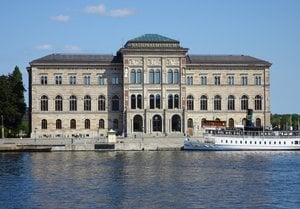
By 1874, Södermark reaches a professional peak as a full member of the Swedish Academy. His presence is felt in major exhibitions, from Copenhagen's Charlottenborg Palace in 1851 to various Nordic Art exhibitions held between 1872 and 1888. He leaves behind a tangible contribution to Swedish collections, having donated his original lithographs to the Nationalmuseum in 1868.
His life concludes in Stockholm on 16 November 1889. While he did not pursue the same level of realistic clarity as his father, his ability to navigate between the roles of officer and artist remains a distinct chapter in Swedish art history. His works remain accessible today through institutions such as the Academy's art gallery, Waldemarsudde, and the Nordic Museum.