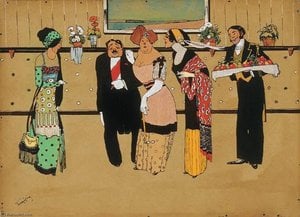
Geza Farago – Hungarian Symbolist Painter
Géza Faragó (1877–1928) was a Hungarian painter and graphic artist who stands as one of the most prominent figures in Hungarian Symbolism. His artistic vision blended influences from Art Nouveau, Japonisme, and Impressionism to create distinctive works that captured both beauty and intellectual depth. Born in Budapest, Faragó’s early life was marked by formal training under Ferenc Újházy, followed by practical experience at a textile factory – experiences that would inform his later artistic endeavors.
Early Artistic Influences & Parisian Years
A pivotal moment arrived in 1898 when Faragó moved to Paris, where he enrolled at Colarossi’s evening classes and studied under Alphonse Mucha. This association proved transformative, immersing him in the vibrant atmosphere of the Art Nouveau movement and fostering a collaborative spirit with Mucha himself. He honed his skills at the Atelier Artistique Delaye and participated in several exhibitions at the Salon in Paris, establishing himself as an emerging talent within the European artistic landscape.
The Impact of Mucha & Japonisme
Faragó’s style was undeniably shaped by Mucha's meticulous attention to detail and decorative elegance—particularly evident in his use of flowing lines, stylized floral motifs, and luminous color palettes. Simultaneously, he embraced the aesthetic principles of Japonisme, incorporating elements of Japanese woodblock prints into his compositions, reflecting a fascination with Eastern artistic traditions. This fusion resulted in artworks characterized by both refined beauty and intellectual contemplation.
Hungarian Poster Art & Propaganda
Faragó’s contribution to Hungarian poster art is unparalleled. He became synonymous with the Symbolist style in Hungary, producing posters that combined humor, caricature, and striking visual impact—a masterful blend of technique and conceptual innovation. During World War I, he tirelessly designed propaganda posters for the Austro-Hungarian army, demonstrating his commitment to artistic expression alongside civic responsibility. His distinctive approach captivated audiences and cemented his legacy as a pioneer of Hungarian graphic design.
Notable Paintings & Legacy
Among Faragó’s celebrated paintings are “Slim Woman with a Cat,” “Paradise Lost,” and “Nakiri”—works that exemplify his stylistic prowess and thematic concerns. These pieces explore themes of mythology, psychology, and social critique, reflecting the intellectual currents of the Symbolist movement. His legacy extends beyond individual artworks; he established a distinctive artistic tradition that continues to inspire artists today. Faragó’s paintings are housed in the Hungarian National Gallery, ensuring his enduring contribution to Hungarian art history.