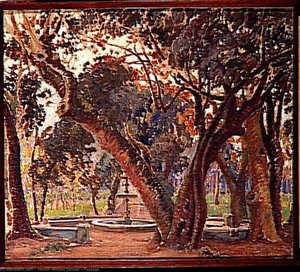
William Samuel Horton: A Painter of Tranquil Landscapes
William Samuel Horton (1865 – 1936) emerged as a prominent figure in American Impressionism, capturing the serene beauty of European-inspired landscapes and water scenes with meticulous detail and luminous color palettes. Born in Grand Rapids, Michigan, Horton’s artistic journey began amidst the burgeoning artistic fervor of his time—a period marked by significant advancements in plein air painting techniques and a fascination with capturing fleeting moments of natural light.- Early Life & Education: Horton received his formative artistic training at Pratt Institute in Brooklyn, New York, where he honed his skills under the tutelage of George Inness III and Frederic Church—luminaries of Hudson River School painting who championed a Romantic sensibility infused with scientific observation. This exposure profoundly shaped Horton’s stylistic preferences, encouraging him to prioritize atmospheric perspective and tonal modulation as core elements of his compositions.
- European Influences: Horton's travels throughout Europe during the late Victorian era proved instrumental in broadening his artistic horizons. Particularly captivated by Impressionist masters like Claude Monet and Camille Pissarro, he absorbed their innovative approaches to color theory and brushwork—techniques that would become hallmarks of his own oeuvre. The Parisian art world exerted a considerable influence on Horton’s aesthetic sensibilities, fostering an appreciation for capturing the ephemeral qualities of light and atmosphere.
Artistic Style & Technique
Horton's artistic style is characterized by a deliberate blend of Hudson River School grandeur with Impressionist subtlety. He skillfully employed loose brushstrokes—often blended to create soft gradations of color—to convey the textures and nuances of natural landscapes, particularly water vistas. His canvases pulsate with vibrant hues derived from direct observation, reflecting the transformative effects of sunlight on foliage and water surfaces. Horton’s meticulous attention to detail—evident in his depiction of reflections, ripples, and subtle tonal variations—underscored his commitment to capturing the essence of a particular moment in time.- Notable Paintings: Among Horton's most celebrated works are “Ritz Tower,” depicting a hazy cityscape bathed in twilight hues; “SOIR D’HIVER A PONTARLIER,” portraying a tranquil winter landscape illuminated by soft moonlight; and “Paysage,” showcasing a panoramic vista of Michigan woodlands. These paintings exemplify Horton’s mastery of Impressionistic technique while retaining an underlying sense of Romantic idealism.
- Hudson River School Legacy: Despite his embrace of Impressionist principles, Horton's artistic heritage remained firmly rooted in the Hudson River School tradition—a movement that championed monumental landscapes infused with moral and spiritual significance. This dual influence contributed to Horton’s distinctive visual language, resulting in paintings that resonate with both grandeur and intimacy.
Museum Collections & Recognition
Horton's artwork resides in prestigious museum collections across the United States and Europe, including The Sir William Dunn School of Pathology and Williams College Museum of Art. His enduring legacy as a painter of serene landscapes continues to inspire admiration for his artistic vision and technical prowess. Furthermore, Horton’s contribution to American Impressionism is acknowledged by art historians who recognize him as one of the movement's foremost practitioners—a testament to his unwavering dedication to capturing the sublime beauty of nature through innovative artistic expression.Historical Significance
William Samuel Horton stands as a pivotal figure in the history of American Impressionism, representing a crucial juncture between Romantic idealism and modern aesthetic sensibilities. His paintings serve as invaluable records of the visual culture of his era—reflecting both the grandeur of European landscapes and the burgeoning fascination with capturing fleeting moments of natural light. Horton’s artistic achievements solidified his place among the most influential painters of the late 19th century, shaping the trajectory of American landscape painting for decades to come.Pitanja i odgovori
Odakle dolazi William Samuel Horton?
William Samuel Horton rođen/a je u United States of America.
Koja su djela umjetnika William Samuel Horton najviše pregledana?
Postoji stranica Statistika posjeta za William Samuel Horton koja prikazuje statistiku o umjetninama tog umjetnika na ovaj web-mjesto.
Postoji li 3D virtualna obilaznost djela umjetnika William Samuel Horton?
Djela umjetnika William Samuel Horton možete pogledati u 3D galeriji na njegovoj stranici 3D galerija.