Théodore Géricault, 1791 – 1824

The 100 Most Famous Paintings by Théodore Géricault

The painting that made Théodore Géricault famous is La Balsa de la Medusa (1818); it hangs in the Louvre, Pariz. Nymph and Satyr (Jupiter and Antiope) (1820) and The Oath of Brutus after the Death of Lucretia (1815) follow it in the hearts of collectors and museum visitors. Of the 183 works by Théodore Géricault in our catalogue, these 100 are the most admired, each presented with its date, its museum and what sets it apart.

Rangirano prema našoj ocjeni popularnosti, koja objedinjuje broj pretraživanja, posjeta i narudžbi za svako djelo. Ažurirano Listopad 2026. Every masterpiece on this page can be ordered as a museum-quality, hand-painted oil reproduction or a fine art print, at the size you choose.

Portret Théodore Géricault
Théodore Géricault · 1791 – 1824
Rođen · umro
1791 – 1824, Rouen
Pokret
Romantic painting
Djela u našem katalogu
183
Najpoznatije
La Balsa de la Medusa (1818)
Najviše djela u
Louvre

Théodore Géricault: the ten masterpieces

La Balsa de la Medusa (1818) od Théodore Géricault
1

La Balsa de la Medusa

1818 · Ulje na platnu · Louvre, Pariz

Jedno Od Najvažnijih Djela Romantične umjetnosti Jean-Louis André Théodore Géricault, ime koje resonira duhom francuske romantike, rođen je u Rouenju 1791. godine među zvukovima revolucije i rastućom silom Napoleonskog snaženja. Iako je naslijedio udoban život kroz obiteljski kapital – uključujući trgovinu tobaca – njegova sudbina nije bila u zakonu ili trgovini već izražavanju umjetnosti. Njegova početna edukacija pod Carle Vernetom, majstorom engleskog sportskog slikarstva, uvješten je anatomijom i pokretanjem, što…

Nymph and Satyr (Jupiter and Antiope) (1820) od Théodore Géricault
2

Nymph and Satyr (Jupiter and Antiope)

1820 · Acrylic On Canvas · Musée des Beaux-Arts et de la Céramique, Rouen

The Allure of the Divine Encounter: Géricault’s *Nymph and Satyr* Jean-Louis André Théodore Géricault's *Nymph and Satyr*, painted in 1819, isn’t merely a depiction of a mythological scene; it’s a profound exploration of desire, transgression, and the inherent tension between innocence and primal instinct. Born amidst the tumultuous backdrop of post-revolutionary France, Géricault, already recognized for his dramatic intensity, sought to capture not just a narrative but an emotional truth—a…

Lions in a Mountainous Landscape (1818) od Théodore Géricault
4

Lions in a Mountainous Landscape

1818 · Acrylic On Canvas · Metropolitan Museum of Art, New York

This vigorous painting of six lions in a remote, spectrally illuminated lair—possibly intended to evoke the Atlas Mountains of Morocco—is an extraordinary example of Gericault’s spontaneous handling of paint. Rather than applying finishing touches to make a polished cabinet picture, the artist left the painting in a state known as an esquisse, or sketch, a work prized by fellow artists for its strength of directly capturing a subject or effect.…

The Kiss (1822) od Théodore Géricault
5

The Kiss

1822 · Acrylic On Canvas · Thyssen-Bornemisza Museum, Madrid

Théodore Géricault's "The Kiss," painted in 1816, isn’t merely a depiction of lovers entwined; it’s a visceral embodiment of the burgeoning Romantic movement’s fascination with raw emotion, dramatic intensity, and the sublime. This arresting work, housed within the Thyssen-Bornemisza Museum in Madrid, transcends simple representation to become a profound meditation on passion, vulnerability, and the very essence of human connection. Géricault, already a figure known for his unflinching portrayals of…

Wounded Soldiers Retrating from Russia (1814) od Théodore Géricault
6

Wounded Soldiers Retrating from Russia

1814 · Acrylic On Canvas · Musée des Beaux-Arts, Rouen

A Symphony of Suffering: Géricault’s “Wounded Soldiers Retrating from Russia” Jean-Louis André Théodore Géricault's "Wounded Soldiers Retrating from Russia" is not merely a painting; it’s a visceral embodiment of the horrors and human cost of war, rendered with an unprecedented level of realism and emotional intensity for its time. Completed in 1814, this monumental canvas—measuring a commanding 250 x 206 cm—captures a pivotal moment during Napoleon's disastrous invasion of Russia,…

Study of Feet and Hands (1818) od Théodore Géricault
7

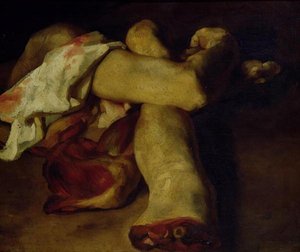
Study of Feet and Hands

1818 · Oil On Canvas · Musée Fabre, Montpellier

Jean-Louis André Théodore Géricault's "Study of Feet and Hands," painted in 1818, isn’t a grand statement of Romantic drama like his monumental “The Raft of the Medusa.” Instead, it offers a profoundly intimate glimpse into the artist’s meticulous process and a poignant meditation on the human form. This unassuming oil painting—measuring a modest 52 x 64 cm—is far more than just a preparatory sketch; it's a concentrated distillation of Géricault’s…

The Raft of the Medusa (detail) (1818) od Théodore Géricault
8

The Raft of the Medusa (detail)

1818 · Oil On Canvas · Louvre, Pariz

Jean-Louis André Théodore Géricault's "The Raft of the Medusa," a monumental detail from his 1818 painting, isn’t merely a depiction of shipwreck; it’s a visceral plunge into the depths of human suffering and political indictment. The scene, rendered with a dramatic intensity characteristic of Romanticism, captures the harrowing aftermath of the French frigate *Medusa*'s wreck off the coast of Mauritania in 1816. This disaster, largely attributed to the incompetence and…

The Wreck (1821) od Théodore Géricault
10

The Wreck

1821 · Oil On Canvas · Louvre, Pariz

Théodore Géricault's "The Wreck," painted in 1821, isn’t merely a seascape; it’s a visceral confrontation with the sublime—a raw depiction of humanity’s vulnerability against the overwhelming force of nature. Born amidst the turbulent currents of post-revolutionary France, Géricault, a figure both lauded and controversial within the burgeoning Romantic movement, channeled his own anxieties and the era's fascination with dramatic events into this monumental canvas. The painting immediately commands attention not…

More Théodore Géricault masterpieces, 11 to 100

The Horse Race (1816) od Théodore Géricault
#11

The Horse Race

1816 · Thyssen-Bornemisza Museum

Jean-Louis André Théodore Géricault's "The Horse Race," painted in 1816, isn’t merely a depiction of a sporting event; it’s a visceral embodiment of Romanticism’s core tenets – passion,…

Bring it home →
Swiss Guard and Wounded Veteran (1819) od Théodore Géricault
#12

Swiss Guard and Wounded Veteran

1819 · Louvre

Jean-Louis André Théodore Géricault's "Swiss Guard and Wounded Veteran," painted in 1819, is not merely a historical depiction; it’s a profound meditation on duty, sacrifice, and the lingering…

Order a reproduction →
Mazeppa (1823) od Théodore Géricault
#13

Mazeppa

1823 · Château de Chantilly

Théodore Géricault's "Mazeppa," painted in 1823, isn’t merely a depiction of a dramatic legend; it’s a visceral embodiment of Romantic turmoil—a raw exploration of suffering, resilience, and the…

Bring it home →
Two Horses (1809) od Théodore Géricault
#14

Two Horses

1809 · The Phillips Collection

Jean-Louis André Théodore Géricault's "Two Horses," painted in 1808-1809, isn’t merely a depiction of two magnificent animals; it’s a visceral exploration of movement, power, and the fleeting nature…

Bring it home →
A Turk (Mustapha) (1820) od Théodore Géricault
#15

A Turk (Mustapha)

1820 · Louvre

Jean-Louis André Théodore Géricault's "A Turk (Mustapha)," painted in 1820, is not merely a portrait; it’s a carefully constructed tableau of exoticism, melancholy, and the burgeoning Romantic sensibility…

Order a reproduction →
A Carabinier with his Horse (1814) od Théodore Géricault
#16

A Carabinier with his Horse

1814 · Musée des Beaux-Arts

In the quiet intensity of Jean-Louis André Théodore Géricault’s 1814 masterpiece, "A Carabinier with His Horse," we encounter more than a mere military portrait; we witness a profound…

Order a reproduction →
Riderless Horse Races (detail) (1817) od Théodore Géricault
#17

Riderless Horse Races (detail)

1817 · Louvre

A Moment Frozen in Time: Géricault’s “Riderless Horse Races” Jean-Louis André Théodore Géricault's "Riderless Horse Races (detail)" is not merely a depiction of a sporting event; it’s a…

Bring it home →
Boxers (1818) od Théodore Géricault
#18

Boxers

1818 · Château de Chantilly

A Tempestuous Vision: Géricault’s “Boxers” Jean-Louis André Théodore Géricault's "Boxers," completed in 1818, isn’t merely a depiction of a boxing match; it’s a visceral embodiment of Romanticism’s fascination…

Order a reproduction →
The Epsom Derby (1821) od Théodore Géricault
#20

The Epsom Derby

1821 · Louvre

Jean-Louis André Théodore Géricault's "The Epsom Derby," painted in 1821, isn’t merely a depiction of horse racing; it’s a visceral embodiment of Romanticism’s fascination with drama, movement, and…

Bring it home →
Three Lovers (1817) od Théodore Géricault
#22

Three Lovers

1817 · J. Paul Getty Museum

Théodore Géricault captured a private, feverish moment in Three Lovers. This small oil sketch, created about 1817–1820, offers a rare glimpse into the artist's more intimate preoccupations. It…

Order a reproduction →
Lion devouring a horse od Théodore Géricault
#26

Lion devouring a horse

Château de Chantilly

Théodore Géricault's "Lion Devouring a Horse," painted in 1819, isn’t merely a depiction of predatory action; it’s a visceral exploration of power, mortality, and the primal instincts that…

Bring it home →
Untitled (ARJCHM) od Théodore Géricault
#28

Untitled (ARJCHM)

Louvre

In the annals of art history, few works command the room with such visceral intensity as Théodore Géricault’s The Raft of the Medusa. This monumental oil on canvas…

Bring it home →
Portrait of a Young Man (1818) od Théodore Géricault
#32

Portrait of a Young Man

1818 · Minneapolis Institute of Art

A young man emerges from a deep, indistinct darkness, his presence felt through the sudden, sharp clarity of light hitting his features. He sits in a quiet, intimate…

Order a reproduction →
A study for a nude. (1801) od Théodore Géricault
#33

A study for a nude.

1801 · Narodni muzej u Varšavi

A study for a nude. emerges from the shadows as a powerful presence by Théodore Géricault. Created about 1801, this oil on canvas captures a singular moment of…

Bring it home →
Study of a Model (1818) od Théodore Géricault
#34

Study of a Model

1818 · J. Paul Getty Museum

This oil on canvas portrait study presents a close-up, three-quarter view of a Black man's head and shoulders. The subject is positioned slightly off-center, looking toward the viewer…

Commission a hand-painted copy →
The Martyrdom of Saint Peter (1814) od Théodore Géricault
#35

The Martyrdom of Saint Peter

1814 · Kunstmuseum Basel

The Martyrdom of Saint Peter is an oil on canvas by Théodore Géricault. Created about 1814, the work captures a moment of profound tension. The physical presence of…

Bring it home →
The Wreck (1824) od Théodore Géricault
#36

The Wreck

1824 · Louvre

In the annals of French Romanticism, few works command the visceral attention of Théodore Géricault’s The Wreck as profoundly as this haunting seascape. Painted in 1824, a year…

Commission a hand-painted copy →
Mater dolorosa, Copy after Ribera (1811) od Théodore Géricault
#38

Mater dolorosa, Copy after Ribera

1811 · Kunstmuseum Basel

Mater dolorosa, Copy after Ribera is a religious oil painting by the French artist Théodore Géricault. Created about 1811–1815, the work reflects the artist's engagement with the traditions…

Bring it home →
Lion in Repose od Théodore Géricault
#39

Lion in Repose

Walters Art Museum

Jean-Louis André Théodore Géricault’s “Lion in Repose,” painted circa 1820-1823, isn’t merely a depiction of an animal; it’s a profound meditation on power, vulnerability, and the very nature…

Order a reproduction →
Portrait of a Negro (1800) od Théodore Géricault
#71

Portrait of a Negro

1800 · Palácio Nacional da Ajuda

Dating from 1800, Jean-Louis André Théodore Géricault’s “Portrait of a Negro” is more than just a depiction of an individual; it’s a poignant statement born from the turbulent…

Bring it home →
Portrait d'homme (1825) od Théodore Géricault
#73

Portrait d'homme

1825 · Musée Fabre

Portrait d'homme is an oil on canvas work attributed to the French Romantic painter Théodore Géricault. While historically categorized under various titles, including a mistaken identification as a…

Commission a hand-painted copy →
Horses of the Auvergne (1822) od Théodore Géricault
#76

Horses of the Auvergne

1822 · University of Michigan Museum of Art

In the quiet, monochromatic depths of Théodore Géricault’s 1822 lithograph, Horses of the Auvergne, we are transported to a rugged, mist-shrouded corner of France. This evocative work serves…

Commission a hand-painted copy →
A Prancing Grey Horse (1812) od Théodore Géricault
#77

A Prancing Grey Horse

1812 · Burrell Collection

A single light grey horse occupies the center of this oil painting, captured in a rearing pose. The animal's body is angled vertically, its muscular flanks and neck…

Bring it home →
Sheet of Figure Studies (1818) od Théodore Géricault
#78

Sheet of Figure Studies

1818 · Courtauld Gallery

To gaze upon Jean-Louis André Théodore Géricault’s "Sheet of Figure Studies" is not merely to look at painted forms; it is to witness the very act of human…

Bring it home →
The Plaster Kiln (1823) od Théodore Géricault
#82

The Plaster Kiln

1823 · Louvre

In the quiet, brooding landscapes of nineteenth-century France, few works capture the raw, unvarnished essence of pastoral life as poignantly as Théodore Géricault’s “The Plaster Kiln.” Completed in…

Order a reproduction →

Théodore Géricault's paintings by period

The subjects Théodore Géricault painted most

The four subjects that return most often among these masterpieces, with the finest example of each.

Where to see Théodore Géricault's paintings

8 muzeja u kojima se nalazi najviše djela s ove stranice.

Muzej Grad Djela autora Théodore Géricault Slike iz ovog popisa
Louvre, ParizLouvre Pariz 20 La Balsa de la Medusa, The Raft of the Medusa (detail), Leda and the Swan
Château de Chantilly, ChantillyChâteau de Chantilly Chantilly 6 Mazeppa, Boxers, Lion devouring a horse
J. Paul Getty Museum, Los AngelesJ. Paul Getty Museum Los Angeles 3 Three Lovers, Study of a Model, The Race of the Riderless Horses
Narodni muzej u Varšavi, VaršavaNarodni muzej u Varšavi Varšava 3 Equestrian portrait of Wincenty Krasiński., A study for a nude., Study of a nude man
Burrell Collection, GlasgowBurrell Collection Glasgow 8 The Trumpeter of the Lancers of the Guard, A Prancing Grey Horse
Musée Fabre, MontpellierMusée Fabre Montpellier 4 Study of Feet and Hands, Portrait d'homme
Petit Palais, ParizPetit Palais Pariz 3 The Scotsman, Italian Landscape with Tomb
Thyssen-Bornemisza Museum, MadridThyssen-Bornemisza Museum Madrid 2 The Kiss, The Horse Race

Théodore Géricault, decade by decade: the defining painting of each

  1. 1800s
    Two Horses (1809) od Théodore Géricault
    Rank 14 / 100

    Two Horses

    Godine 9 – 18 · The Phillips Collection

    Jean-Louis André Théodore Géricault's "Two Horses," painted in 1808-1809, isn’t merely a depiction of two magnificent animals; it’s a visceral exploration of movement, power, and the fleeting nature…

  2. 1810s
    La Balsa de la Medusa (1818) od Théodore Géricault
    No. 1 of 100

    La Balsa de la Medusa

    Godine 19 – 28 · Louvre

    Jedno Od Najvažnijih Djela Romantične umjetnosti Jean-Louis André Théodore Géricault, ime koje resonira duhom francuske romantike, rođen je u Rouenju 1791. godine među zvukovima revolucije i rastućom silom…

  3. 1820s
    Nymph and Satyr (Jupiter and Antiope) (1820) od Théodore Géricault
    #2 of 100

    Nymph and Satyr (Jupiter and Antiope)

    Godine 29 – 33 · Musée des Beaux-Arts et de la Céramique

    The Allure of the Divine Encounter: Géricault’s *Nymph and Satyr* Jean-Louis André Théodore Géricault's *Nymph and Satyr*, painted in 1819, isn’t merely a depiction of a mythological scene;…

Théodore Géricault's masterpieces: questions and answers

Which painting is Théodore Géricault best known for?Show the answer

La Balsa de la Medusa (1818), Louvre, Pariz. Next come Nymph and Satyr (Jupiter and Antiope) (1820) and The Oath of Brutus after the Death of Lucretia (1815).

How old was Théodore Géricault when painting La Balsa de la Medusa?Show the answer

27 years old: La Balsa de la Medusa dates from 1818 and Théodore Géricault was born in 1791.

What are Théodore Géricault's ten greatest paintings?Show the answer

La Balsa de la Medusa, Nymph and Satyr (Jupiter and Antiope), The Oath of Brutus after the Death of Lucretia, Lions in a Mountainous Landscape, The Kiss, Wounded Soldiers Retrating from Russia, Study of Feet and Hands, The Raft of the Medusa (detail), Leda and the Swan i The Wreck. The ranking above gives the year and the museum of each.

How many works did Théodore Géricault paint?Show the answer

Our catalogue lists 183 works by Théodore Géricault, dated from 1800 to 1824.

In which museums can I see Théodore Géricault's masterpieces?Show the answer

Most of them are in Louvre (Pariz), Château de Chantilly (Chantilly) i J. Paul Getty Museum (Los Angeles). The table above lists the museums one by one.

When did Théodore Géricault paint the masterpieces?Show the answer

In 1810s: 67 of the 100 works on this page date from then, among them La Balsa de la Medusa.

What are the first and last famous paintings of Théodore Géricault?Show the answer

The earliest on this page is Portrait of a Negro (1800), the latest The Wreck (1824).

What were Théodore Géricault's favourite subjects?Show the answer

Man (12), Portrait (9) i Horse (8), among the 100 works on this page.

Which technique did Théodore Géricault favour?Show the answer

Oil On Canvas: 25 of the 100 works on this page.

What art movement is Théodore Géricault part of?Show the answer

Romantic painting, as the paintings on this page show.

Which masterpieces by Théodore Géricault hang at the Louvre?Show the answer

La Balsa de la Medusa, The Raft of the Medusa (detail) i Leda and the Swan are among the 14 works on this page held by the Louvre, Pariz.

Can I own a reproduction of a Théodore Géricault masterpiece?Show the answer

Yes. Every painting on this page can be ordered as a museum-quality, hand-painted oil reproduction or a fine art print, in the size you choose, from the painting's own page.

The life of Théodore Géricault

Život iskovan u romantičnoj vatri

Jean-Louis André Théodore Géricault, ime koje odjekuje duhom francuskog romantizma, rođen je u svijetu na pragu dramatičnih promjena. U Rouen, Francuska, 1791. godine, njegovi su rani dani bili prožeti odjecima revolucije i rastućih ambicija Napoleona. Iako je naslijedio udobnu egzistenciju kroz obiteljske pravne i poslovne pothvate – uključujući tvrtku za duhan – Géricaultova sudbina nije bila u zakonu ili trgovini, već u području umjetničkog izražaja. Njegovo prvo obrazovanje pod vodstvom Carla Verneta, majstora engleske sportske umjetnosti, usadilo mu je oštar pogled na anatomiju i pokret, što se posebno očituje u njegovim prikazima konja. Međutim, upravo su njegove kasnije studije s Pierre-Narcisseom Guérinom pružile temelj klasične kompozicije, iako ga je Géricaultova nemirna duša ubrzo navela da samostalno traži znanje u hramovima Louvrea.

Louvre kao Akademija: Dijalog s majstorima

Od 1810. do 1815. godine Louvre postaje prava akademija Géricaulta. Uronio se u djela starih majstora – Rubensa, Titiana, Velázqueza i Rembrandta – ne samo kopirajući njihove tehnike, već ulazeći u duboki dijalog s njihovim umjetničkim filozofijama. Ovo je razdoblje bilo ključno za oblikovanje njegovog prepoznatljivog stila, obilježeno dramatičnim chiaroscuroom, dinamičnim kompozicijama i intenzivnom emocionalnošću koja ga je razlikovala od suvremenika. Nije samo replicirao; upijao je bit tih majstora, internalizirajući njihove pristupe svjetlu, sjeni i ljudskom obliku. Ovo samostalno obrazovanje potaknulo je jedinstveni umjetnički glas, koji će uskoro izazvati prevladajuće neoklasične konvencije. Njegova ranija djela, poput Napadačkog lovca (1812.), već su nagovještavala ovu novu osjetljivost, pokazujući hrabrost izvedbe i fascinaciju pokretom koja podsjeća na Rubensove energične platna. Nastavio je istraživati konjičke teme, usavršavajući svoje vještine u prikazivanju snage i gracioznosti konja – tematike koja će ostati ponavljajući motiv tijekom njegove karijere.

Splav Meduze: Spomenik ljudskoj patnji

Géricaultovo ime je neraskidivo povezano sa Splavom Meduze (1818.-1819.), monumentalnim platnom koje nadilazi puku povijesnu reprodukciju i postaje žestoka optužnica ljudske pogrešivosti i društvene nepravde. Inspiriran potresnom istinitom pričom o brodolomu francuske fregate Méduse 1816. godine, gdje su nemarnost i nesposobnost dovele do nezamislive patnje putnika, slika je visceralni prikaz očaja, nade i beznađa. Géricault se podvrgnuo temeljitom istraživanju, intervjuirajući preživjele, proučavajući leševe u bolnicama, čak i konstruirajući model splava u stvarnoj veličini kako bi osigurao točnost. Rezultat nije samo prikaz tragedije; to je impresivno iskustvo koje suočava gledatelja s golom realnošću ljudske patnje. Kompozicija, izgrađena oko dviju piramidalnih struktura – jedne koja predstavlja očaj i smrt, a druge nade i potencijalnog spasenja – stvara dinamičku napetost koja privlači pogled po platnu. Splav Meduze izazvao je kontroverze nakon izložbe na Salonu 1819., potaknuvši političku raspravu i učvršćujući Géricaultovu reputaciju kao hrabrog i nekonvencionalnog umjetnika. Utjecaj slike protezao se izvan umjetničkog svijeta, postajući simbol vladine nesposobnosti i ljudske otpornosti suočene s nezamislivim nedaćama.

Izvan Tragedije: Vojne teme i Umjetnička ostavština

Iako Splav Meduze ostaje njegovo najpoznatije djelo, Géricaultov umjetnički opus protezao se izvan ovog jedinstvenog remek-djela. Kontinuirano se vraćao vojnim temama, što je vidljivo u djelima poput Ranjenog konjanika (1814.) i Derbija u Epsomu (1821.), pokazujući fascinaciju dramom i ekspresivnom snagom. Ove slike otkrivaju njegovo kontinuirano istraživanje ljudskih emocija pod pritiskom, često usredotočujući se na fizički i psihološki danak sukoba. Poduzeo se i u portretiranje i litografiju, dodatno proširujući svoj umjetnički repertoar. Nažalost, Géricaultov život je prekinut bolešću u dobi od 32 godine 1824., nakon godina patnje od ozljeda nastalih padom s konja i kronične tuberkuloze. Njegova prerana smrt lišila je umjetnički svijet iznimnog talenta, ali njegov utjecaj na kasnije generacije umjetnika – posebno Eugènea Delacroixa – bio je dubok. Zapamćen je kao pionir romantizma, umjetnik koji se usudio suočiti se s teškim istinama i ugraditi snažnu emocionalnu rezonancu u svoje djelo koja nastavlja očaravati publiku danas. Njegova brončana figura leži, kist u ruci, na njegovom grobu na groblju Père Lachaise u Parizu, iznad niskog reljefa koji prikazuje potresnu scenu sa Splava Meduze, prikladan omaž umjetniku koji je posvetio svoj život hvatanju složenosti i proturječja ljudskog stanja.

Ključne karakteristike & Utjecaji

  • Romantizam: Géricault se smatra jednim od prvih francuskih romantičarskih slikara, udaljavajući se od neoklasičnih ideala prema emocionalnoj intenzivnosti i dramatičnom izrazu.
  • Dramatična kompozicija: Njegove su slike poznate po dinamičnim kompozicijama, često koristeći dijagonalne linije i kontrastno svjetlo i sjenu kako bi stvorile osjećaj pokreta i napetosti.
  • Realizam & Istraživanje: Géricault je bio posvećen realizmu, provodeći opsežno istraživanje – uključujući proučavanje leševa i intervjuiranje preživjelih – kako bi osigurao točnost i emocionalni utjecaj svog rada.
  • Utjecaj starih majstora: Crpio je inspiraciju iz baroknih majstora poput Rubensa, Titiana i Velázqueza, usvajajući njihove tehnike za dramatično osvjetljenje i ekspresivan kist.
  • Fokus na ljudsku patnju: Njegova umjetnost često prikazuje scene tragedije, očaja i tamnijih aspekata ljudskog iskustva, odražavajući romantičarsku fascinaciju intenzivnim emocijama.

Sva 183 djela umjetnika Théodore Géricault →