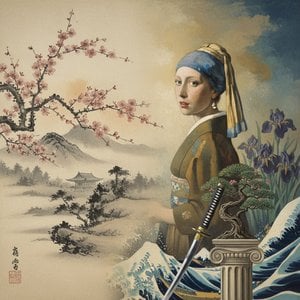
The Samurai of Light and Shadow: The Legacy of Odano Naotake
In the twilight of the Edo Period, a transformative era where Japan’s borders were tightly controlled yet intellectual curiosity began to leak through the cracks of isolation, one figure emerged to bridge two seemingly irreconcilable worlds. Odano Naotake (1749–1822) was not merely a painter; he was a samurai whose brush dared to capture the interplay of light and shadow, a technique previously foreign to the traditional Japanese aesthetic. Born in the Kubota Domain, Naotake’s life was defined by a unique duality—the disciplined, martial existence of a retainer to the Satake clan and the visionary, experimental spirit of an artist seeking the "new." His journey represents one of the most fascinating chapters in art history, marking the birth of Akita Ranga, a brief but luminous movement that infused Japanese subjects with the structural depth of Western perspective.
Naotakе's artistic evolution was catalyzed by an extraordinary intellectual encounter. When the polymath and scholar Hiraga Gennai arrived in the Akita region to oversee copper mining projects, he brought with him more than just scientific knowledge; he brought the seeds of Rangaku, or Dutch studies. This exposure to Western science, anatomy, and art fundamentally altered Naotake’s perception of the canvas. Under the influence of Gennai, Naotake began to move beyond the flat, calligraphic elegance of the Kano School masters toward a style that embraced the tangible. He became deeply involved in the monumental task of illustrating the Kaitai Shinsho (New Book of Anatomy), where his ability to render biological forms with newfound precision helped translate Western medical understanding into a visual language accessible to the Japanese eye.
A Synthesis of East and West
The brilliance of Naotake’s work lies in its refusal to abandon Japanese tradition in favor of total imitation. Instead, he achieved a sophisticated synthesis. While his subjects remained deeply rooted in the local landscape and classical themes—such as the delicate Lotus or serene seasonal flora—his execution utilized revolutionary Western-inspired techniques. He experimented with linear perspective to create depth, used shading to give volume to petals and leaves, and even incorporated reflections in water to suggest a three-dimensional reality. This was not merely a technical exercise but an emotional one; by introducing shadows, he introduced a sense of atmosphere and time that had been largely absent from the more stylized, ethereal traditions of his predecessors.
To understand the technical mastery of the Akita Ranga school, one must look at the specific elements Naotake brought to the forefront:
- The Use of Chiaroscuro: The subtle application of light and dark to define form and create a sense of weight.
- Spatial Depth: Moving away from flat compositions toward a structured use of foreground and background through perspective.
- Material Innovation: An experimental approach to pigments, sometimes utilizing resins and oils to mimic the rich textures found in European paintings.
- Naturalism: A renewed focus on the physical presence of nature, treating botanical subjects with an almost scientific reverence for their structural integrity.
Historical Significance and Enduring Influence
Though the Akita Ranga movement was relatively short-lived, its impact reverberated through the centuries. Naotake’s courage to experiment during a period of strict isolationism paved the way for future generations of Japanese artists to engage with global movements. He proved that the traditional Japanese eye could embrace the "foreign" without losing its cultural soul. His work stands as a testament to the power of cross-cultural dialogue, demonstrating how the meeting of different philosophies—the martial and the academic, the Eastern and the Western—can produce an entirely new form of beauty.
Today, the legacy of Odano Naotake is preserved not just in museums, but in the very way we perceive the evolution of Japanese modernism. He remains a symbol of the pioneering spirit, a man who looked at the shadows cast by Western influence and saw not a threat to tradition, but an opportunity to illuminate it. His paintings continue to fascinate contemporary viewers, offering a window into a moment in time when the world was beginning to shrink, and the possibilities for art were expanding beyond all known horizons.