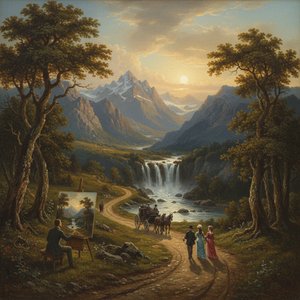
Washington Allston: Pioneer of American Romanticism
Born in Waccamaw Parish, South Carolina, in 1843, Washington Allston’s life and artistic journey were inextricably linked to the burgeoning landscape movement in America. His early years on a rice plantation instilled a deep appreciation for the natural world, a theme that would permeate his entire oeuvre. Allston wasn't merely a painter of scenery; he sought to capture the *feeling* of nature – its sublime grandeur, its ethereal light, and its profound emotional resonance. He was a true Romantic, influenced by the works of Turner, Constable, and the Pre-Raphaelites, but crucially, he adapted these European sensibilities to create a distinctly American voice.
Allston’s formal training began at Harvard College, where he honed his academic skills before embarking on a transformative period in England. From 1801 to 1809, he immersed himself in the art world of London and Paris, studying at the Royal Academy Schools and absorbing the techniques and philosophies of leading artists. Crucially, he spent time in Italy, sketching ancient ruins and immersing himself in the classical tradition – a foundation that would later inform his dramatic compositions. His travels weren’t simply for artistic inspiration; they were deeply personal experiences, shaping his worldview and fueling his creative spirit. His friendship with Samuel Taylor Coleridge further enriched his intellectual life, exposing him to radical ideas about imagination and the power of art.
Allston's early works are characterized by a fascination with dramatic lighting effects and monumental landscapes – scenes like “The Expulsion from Paradise” (1807) and "The Sylphs of the Seasons" (1809-10) demonstrate this. These paintings, often depicting biblical or mythological subjects set against vast, atmospheric backgrounds, showcase his mastery of color and his ability to evoke a sense of awe and wonder. However, as he matured, Allston’s style evolved, moving towards more subjective and introspective landscapes. He began to explore the psychological dimensions of nature, capturing not just its outward appearance but also its emotional impact on the human soul. His later works, such as “The Haunted Mill” (1838) and "The Spectre" (1840), are imbued with a haunting melancholy and a sense of mystery.
A Life Marked by Loss and Artistic Intensity
Allston’s personal life was shadowed by tragedy. The early death of his mother, Rachel Moore, profoundly affected him, as did the loss of his wife, Ann Channing, just a few years after their marriage in 1809. These experiences fueled a deep sense of melancholy that is evident in many of his paintings. His correspondence reveals a man grappling with grief, loneliness, and a yearning for connection – emotions he channeled into his art.
Despite these personal struggles, Allston remained a prolific artist throughout his life. He continued to paint prolifically, experimenting with new techniques and pushing the boundaries of American landscape painting. He also pursued his passion for poetry, publishing *The Sylphs of the Seasons* in 1813, a collection of poems that explored themes of nature, beauty, and mortality. His artistic output was not always commercially successful during his lifetime, but he gained recognition as a significant figure in the American Romantic movement.
Technique and Style: A Master of Atmospheric Color
Allston’s distinctive style is characterized by several key elements. He was a master of atmospheric perspective, using subtle gradations of color to create a sense of depth and distance. His paintings are often suffused with a hazy, dreamlike quality, achieved through the liberal use of white – a technique he learned from studying the works of J.M.W. Turner. He employed a rich, vibrant palette, favoring deep blues, greens, and purples to evoke the mood and atmosphere of his scenes.
Furthermore, Allston’s compositions are often asymmetrical and dynamic, creating a sense of movement and energy. He frequently used diagonals and sweeping curves to draw the viewer's eye into the scene, capturing the feeling of vastness and grandeur. His meticulous attention to detail – particularly in rendering foliage and water – combined with his expressive use of color and light, resulted in paintings that are both visually stunning and emotionally resonant.
Legacy and Historical Significance
Washington Allston’s influence on American landscape painting is undeniable. He played a crucial role in establishing the Romantic tradition in America, paving the way for later generations of artists such as Frederic Church and Albert Bierstadt. His pioneering use of atmospheric color and his exploration of the psychological dimensions of nature set him apart from his contemporaries.
Although he faced challenges during his lifetime, Allston’s work has been increasingly recognized in recent decades. His paintings are now housed in major museums across the United States and Europe, testament to their enduring beauty and artistic merit. Washington Allston remains a vital figure in American art history – a visionary artist who captured the spirit of a nation and left behind a legacy of breathtaking landscapes that continue to inspire awe and wonder.