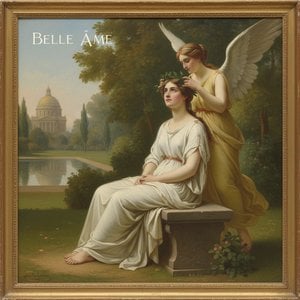
The Ethereal Vision of Jules Cyrille Cavé
In the golden twilight of the nineteenth century, a period where the rigid structures of Academicism began to dance with the evocative whispers of Symbolism, Jules Cyrille Cavé emerged as a master of delicate emotion. Born in Paris on 4 January 1859, Cavé’s life and art were deeply rooted in the French tradition, yet his spirit seemed to wander through more mystical realms. His early training at the prestigious Académie Julian served as the foundation for a career defined by an exquisite sensitivity to light and color. Under the watchful eyes of luminaries such as Tony Robert-Fleury and the legendary William-Adolphe Bouguereau, Cavé refined a technique that married meticulous realism with an idealized, almost dreamlike, grace. This education did more than teach him how to render form; it instilled in him a profound reverence for the classical beauty that would become the hallmark of his oeuvre.
The influence of Bouguereau was particularly transformative for Cavé, acting as a stylistic North Star throughout his development. From this mentorship, he inherited a penchant for pastoral scenes and the idealized human form, yet Cavé infused these subjects with a unique, haunting resonance. While his contemporaries might have focused on the literal, Cavé sought the spiritual. His canvases often feature nymphs, serene figures, and lush floral landscapes that seem to exist in a state of perpetual, quiet enchantment. This approach aligned him beautifully with the burgeoning Symbolist movement, where the goal was not merely to depict the world as it appeared, but to evoke the emotional and psychological truths hidden beneath the surface of reality.
A Legacy of Light and Shadow
Cavé’s artistic journey was marked by significant milestones that solidified his standing within the French art establishment. Since 1885, he was a consistent presence at the Paris Salon, where his works captured the attention of both critics and the public alike. One of his most profound early achievements occurred in 1886 with the completion of “Martyr in the Catacombs” (Martyre aux catacombes). This piece, which earned him a third-class medal, stands as a testament to his ability to navigate the darker, more Gothic aspects of the human experience. In this work, the solemn beauty of sacrifice is rendered with a palpable sense of atmosphere, proving that Cavé could command the heavy shadows of history just as easily as the bright sunlight of a summer meadow.
As his career progressed, his repertoire expanded to include a breathtaking variety of subjects that showcased his versatility:
- Floral Masterpieces: Works such as Moisson de fleurs (1899) and Fleurs des Champs (1905) demonstrate his ability to imbue nature with a sense of life and vitality.
- Portraiture: His portraits of women, often characterized by a soft, luminous quality, found great success not only in France but also across the Atlantic in the United States.
- Allegorical Compositions: Through religious and mythological motifs, he explored themes of innocence, nature, and the passage of time.
Beyond his individual triumphs, Cavé’s historical significance lies in his role as a bridge between eras. He maintained the rigorous standards of the Société des Artistes Français while simultaneously embracing the evocative, atmospheric qualities that would define modern sensibilities. Even as the art world moved toward more radical abstractions, Cavé remained a steadfast guardian of beauty, leaving behind a legacy of paintings that continue to enchant viewers with their quiet dignity and timeless, symbolic depth.