The Alchemist of Color: The Life and Legacy of Jan Matulka
Jan Matulka stands as a luminous bridge between the deep-rooted traditions of European Bohemia and the experimental frontiers of American Modernism. Born in 1890 in Vlachovo Březí, within the then-Austro-Hungarian territory of Bohemia, his early life was defined by a profound sense of cultural heritage that would later infuse his canvases with a unique, symbolic depth. His journey to the United States in 1907 brought him to the Bronx, where he faced the challenges of a young immigrant but found within the bustling energy of New York a new canvas for his burgeoning talent. This duality—the nostalgic echoes of his Czech roots and the rhythmic pulse of American urbanity—became the heartbeat of his artistic evolution.
Matulka’s formal training was a rigorous pursuit of excellence, beginning at the National Academy of Design in New York between 1911 and 1916. This classical foundation provided him with the technical mastery required to later deconstruct form and color. However, it was his exposure to the avant-garde movements of Europe that truly ignited his creative spirit. During his time in Paris, he moved within circles of profound intellectual influence, becoming acquainted with luminaries such as Gertrude Stein and André Lhote. These encounters allowed him to absorb the lessons of Cubism and Surrealism, which he would eventually weave into a personal style that refused to be confined by a single movement.
A Tapestry of Styles: From Landscapes to Abstraction
The brilliance of Matulka’s oeuvre lies in its remarkable fluidity; his artistic temperament was such that he could traverse the spectrum from serene landscapes to jarring abstraction, sometimes within the span of a single day. His early works often captured the melancholic beauty of Bohemian vistas and the picturesque charm of Czechoslovakian hill towns, rendered with an impressionistic sensitivity to light and atmosphere. Yet, as the twentieth century progressed, his brushwork grew bolder and more experimental. He began to embrace the geometric complexities of modern life, creating vibrant cityscapes that pulsed with the kinetic energy of a changing world.
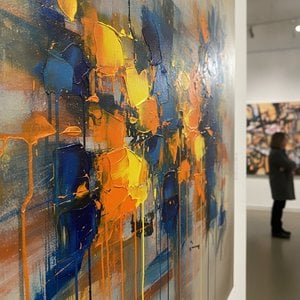
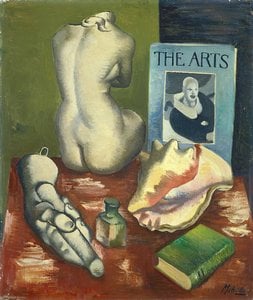
As his career matured, Matulka’s work delved into the realms of Surrealism and Abstract Expressionism. His compositions became playgrounds for the subconscious, where symbolic elements—such as shells, nude figures, or botanical forms—interacted with abstract shapes in dreamlike arrangements. This period of his work is characterized by:
- Vibrant Chromaticism: A fearless use of saturated hues that evoke intense emotional responses.
- Dynamic Composition: The use of intersecting lines and fragmented planes to create a sense of movement and depth.
- Symbolic Narrative: The integration of folklore and mythic imagery, reflecting his Bohemian intellectual heritage.
One of his most significant achievements was his ability to translate the industrial and social shifts of America into a visual language that felt both contemporary and timeless. His collaboration with the sculptor David Smith serves as a testament to his role in the broader movement of American modern art, pushing the boundaries of how materials and forms could represent the human experience.
Historical Significance and Enduring Influence
Beyond the physical beauty of his paintings, Jan Matulka’s historical significance lies in his role as a cultural conduit. He did not merely adopt new styles; he synthesized them, creating a unique aesthetic that helped define the American modernist landscape. As an instructor at the Art Students League, he passed this rich, multifaceted tradition down to subsequent generations, influencing notable artists such as Dorothy Dehner, Francis Criss, and Burgoyne Diller.
His legacy is preserved not only in museum collections like the Smithsonian American Art Museum but also in the very fabric of modern art history. Matulka’s ability to maintain a connection to his origins while fearlessly embracing the unknown allowed him to create works that remain as captivating and intellectually stimulating today as they were during his lifetime. He remains a master of the transitional moment, an artist who captured the precise instant when tradition met the future.
Pitanja i odgovori
Mogu li istražiti djela umjetnika Jan Matulka prema tematici?
Djela umjetnika Jan Matulka možete istražiti prema tematici na umjetnikovoj stranici Atlas tema.
Kako je karijera umjetnika Jan Matulka podijeljena u razdoblja?
Kronološki prikaz djela umjetnika Jan Matulka dostupan je na njegovoj stranici Kronika, gdje se umjetnička djela prikazuju redoslijedom nastanka, poglavlje po poglavlje.
Gdje mogu pronaći statistiku o djelima umjetnika Jan Matulka?
Statistike o djelima umjetnika Jan Matulka dostupne su na njegovoj stranici Statistika.