A Life Etched in Light: The World of Howard Somerville
Howard Somerville, born in 1873 and passing in 1952, remains a compelling figure within the landscape of early 20th-century British art. Though perhaps not a household name today, his delicate portraits, evocative landscapes, and masterful etchings offer a poignant glimpse into a world transitioning between Victorian sensibilities and the burgeoning modern era. Somerville’s artistic journey was deeply rooted in his Scottish heritage, specifically the city of Dundee, where he spent much of his life and developed a distinctive style that blended meticulous realism with an atmospheric sensitivity. He often worked under the pseudonym Adamson, adding a layer of intrigue to his already nuanced body of work. While biographical details remain somewhat sparse, the art itself speaks volumes about a man attuned to the subtleties of light, character, and place.From Dundee Roots: Early Training and Influences
Somerville’s artistic education began within the vibrant cultural milieu of Dundee. The city, a major center for jute production and shipbuilding, possessed a unique energy – a blend of industrial grit and artistic aspiration. He received formal training at the Dundee School of Art, an institution known for its emphasis on practical skills and traditional techniques. This foundation in drawing and painting proved crucial to his later development. Early influences likely included the Scottish Colourists, though Somerville’s palette tended towards more muted tones than their bold vibrancy. The Pre-Raphaelites also cast a long shadow over British art during this period, and traces of their meticulous detail and romantic subject matter can be detected in Somerville's early portraits. However, he wasn’t merely an imitator; he began to forge his own path, focusing on capturing the essence of his subjects rather than adhering strictly to academic conventions. His work demonstrates a keen observation of human form and a growing fascination with the interplay of light and shadow – qualities that would become hallmarks of his mature style.Portraits and Landscapes: A Dual Pursuit
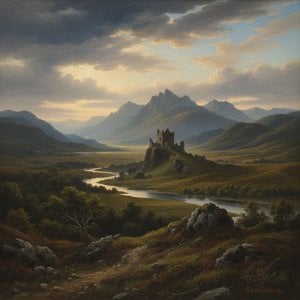
Somerville’s artistic output was remarkably diverse, encompassing both portraiture and landscape painting. His portraits are characterized by their psychological depth and sensitivity to character. He wasn't interested in grand displays of wealth or status; instead, he sought to capture the inner lives of his sitters – their hopes, anxieties, and quiet dignity. These weren’t idealized representations but rather intimate studies of individual personalities. Simultaneously, Somerville developed a profound connection with the Scottish landscape. His landscapes are not dramatic vistas but rather subtle evocations of mood and atmosphere. He frequently depicted scenes around Dundee and Angus, capturing the rolling hills, winding rivers, and weathered coastline with remarkable precision. The use of soft lighting and delicate brushwork creates a sense of tranquility and nostalgia, inviting viewers to immerse themselves in the beauty of the natural world.The Art of Etching: A Masterful Technique
Beyond painting, Howard Somerville excelled as an etcher – a medium that allowed him to explore line, texture, and tonal values with exceptional finesse. He became particularly renowned for his etching work, producing numerous plates depicting scenes from Dundee and the surrounding countryside. The process of etching, involving the careful application of acid to a metal plate, demanded both technical skill and artistic vision. Somerville’s etchings are notable for their exquisite detail, atmospheric depth, and subtle use of light and shadow. They offer a unique perspective on his subjects, revealing a level of nuance that is often difficult to achieve in painting. His mastery of this technique solidified his reputation as one of the leading etchers of his time, and his prints were widely collected by art enthusiasts. The etchings are particularly valued for their ability to capture the spirit of place.Legacy and Historical Significance
While Howard Somerville’s work may not be as widely recognized as that of some of his contemporaries, his contribution to early 20th-century British art is significant. He represents a bridge between the Victorian tradition and the emerging modern aesthetic – blending meticulous realism with an atmospheric sensitivity that anticipates later developments in landscape painting. His portraits offer valuable insights into the social and cultural life of Scotland during this period, while his landscapes capture the beauty and tranquility of the natural world. Somerville’s etchings remain particularly admired for their technical brilliance and artistic depth. He stands as a testament to the enduring power of observation, skill, and a deep connection to one's surroundings. His work continues to resonate with viewers today, offering a poignant glimpse into a bygone era and reminding us of the beauty that can be found in the everyday moments of life.- Somerville’s pseudonym, Adamson, adds an element of mystery to his artistic career.
- His etchings are considered some of the finest examples of the medium from the early 20th century.
- He successfully balanced portraiture and landscape painting throughout his life.